

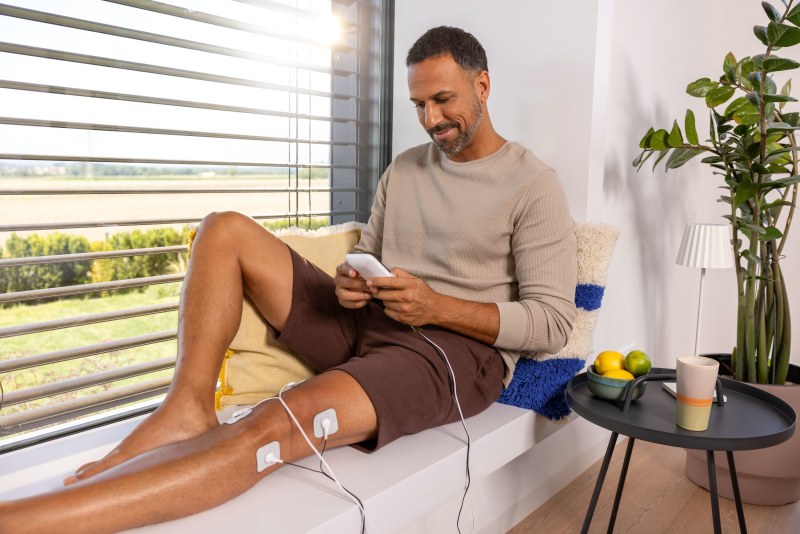
After a long day at your desk, your neck feels tight again and your shoulders feel hard. Perhaps you are then looking for an application you can carry out yourself in the evening on the sofa. Yet the term electrotherapy covers very different methods, and not all of them are intended for home use. Here you can find out which methods exist, which ones you can apply yourself, and which Beurer device, such as the Digital TENS/EMS EM 49, suits your purpose.
What is electrotherapy?
Electrotherapy is the umbrella term for applications in which specific current forms are used to relieve pain, stimulate nerves or activate the muscles. The current reaches the tissue through electrodes placed directly on the skin. As a rule, electrotherapy is applied in addition to active measures such as movement exercises and training.A
With a stimulation current device for home use such as the EM 49, you usually feel a gentle tingling or vibration. The effect of electrical stimulation usually only becomes noticeable after regularly repeated applications. That is why it is worth scheduling the application as a fixed part of your evening routine.
The two methods you hear about most often are TENS and EMS. TENS is the electrical stimulation of nerves through the skin, while EMS is the electrical stimulation of muscle tissue. We explain how the two differ in detail in our guide TENS and EMS: the difference simply explained.
Which methods of electrotherapy there are
The methods of electrotherapy are classified according to the frequency spectrum of the currents used.B The frequency indicates how many individual impulses flow per second and is measured in hertz.
- Galvanisation: direct current or pulsed direct current.
- Low frequency: above 0 Hz to below 1,000 Hz.
- Medium frequency: 1,000 Hz to below 100,000 Hz.
- High frequency: above 100,000 Hz.
And which frequency range relieves pain? Low-frequency currents have a pain-relieving effect at roughly between 1 and 150 Hz.B The EM 49 works precisely in this range: with biphasic rectangular pulses and a pulse frequency of 1 to 150 Hz.
Besides frequency, the methods also differ in how the current enters the body. With interferential current, a medium frequency method, the current does not flow through one circuit but through two circuits that cross each other over the treatment area.C With the Stanger bath, a hydroelectric bath, the electrodes sit in a special tub as metal plates, and the water conducts the current.A
What you can do at home and what belongs in a practice
Electrotherapy for home use means TENS and EMS. TENS and EMS devices are aids that you can use independently for pain therapy or muscle stimulation.D Low frequency electrical stimulation devices form their own product subgroups in the aids directory of the statutory health insurance system.B Our EM 49 is built precisely for this: it is intended for self-application in a home environment and is generally suitable for all adults with no contraindications.
Other methods belong in a practice. The table shows where each method has its place.
| Method | Type of current | Where it is applied |
|---|---|---|
| TENS and EMS | Low frequency | Independently, with your own deviceD |
| Ultrasound therapy | Ultrasound | Only in a doctor's practice or physiotherapy, because of its potential effects and risksB |
| Iontophoresis with medication | Direct current | Instruction and supervision by physiotherapy and a doctorA |
| Galvanisation | Direct current | Reserved for doctor's practices and physiotherapy, apart from tap water iontophoresisB |
| Stanger bath and cell baths | Current with water as the conducting medium | Usually in hospital or rehabilitationA |
| Interferential current | Medium frequency | There is not yet sufficient scientific evidence for home applicationB |
With iontophoresis, an ointment or gel containing a medication is applied under an electrode, and the current carries it through the skin into the body.A Tap water iontophoresis devices for treating excessive sweating, by contrast, use tap water as the conducting medium.B In professional practice, electrotherapy counts among the remedies that can be prescribed in a doctor's practice.A
What is electrotherapy good for?
Electrotherapy is good for relieving pain, releasing tense muscles and strengthening muscles. Stimulation current therapy is generally used for pain treatment and for strengthening the musculature.A Muscle stimulation is used, for example, for reflex-related tension.B
With EMS, we distinguish two directions. The activating application serves muscle training to increase endurance and to strengthen specific muscles or muscle groups. The relaxing application helps release muscular tension and improve signs of muscular fatigue. Added to this is the massage function: with a programme modelled on the sensation and effect of a real massage, you can work away muscular tension.
Which types of pain can TENS help with?
TENS is applied particularly for chronic pain conditions, and longer-term application is important.A With the EM 49, TENS application is intended for these complaints:
- Back pain, at rest and during exertion
- Joint pain, at rest and under load
- Neuralgia (nerve pain)
- Menstrual cramps
- Headaches
- Pain caused by circulatory disorders
- Pain after injuries to the musculoskeletal system
- Chronic pain of various causes
Every condition that makes TENS application sensible should be clarified with a doctor beforehand. For tension pain in the neck and shoulders, our guide TENS/EMS for neck and joint pain shows you how to position the electrodes.
Which method for which goal
With electrotherapy at home, your goal determines the method. What do you want to achieve: relieve pain, release tension, or strengthen your muscles? The table matches the three most common goals to the right method and the programme type on our TENS/EMS devices.
| Your goal | Suitable method | Programme type on the device |
|---|---|---|
| Relieve pain, for example in the back or shoulder | TENS | TENS programmes; on the EM 49, for example, programme 5 for the shoulder and programme 6 for the back |
| Release tension | relaxing EMS or massage | Massage programmes such as tapping, kneading and pressure massage, or tension-releasing massage |
| Strengthen muscles | activating EMS | EMS programmes for arm, abdominal, back, shoulder or leg muscles |
The goals are often connected. With a Digital TENS/EMS device, you therefore choose a specific programme for each application: you can select from numerous TENS and EMS programmes for your application. On the EM 49, the TENS and EMS programmes are usually preset to 30 minutes and the massage programmes to 20 minutes; the duration can, however, be adjusted individually. How often per day or per week an application makes sense for you is best discussed with your doctor or physiotherapist.
Where the electrodes are placed also matters for success. As a guideline, keep a distance of about 5 to 15 cm. For pain treatment, place the painful point between the electrodes of one channel, or place one electrode directly on the painful point and the second at least 2 to 3 cm away. You can find out more in our guide to targeted application and electrode placement.
Which Beurer device for which purpose
For pain, tension and muscle training in one device, our TENS devices with EMS and massage function are a good fit: the EM 49, the EM 59 Heat and the EM 89 Heat. They are small and handy, designed for self-treatment at home and approved as medical devices. On all of them, the pulse intensity can be adjusted separately for each channel.
- For getting started: the Digital TENS/EMS EM 49 offers 12 TENS, 32 EMS and 20 massage programmes. It has 2 channels and 4 electrodes and runs on batteries. You can apply it, among other areas, to the back, neck and shoulders.
- With rechargeable battery and warmth: the Digital TENS/EMS EM 59 Heat has the same programmes, 2 channels and 4 electrodes. It also offers 2 heat levels as a comfort feature and a rechargeable battery. The tangible difference to the EM 49 in everyday use is the power supply, not the number of programmes. The EM 59 Heat is the test winner in the TENS device test by F.A.Z. Kaufkompass on faz.net (as of 30 June 2026), among 26 TENS devices tested. The test praises its versatile TENS, EMS and massage programmes.
- For larger areas: the Digital TENS/EMS EM 89 Heat works with 4 channels and 8 electrodes for a wide-area application. You can use TENS and EMS in parallel or individually. The F.A.Z. Kaufkompass describes it as follows: "very pleasant to use and convincing in all other aspects as well" (as of 30 June 2026).
If muscle training alone is your goal, the EM 95 EMS homeSTUDIO is an option from our EMS devices. It is a pure EMS device for full-body training and not a medical device, so it has no TENS programmes for pain relief. The EM 95 offers 40 EMS programmes, 4 separately adjustable channels and 8 electrodes. Via Bluetooth® you connect it to the “beurer EMS homeSTUDIO” app, which accompanies you through your training with a virtual coach.
Our comparison of Beurer TENS/EMS devices shows which of our TENS/EMS devices suits you best in detail.
Using electrotherapy safely at home
An application does not replace medical consultation and treatment. For any kind of pain or illness, you should therefore always ask your doctor first. Before your first application, read the instructions for use of the EM 49 or of your device. For the EM 59 Heat, the EM 89 Heat and the EM 95, the instructions for use supplied with each device apply.
Do not use the EM 49 in these cases:
- with implanted electrical devices such as a cardiac pacemaker
- with metal implants or when using an insulin pump
- during pregnancy
- with a high fever, for example above 39 °C
- with known or acute cardiac arrhythmias and disorders of the heart's conduction system
- with seizure disorders such as epilepsy
- with cancer
- after surgery, if strong muscle contractions could impair healing
- with acute or chronic diseases of the gastrointestinal tract
- when connected to a high-frequency surgical device
- with a known allergy to the electrode material
- after consuming alcohol, drugs or medication that impairs consciousness
- in environments with high humidity, such as in the bathroom or while bathing or showering
The electrodes of the EM 49 must never be placed near the heart, that is, not on the front of the chest. The skull, mouth, throat, larynx, neck and carotid artery as well as the genital area are also off limits, as are diseased, injured or inflamed skin. With acute conditions such as high blood pressure, blood clotting disorders or a tendency to thrombosis, consult your doctor beforehand. The same applies to skin conditions, unclarified chronic pain, diabetes and sensory disturbances.
The intensity must never cause pain; a slight tingling is enough. You should apply the first few minutes while sitting or lying down. If you feel weak, switch the device off immediately and raise your legs for about 5 to 10 minutes. The EM 49 is intended for adults only, not for use while sleeping, driving or operating machinery, and not together with other stimulation current devices. Possible unwanted side effects include, for example, skin irritation, a feeling of pressure at the electrode site or slight reddening of the skin after treatment.
Frequently asked questions
Is a stimulation current device for home use the same as a TENS device?
Stimulation current device is the umbrella term. A TENS device is a stimulation current device for pain relief, an EMS device one for muscle stimulation, and devices such as the Beurer EM 49 can do both.
Can I use TENS, EMS and massage with one device?
Yes, the Beurer Digital TENS/EMS devices EM 49, EM 59 Heat and EM 89 Heat have TENS, EMS and massage programmes on board. You select the programme that matches your goal directly on the device.
Is the EM 95 EMS homeSTUDIO a TENS device?
No, the EM 95 is a pure EMS device for full-body training and not a medical device. The TENS/EMS devices are intended for pain relief.


