

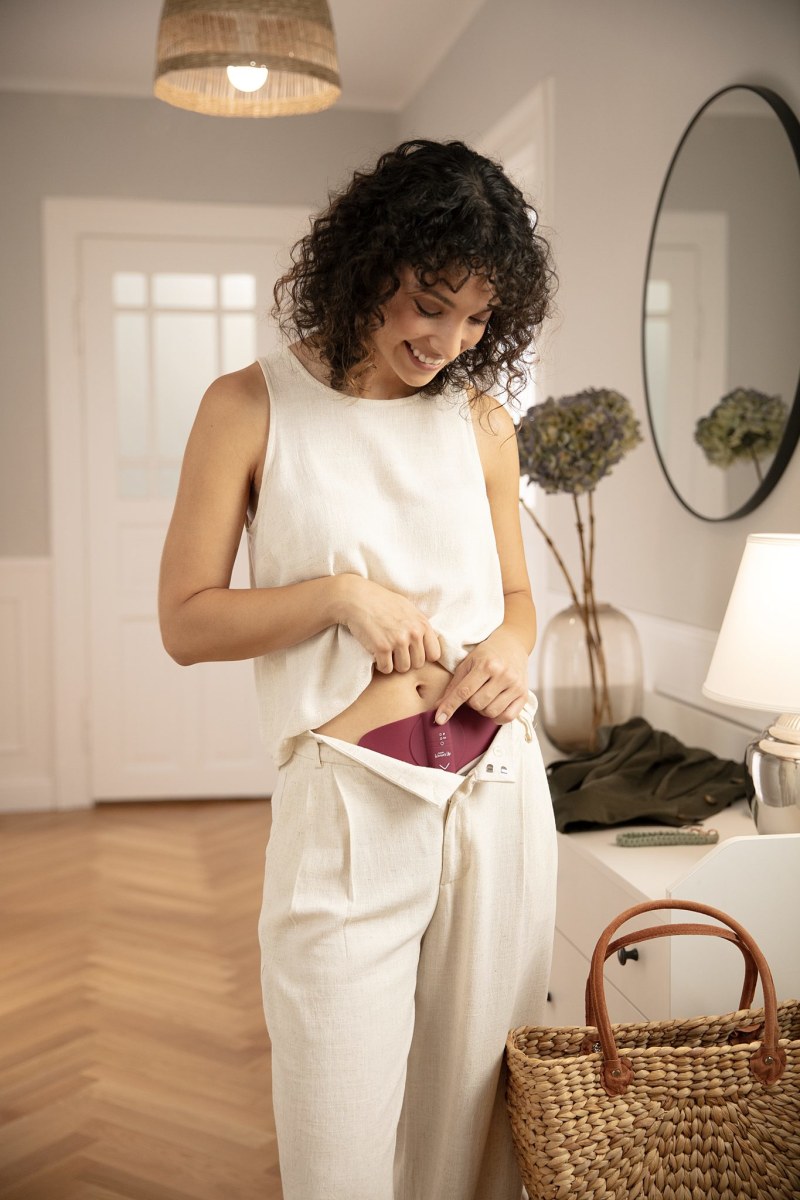
Studies suggest that TENS can help to relieve period pain. Cochrane review CD013331 from 2024 analysed 20 randomised trials involving 585 women. It found that both high-frequency and low-frequency TENS can reduce pain compared with placebo or no treatment.A If you are wondering whether TENS helps with menstrual pain, this is the key answer from research. The pain you feel on the first days of your cycle is real, and it makes sense to look at what the studies say before you try it. For exactly those days, we developed the Beurer EM 50 Menstrual Relax, a medical device for relieving menstrual pain that you wear wirelessly and discreetly under your clothes. Below, you will find out how TENS works, what the figures from the review mean and who TENS is not suitable for.
How TENS works on period pain
TENS stands for transcutaneous electrical nerve stimulation. A TENS device is a small, portable device with electrode pads that women usually use themselves at home as soon as the pain starts. A weak current passes through the skin via the electrodes, which can feel like tingling.A TENS devices are aids you can use on your own for pain relief: the electrodes go on the painful parts of the body, and the stimulation works via the nerves.B
What happens in the body
So what can you expect? TENS does not change the cramping of the womb. It affects how you perceive pain.A This is described as the pain gate or masking effect. Nerve cells in the spinal cord are stimulated to influence the body's own pain inhibition. There is also a second pathway: TENS is thought to encourage the release of endorphins, the body's natural painkillers, and to affect how pain signals travel to the brain.B
Period pain is explicitly listed as a use for TENS, as is pain caused by conditions such as endometriosis.B We explain how period pain develops in the first place and what role the womb plays in our article How menstrual pain develops.
Primary and secondary period pain
One distinction is key to understanding the research. Primary period pain is caused by the womb contracting alone; prostaglandins play an important role here. It is more common in women under 30 and in women with heavy periods. Secondary period pain, by contrast, is often caused by fibroids or polyps, and severe pain can also be a sign of endometriosis.C If you do not know what is causing your pain, you should have it checked by a doctor before trying TENS for the first time.B
What the Cochrane review shows
Cochrane review CD013331 is titled “Transcutaneous electrical nerve stimulation (TENS) for pain control in women with primary dysmenorrhoea”. It was published in 2024, replaces a 2009 version and reflects the evidence as of April 2024. It includes 20 randomised controlled trials published between 1985 and 2019, mostly from Brazil, the USA and Sweden. The participants were women and girls aged 12 to 49 whose pain was caused by their period alone.A
High-frequency and low-frequency TENS compared
With TENS, both the frequency and the strength of the current can be adjusted. That is why researchers distinguish between high-frequency and low-frequency TENS. For both forms, the review found less pain than with placebo or no treatment. A negative mean difference means that pain scores in the TENS group were lower than in the comparison group.A
| Comparison | Studies | Result for pain |
|---|---|---|
| High-frequency TENS vs. placebo or no treatment | 10 | mean difference −1.39 (95% CI −2.51 to −0.28) |
| Low-frequency TENS vs. placebo or no treatment | 3 | mean difference −2.04 (95% CI −2.95 to −1.14) |
| High-frequency vs. low-frequency TENS | 3 | unclear which form works better |
| High-frequency TENS vs. other methods | 1 on acupressure, 1 on paracetamol, 2 on interferential current | unclear, too few studies |
So what does this mean for your everyday life? Both frequency ranges did better than placebo or no treatment. Which form works better cannot yet be told from the studies so far.A
How well TENS is tolerated
The review does not yet provide a clear picture of how well TENS is tolerated. In two out of three studies that reported on side effects of high-frequency TENS, there were none. The review lists mild redness or irritation of the skin around the electrodes as possible side effects.A If the skin under the pads becomes irritated, red or itchy, you should switch the device off and remove the pads.B
How the researchers assess the evidence
Assessing the evidence starts with a simple question: how large were the studies? Many of the included studies were small with few participants, and most did not report side effects in enough detail. From this, the review authors set out a clear task for research. Future studies should include more women and use robust methods. They should also look at side effects, the need for additional pain relief, pain-related limits on daily life and quality of life.A
What this means for you: the review is about women with primary period pain, in other words the recurring cramps on the first days of your cycle that you probably know well.
Who TENS can be an option for
Many women take over-the-counter painkillers for period pain. However, some cannot use these medicines because of side effects or other health conditions.A For them, TENS is a medication-free option they can use themselves at home or on the go. In our article TENS for period pain in everyday life, we describe what TENS feels like day to day with period pain and when it makes sense.
What is known about TENS for endometriosis
Endometriosis is a medical diagnosis, and there is no cure for its cause yet. This is why TENS is never a treatment for endometriosis itself. This boundary matters to us. It can, however, complement treatment when it comes to tension in the lower abdominal muscles and the period pain that comes with it. We explain what lies behind the condition and how it is diagnosed in our guide Understanding endometriosis.
A randomised study from 2020
Mira and colleagues studied TENS in deep infiltrating endometriosis in a multicentre randomised trial. It was published in 2020 in the European Journal of Obstetrics & Gynecology and Reproductive Biology. 53 women received hormone treatment plus electrotherapy with TENS, and 48 women received hormone treatment alone, followed over eight weeks. Chronic lower abdominal pain eased only in the TENS group. The authors therefore see electrotherapy with TENS as a good complementary option for pain control.D We have put together studies, programmes and tips for use with endometriosis in our article TENS for endometriosis.
Do you have endometriosis, or think you might? Then you should talk to your gynaecologist about TENS. Suspected endometriosis needs to be assessed by a gynaecologist, not treated on your own.
Who TENS is not suitable for
Who TENS is not suitable for is set out in the instructions for use of each device. For the EM 50: it must not be used during pregnancy. The EM 50 must also not be used if you have a pacemaker or another implanted electrical device.
Other contraindications for the EM 50 are:
- metal implants such as a copper coil
- insulin pumps
- high fever
- known cardiac arrhythmia
- seizure disorders such as epilepsy
- cancer
- injured or inflamed skin at the application site
You should also not use the EM 50 while asleep, while driving or operating machinery, or in damp surroundings such as in the bath or shower. If you notice that your period becomes noticeably heavier while using it, you should stop. The EM 50 does not replace a medical examination or treatment. Read the EM 50 instructions for use before using it for the first time, as they contain all the information in full. They always take priority over general tips.
What this means for trying the EM 50 yourself
With the Beurer EM 50 Menstrual Relax, you can try out what the studies describe. The EM 50 is a self-adhesive TENS device intended to relieve menstrual pain and pain caused by endometriosis. We designed it to be slim and wireless so that you can wear it discreetly under your clothes. The soft, flexible silicone adapts to the shape of your body. The EM 50 is a medical device.
How to get started with the EM 50
Here is how to get started with the EM 50: start at a low intensity level and increase it slowly until you feel a tingling sensation. It should not be painful.B These key facts will help you day to day:
- 15 TENS intensity levels that you adjust to how it feels for you
- a rechargeable battery for use at home and on the go
- an automatic switch-off after 20 minutes of use
- a break of at least 30 minutes between two applications
How often a day can you use the EM 50? Follow the instructions for use and go by what feels comfortable for you. If you have questions about how often to use it, your doctor or physiotherapist can advise you.
EM 50 or EM 55
If you would like a larger contact area, there is the Beurer EM 55 Menstrual Relax +. It has larger gel pads measuring 61 x 89 mm instead of 50 x 56 mm on the EM 50, an extra set of gel pads, and it suits all body shapes. You will find both pads alongside our other TENS devices from Beurer.
We compare which pad suits you better in our article Which device for period pain: EM 50 or EM 55.
Frequently asked questions
Does TENS help with period pain?
Research suggests that TENS can help to relieve period pain. In the Cochrane analysis, pain scores with TENS were lower than with placebo or no treatment. The results relate to primary period pain, which is caused by the period alone.
What did the Cochrane review find?
Cochrane review CD013331 pools studies from 1985 to 2019 involving a total of 585 women. With both frequency ranges, pain was lower than with a sham treatment. Which form works better is still unclear. The evidence is up to date as of April 2024.
How reliable is this data?
The included studies were mostly small with few participants. The researchers therefore call for further, larger studies using robust methods. These should also measure the need for painkillers, limits on daily life and quality of life.
How does TENS work on pain?
TENS delivers weak electrical impulses through electrodes on the skin and works via the nerves. The impulses affect how pain is perceived; the cramps themselves remain. The pain gate effect in the spinal cord and the release of endorphins, the body's natural painkillers, are the mechanisms being discussed.
What is known about TENS for endometriosis?
A randomised study from 2020 compared women with deep infiltrating endometriosis who received hormones plus TENS or hormones alone. Lower abdominal pain eased only in the TENS group. TENS complements medical treatment and is not a treatment for endometriosis itself.
Who should not use TENS?
The EM 50 must not be used during pregnancy or if you have a pacemaker. The EM 50 is also not suitable if you have cardiac arrhythmia, epilepsy, metal implants such as a copper coil, an insulin pump, a high fever or cancer. You will find all contraindications in the device's instructions for use.

