

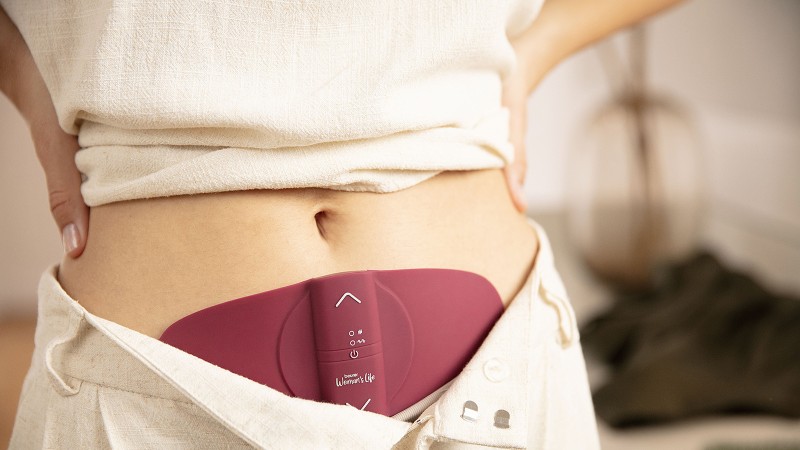
Your lower abdomen aches as if your period were about to start, but no bleeding comes. Pelvic pain without a period often has a cause linked to your cycle. Mid-cycle, ovulation can trigger one-sided ovulation pain (mittelschmerz). In the days before a period, many women get cramps before any bleeding starts. If the pain keeps coming back regardless of bleeding, however, a condition such as endometriosis could also be the cause. In that case, you should have it checked by a gynaecologist. For medically assessed menstrual and endometriosis pain, we at Beurer developed the Beurer EM 50 Menstrual Relax, a discreet, portable aid that combines TENS with soothing heat. Here you will find out how to make sense of your symptoms across your cycle and when it is time to see your doctor.
Why pelvic pain occurs without bleeding
Pelvic pain without bleeding is easier to interpret once you know the two forms of period pain. Your pain is real, even when there is no bleeding to see. Whether it belongs to the normal cycle or has another cause often only becomes clear with a close look at how it progresses.
Primary and secondary menstrual pain
Primary menstrual pain is triggered solely by the womb contracting. It typically begins in the first cycles after your first period and eases over the years.
Secondary menstrual pain, by contrast, usually begins later in life, often appears as new pain, stays the same or gets worse, and can also occur outside your period. Common causes are fibroids or polyps, and severe pain can also be a sign of endometriosis.A
Endometriosis as a possible cause
With endometriosis, tissue similar to the lining of the womb grows in the wall of the womb or outside the womb. The pain can be cramping or stabbing, temporary or chronic.
Among women with chronic pelvic pain, around 50 percent are estimated to have endometriosis. It often takes years before endometriosis is confirmed as the cause.B
For pain without bleeding, one point matters in particular: endometriosis pain can occur both in line with the cycle and independently of it. Commonly described are recurring lower abdominal pain, especially in the second half of the cycle, and lower abdominal pain that has nothing to do with the period.C Cyclical pain that can also occur when urinating, during bowel movements or during sex is typical.D
Making sense of your symptoms across your cycle
Placing your symptoms in the context of your cycle is the first step towards more clarity. When exactly does it hurt, and does it repeat every month? Three patterns can help you sort out your symptoms in your own time.
Around ovulation
So-called ovulation pain (mittelschmerz) occurs mid-cycle, about two weeks after the first day of your last period, when ovulation takes place. It is strongest at the start and fades after one to two days. It can occur on the right or the left, but only on one side at a time.E
In the days before your period
In the days before their period, many women get pelvic pain or headaches. These symptoms of premenstrual syndrome (PMS) occur in the second half of the cycle, after ovulation.FThey can start anywhere from a few days to two weeks before your period. Cramping menstrual pain can also begin a few days before your period.E
Without a recognisable cycle pattern
But not every pain follows the cycle. Some gynaecological conditions cause cyclical pelvic pain, while in others the pain follows no cycle pattern or is constant.E That is exactly when it is worth taking a closer look.
| Timing of the pain | Typical pattern | Possible background |
|---|---|---|
| Mid-cycle, about two weeks after the start of your period | one-sided, gone after one to two days | ovulation pain (mittelschmerz) |
| Days before your period | pelvic pain, cramps before the bleed | premenstrual symptoms or menstrual pain that starts early |
| Recurring, independent of the bleed | cycle-related or unrelated to the cycle | secondary menstrual pain, for example due to endometriosis |
| Constant or without a pattern | constant | gynaecological cause that should be assessed |
A pain diary helps with the assessment
You should watch closely when and in which situations the pain occurs and whether it is linked to your cycle, because a pain diary helps with the diagnosis.D You can note down the following:
- the day in your cycle on which the pain begins and ends
- the situation in which it occurs, for example during sex, when urinating or during a bowel movement
- whether the pain coincides with a bleed or occurs independently of it
Why pain can persist despite the pill
Pain despite the pill can be unsettling, because the bleeding often feels quite different from before. The bleed during the pill-free break is called a withdrawal bleed and has nothing to do with natural menstruation.
With the pill, periods are often lighter or less painful. For women with painful periods, taking the pill in an extended cycle can be an option.G
With hormonal contraception, the lining of the womb does not build up to its normal thickness. Bleeding is therefore usually lighter and shorter, or does not happen at all.A Cycle-related pain such as cramps or endometriosis can be treated with the pill or other hormonal contraceptives.E Which approach suits you is something to discuss with your gynaecologist.
Do you keep getting severe pelvic pain despite the pill, with no bleeding involved? Then the same applies as without the pill, and you should have your symptoms assessed by a gynaecologist. The next section shows which signs mean you should book an appointment.
When a medical assessment is needed
Whether you need a medical assessment depends on how severe the pain is and what comes with it. Nobody has to accept severe pain that disrupts everyday life every month as natural.
If the pain is very severe or keeps getting worse, it is a good idea to talk to your gynaecologist.A You should also have recurring period problems that restrict your everyday life assessed by a gynaecologist early on.D
Warning signs for booking an appointment
You should take these warning signs seriously and raise them at your appointment:
- recurring severe pelvic pain regardless of the bleed
- pain during sex, when urinating or during bowel movements
- blood in your urine or stool
With mild pain and no warning signs, a routine appointment is enough. A delay of a few days usually does no harm.
When you need help right away
New pelvic pain, pain that comes on suddenly or pain that becomes very severe needs medical help as soon as possible. Sudden, severe pain with nausea, vomiting, sweating or restlessness, as well as fever or chills, is cause for concern. If you have any of these warning signs, you should seek medical help immediately.E
What brings short-term relief
What brings short-term relief varies from woman to woman. If the pain involves the muscles, rest, warmth or physiotherapy can help.E
Warm baths, hot water bottles and saunas are often felt to be soothing. Some women also find that walking or light exercise brings relief.A For menstrual pain, relaxation and mindfulness exercises are a useful addition.
Painkillers can be an option alongside other measures when symptoms are more severe. Pelvic pain is initially treated with an anti-inflammatory painkiller (NSAID) such as ibuprofen.E Painkillers that inhibit the production of prostaglandins can relieve menstrual pain.A
What the Beurer EM 50 can do after assessment
After a medical assessment, the Beurer EM 50 Menstrual Relax can support you with menstrual pain in everyday life. Our pad is intended for pain relief in the case of menstrual pain and pain caused by endometriosis. You do not use it to treat suspected endometriosis yourself, and the EM 50 is not an endometriosis therapy. Once a diagnosis has been made, it is a drug-free way to support you.
TENS and soothing heat in one pad
Our EM 50 combines TENS with soothing heat. With TENS, the pad sends weak electrical impulses through the skin. These impulses can influence the transmission of pain signals and so help relieve menstrual pain.
The gel pads transmit the TENS impulses through the skin. The heat feels pleasant, can contribute to relaxation and can also be used separately without TENS.
Discreet in everyday life
The EM 50 is discreet in everyday life because you wear it wirelessly under your clothes, at home or out and about. You decide when and where to use it and operate it easily with one button on the device. These key facts make it practical for everyday use:
- 15 TENS intensity levels that you adjust to how you feel
- 1 heat setting with a temperature of up to 43 degrees Celsius
- a rechargeable battery for up to 6 applications of 20 minutes each
- an LED that indicates a low battery level
- a medical device with a 5-year guarantee
Need a larger area? The Beurer EM 55 Menstrual Relax + has larger gel pads measuring 61 x 89 mm instead of 50 x 56 mm, plus an additional set of gel pads. It is charged exclusively with the specially coded USB-C cable supplied, because standard USB-C cables are not compatible with the EM 55. We compare which pad suits you better in our article EM 50 and EM 55 compared. Both belong to our TENS devices and are intended exclusively for period problems.
Using it safely
Do not use the EM 50 or EM 55 during pregnancy, if you have implanted electrical devices or metal implants such as a copper coil, if you use an insulin pump, or if you have a high fever, known or acute cardiac arrhythmias or other disorders of the heart’s impulse and conduction system, a seizure disorder such as epilepsy, cancer, or an acute or chronic disease of the gastrointestinal tract. Do not use the devices after operations where muscle contractions could interfere with healing, or while connected to a high-frequency surgical device. Do not apply them to injured or inflamed skin, open or healing wounds, healing surgical scars, or the genital area. You must not use the EM 50 while sleeping, bathing or showering, while driving, or while operating machinery. Read the instructions for use before using the EM 50 for the first time; you will find all further contraindications there.
Has your pain been medically assessed? Then take a look at the EM 50 Menstrual Relax among our TENS devices as a drug-free aid for assessed menstrual pain.
Frequently asked questions
Why do I have pelvic pain even though I am not on my period?
Often there is a cycle-related reason behind it, such as ovulation at mid-cycle or cramps that begin a few days before your period. If the pain keeps recurring independently of the bleed, a condition such as endometriosis could also be the cause. You should have this assessed by a gynaecologist.
Why does period pain continue on the pill?
The pill often makes bleeds lighter and less painful, but cycle-related cramps or endometriosis can still cause discomfort. The bleed during the pill-free break is also not a natural period. If severe pain keeps occurring while you are on the pill, you should discuss this with your gynaecologist.
When should I see a doctor about it?
You should see a gynaecologist early if the pain keeps coming back and restricts your everyday life, or keeps getting worse. If you have sudden, severe pain with fever, vomiting or sweating, you need medical help immediately. You can raise mild pain without warning signs at a routine appointment.
What helps in the meantime?
In the meantime, rest, warmth and gentle exercise such as a walk can do you good, supplemented by relaxation exercises. For stronger complaints, painkillers can be considered as a supplement. A pain diary also helps you record your observations for your appointment.


