

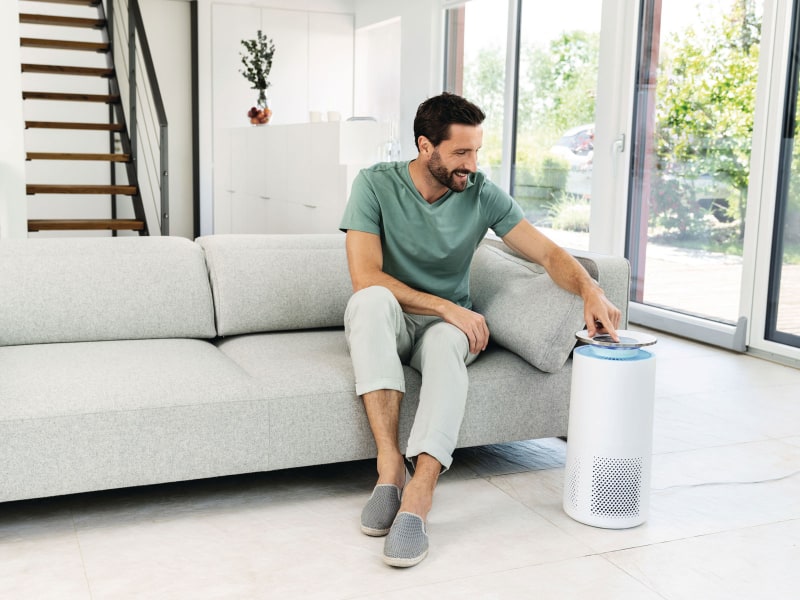
Find out what a HEPA H13 filter can do, which particles it holds back and how often you should replace the filter in your air purifier.
HEPA H13: meaning and filter class
HEPA stands for "High-Efficiency Particulate Air", in other words a highly efficient particulate air filter. HEPA filters are particulate air filters, that is, filters that remove the finest suspended particles from the air. The European test standard DIN EN 1822-1 defines how powerful such a filter is: it divides particulate air filters into the groups EPA, HEPA and ULPA and tests each filter at the particle size that is hardest to remove[1].
| Filter group | Separation efficiency at the MPPS | Typical particles |
|---|---|---|
| EPA (E10 to E12) | approx. 85 to 99.5%[2] | Germs, bacteria, soot |
| HEPA (H13 and H14) | approx. 99.95 to 99.995%[2] | Viruses, suspended dust, particles from combustion processes |
| ULPA (U15 to U17) | approx. 99.9995 to 99.999995%[2] | Suspended dust, mainly in cleanrooms |
Within the HEPA group, the class designation H13 stands for a firmly defined requirement for separation efficiency. According to DIN EN 1822, HEPA and ULPA filters are also individually tested for leak-tightness, whereas this is not required for EPA filters. The assessment takes place at the so-called MPPS, the particle size at which the filter medium shows its lowest separation efficiency[1].
For the LR 400 this means in concrete terms: the installed HEPA H13 filter removes particles from a size of 0.3 µm at up to 99.95%. This figure is a manufacturer's specification and is based on a test by Kitech in accordance with DIN EN 1822-1. For a household with a pollen or pet hair allergy, class H13 first of all means that the filter was assessed against a defined test standard for its separation efficiency and is therefore comparable.
How a HEPA filter holds back particles
A HEPA filter does not work like a sieve with fine holes, but as a depth filter: densely packed fibres form a thick mat through which the air flows along winding paths. Particles get caught in three ways. Larger particles simply do not fit through the pores between the fibres. Somewhat heavier particles do not follow the curve of the airflow because of their inertia and hit a fibre. Very small particles, in turn, move so irregularly due to collisions with air molecules that they eventually get caught on a fibre.
Because these mechanisms have different effects at different particle sizes, there is one particle size where filters have the hardest job: the most penetrating particle size, or MPPS for short, typically in the range of 0.1 to 0.3 µm. Testing to DIN EN 1822 focuses precisely on this point, because a filter that performs well here also performs well at the other sizes[1].
For the filter system of the LR 400, the manufacturer gives a second, supplementary figure: the system retains at least 95 % of particles of 0.02 µm, tested by IUTA on a test rig according to DIN 71460-1[3]. This is also a manufacturer's specification with a named test basis. It shows that separation does not stop at 0.3 µm but also covers considerably smaller particles, where diffusion is the main working mechanism.
Filtering pollen, house dust and pet hair from your home
What actually floats in the indoor air of an allergy household was investigated by Maya Manzano et al. in a study of 22 bedrooms, published in the journal Clinical and Translational Allergy in 2022: air filtration noticeably reduced the content of fine dust and the house dust mite, cat and dog allergens attached to it in the indoor air. All allergens present in the room attached themselves to dust particles, though with a clear tendency: mite allergens were found particularly often on larger dust grains (particles larger than 10 µm), while cat and dog allergens were found mainly on smaller ones (particles between 2.5 and 10 µm).[4]
- House dust mites: These 0.1 to 0.5 mm creatures cannot be seen with the naked eye. It is mainly their excretions, which contain allergens, that become a problem. During the heating season many mites die off, mite bodies and droppings break down, and large quantities of allergens are released and swirled into the air[5][6].
- Pet allergens: Those affected do not react to the hair itself, but to protein components from the animals' saliva and sebaceous and sweat glands. These allergy triggers bind to dust and thus enter the air; cat allergens stay airborne very easily and remain in the air for a long time even after the cat has been removed[7].
- Pollen: It reaches the bedroom despite closed windows, for example via clothing and hair. The German Allergy and Asthma Association recommends ventilating briefly and intensively rather than leaving the window permanently tilted, ideally early in the morning between 6 and 9 am or in the evening after 9 pm[8].
Removing exactly these particles is the task of an air purifier. The LR 400 moves 266 m³/h of air and is suitable for rooms up to 69 m² (per NRCC-54013-2011). Its PM 2.5 sensor detects fine dust with a particle size of 2.5 µm and automatically selects the appropriate fan level in AUTO mode. Which filter technology helps with pollen, pet allergens and smoke, and what matters when using one in your home, is covered in our magazine article "Air purifiers for allergies, pet hair and smoke".
Particle count, by the way, is only one side of the indoor climate. Temperature and humidity belong to it as well, and both can be monitored with a thermo-hygrometer. You will find an overview of our products for a healthy indoor climate in the Air quality category.
Pre-filter and activated carbon complement the HEPA filter
In the LR 400, the HEPA filter does not work alone but sits as the middle layer in a three-layer filter unit. The replacement filter unit carries the order number 693.09. The division of labour looks like this:
- Pre-filter: It catches coarse particles and pet hair before the air reaches the finer layers, protecting the HEPA filter from clogging quickly.
- HEPA H13 filter: It is responsible for the fine particles, such as pollen, house dust and fine dust.
- Activated carbon: It absorbs gaseous substances, including odours that a particulate filter cannot retain.
This order matches the observations from the bedroom study by Maya Manzano et al.: mite allergens attach particularly to larger dust particles, and it is precisely these larger particles that reach the pre-filter first. The sensitive HEPA layer therefore stays effective for longer, while the activated carbon takes over the components that have nothing to do with particles. In everyday use, this means that all three layers belong together and are also replaced together as one unit.
As clearly as the filter performance is described, the limits are just as clear: an air purifier separates particles from the indoor air. It prevents neither allergies nor infections, and it is no substitute for a medical diagnosis or therapy.
The Indoor Air Hygiene Commission puts this into context as well: because fine dust in indoor spaces has so many different sources, its statement concludes that no quantitative statements about the health risk can currently be made. Elevated fine dust concentrations indoors are undesirable from a hygiene perspective, and reducing the dust concentration serves as a precaution against avoidable exposure[9].
The instructions for use of the LR 400 draw further limits: the device is intended exclusively for cleaning the air in indoor spaces. If you suffer from a severe illness of the airways or lungs, consult your doctor before using the device.
- No protection against infection: bacteria and viruses are mentioned in the manufacturer's specifications only as particle sizes, not as a promise of protection.
- No prevention: an air purifier can separate allergens from the indoor air, but it cannot prevent an allergy or an infection.
- No substitute for your doctor: diagnosis and therapy decisions belong in medical hands.
- For indoor use only: use is limited to air purification in enclosed rooms.
Filter care and replacement interval in everyday life
A HEPA filter needs a little attention so that it performs throughout its entire service life. The instructions for use of the LR 400 set out clear requirements here: regular cleaning of the filter, once a month, is a prerequisite for hygienic, reliable operation. The outer surfaces of the filter are cleaned with the brush attachment of a vacuum cleaner or a dry cloth. The three-layer filter cannot be washed and should be replaced after 4,320 operating hours.
So that you do not have to work out the replacement yourself, the LR 400 has a filter replacement indicator. If you prefer to replace the filter on your own schedule, for example every 6 months, you simply write a date on the sticker at the upper edge of the filter.
The monthly care routine also includes the PM 2.5 dust sensor: its flap is located on the side of the device, and the opened channel is cleared of coarse dust with a dry cotton swab. In heavily dusty environments, the instructions for use recommend cleaning the sensor more often, as soiling can lead to inaccurate measured values.
The Beurer LR 400 with a three-layer filter
The LR 400 shows how the filter technology from the previous sections translates into a device for everyday life: a three-layer filter system consisting of a pre-filter, a HEPA H13 filter and activated carbon, plus a control system that adapts to the situation in the room. The key features at a glance:
- 4 fan levels plus AUTO, TURBO and NIGHT modes; in NIGHT mode the device operates below 30 dB with the control panel switched off.
- PM 2.5 sensor that adjusts the fan level to the measured indoor air in AUTO mode.
- LED light ring that displays the current indoor air quality by colour.
- App “beurer FreshHome” for individual air purification schedules as well as daily, weekly and yearly overviews of the indoor air; the device's basic functions can also be used without the app.
- Suitable for rooms up to 69 m² (per NRCC-54013-2011) with an air flow of 266 m³/h.
- Replacement filter unit with the three layers under order number 693.09.
If you would like to compare different models for your room size, you will find them in our air purifier category from Beurer. For getting started with the filter technology described in this article, the Beurer LR 400 is the suitable device: there you can see the three-layer filter system with HEPA H13 in detail, the technical specifications for rooms up to 69 m² and the accessory and spare part information for the later filter replacement.
Frequently asked questions
What does a HEPA filter do?
A HEPA filter separates airborne particles such as pollen, house dust, pet hair and fine dust from the indoor air. A small study in 22 bedrooms showed that air filtration noticeably reduced fine dust and the mite, cat and dog allergens attached to it in the indoor air.
What does HEPA mean?
HEPA stands for High-Efficiency Particulate Air, in other words a highly efficient particulate air filter. HEPA filters belong to the particulate air filters and are classified into classes according to DIN EN 1822-1: EPA (E10 to E12), HEPA (H13 and H14) and ULPA (U15 to U17). The class indicates how many particles the filter retains at minimum.
What filters does an air purifier need?
An air purifier works in several stages: the pre-filter holds back coarse particles and pet hair, the HEPA filter takes care of pollen, house dust and fine dust, and an activated carbon filter can remove odours from the air. The LR 400 combines these three layers in one filter unit, and the replacement filter carries the order number 693.09.
Can you clean a HEPA filter?
Partly. Clean the outside of the filter once a month with the brush attachment of a vacuum cleaner or a dry cloth. The three-layer filter cannot be washed. Once it is exhausted, it is replaced completely, not rinsed out.
How often should you replace a HEPA filter?
The replacement depends on the operating hours, not on the calendar. The three-layer filter of the LR 400 should be replaced after 4,320 operating hours. A filter replacement indicator on the device reminds you of the replacement, and a sticker on the filter edge helps you keep track of your own rhythm.
What are the disadvantages of a HEPA filter?
HEPA filters are not washable and must be cleaned regularly and replaced after some time, which causes ongoing costs. A soiled or incorrectly used filter can reduce the cleaning performance and make the air purifier louder.