

A dark patch in the corner of the room or a musty smell behind the wardrobe: when you find mould in your home, you want to get rid of it quickly. But not every patch needs a specialist straight away: if it is only on the surface, small, and the cause is known and has been fixed, you can remove it yourself.[1]
In this guide, you will find out how to judge the extent of the problem, how to remove small patches safely and why the cause always comes first. We then show you how to measure the humidity with our Thermo hygrometer HM 22 and keep it under control with our LE 250 air dehumidifier.
When you can remove mould yourself
You can remove mould yourself when three conditions are met: the mould is only on the surface, the area is no larger than about half a square metre, and there are no structural defects.[2]
There is a fourth requirement: the cause is known and has been fixed.[1] Without that, even the most thorough cleaning will achieve little.
How big is your patch, really? Half a square metre is roughly an area of 70 by 70 centimetres. If the mould covers more than that, sits behind the wallpaper or keeps coming back, a sponge and cloth are no longer enough. If the area is larger, do not tackle it yourself: larger areas of mould should only be dealt with by qualified professionals.[3]
So three things count when you assess it: size, depth and cause.
Without fixing the cause, the mould comes back
Mould needs moisture. Only once the cause has been found and the damage repaired can mould be removed properly and for good.[1]
Where does the moisture in your home come from? Moisture from everyday activities such as showering, cooking and drying laundry builds up in the air if it cannot be removed, for example when the room is not aired properly.[3] We contribute to it ourselves, too. A person releases up to half a litre of water vapour per night, about as much as one shower.[1] That is why it is worth checking the readings in the bedroom in particular; read more in our guide Is a dehumidifier in the bedroom really useful?
In most cases, mould is caused by condensation, especially when the humidity of the indoor air goes above 60 percent, the temperature falls and the room is not ventilated regularly.[4] That is why measuring the humidity is part of tracking down the cause.
It is a different matter when the moisture comes from the building itself. As a rule, you cannot get rid of this kind of damp yourself. Your landlord must try to find out what is causing the problem, and fixing it will usually be their responsibility.[5]
Removing small patches safely: protection and cleaning agents
Small patches of mould are best removed with good protection. That means gloves, a respirator mask with a particle filter of at least protection class P2, protective eyewear and, if possible, a disposable coverall.[1]
Which cleaning agent works depends on the material:
- Smooth surfaces: mould can usually be wiped off with a household cleaner and a cloth.[1]
- Wallpaper: dampen the affected wallpaper before you strip it so the spores are bound, and throw the cloth away afterwards.[1]
- Wall: then wipe the wall with 70 to 80 percent ethyl alcohol and let it dry.[1] 70 percent alcohol is suitable for dry surfaces, 80 percent for damp ones.[2]
- Porous materials such as plasterboard or chipboard often cannot be cleaned and have to be removed.[1]
- Upholstered furniture and textiles are hard to free from mould and often have to be thrown away.[1]
The alcohol creates a risk of fire and explosion, so make sure the room is well ventilated while you work and keep away from any sources of ignition. Wear the respirator so that you do not breathe in the mould spores.[2]
You can skip two popular home remedies. Vinegar contains organic nutrients that can even encourage the growth of fungi.[2] And spraying mouldy wallpaper with anti-mould spray and then painting it with anti-mould paint makes no sense.[1]
Measuring the humidity and keeping it under control
Once the patch has gone, the real prevention begins. At Beurer, we recommend a humidity level of between 40 and 60 percent for living spaces. Over the long term, it should not exceed 65 to 70 percent in the room air or 80 percent directly at the wall.[2] A hygrometer or another environmental monitor shows you whether the relative humidity stays consistently high.[3]
Our Thermo hygrometer HM 22 shows you the current room temperature and humidity at a glance. It measures relative humidity from 20 to 95 percent, with an accuracy of ± 5 percent in the range from 40 to 80 percent. After setting it up, it can take 10 minutes for the HM 22 to show the correct reading. The HM 22 only measures and does not dehumidify. It also comes with a 3-year guarantee.
In the stern Kaufkosmos hygrometer test “Hygrometer-Test: Auf diese Modelle können Sie sich verlassen” of 24 March 2026, the Beurer HM 22 took 2nd place out of 5 hygrometers tested. The verdict reads: “Knapp geschlagen, aber ebenfalls zuverlässig und ohne Einschränkung empfehlenswert ist das Beurer HM 22, das als kleines Extra (zum Beispiel für die Küche) noch einen Timer an Bord hat.” (Narrowly beaten, but also reliable and recommendable without reservation is the Beurer HM 22, which has a timer as a small extra, for example for the kitchen.) To find out what else matters when measuring, read our guide Hygrometer test: which one measures accurately?
If your hygrometer keeps showing readings that are too high, airing and heating properly is the first step:
- Air the room several times a day for 5 to 10 minutes with the window wide open.[2]
- Avoid leaving windows on the tilt, as this cools down rooms and walls.[6]
- Move furniture about 10 centimetres away from external walls.[2]
- Do not cover radiators, for example by drying clothes on them.[7]
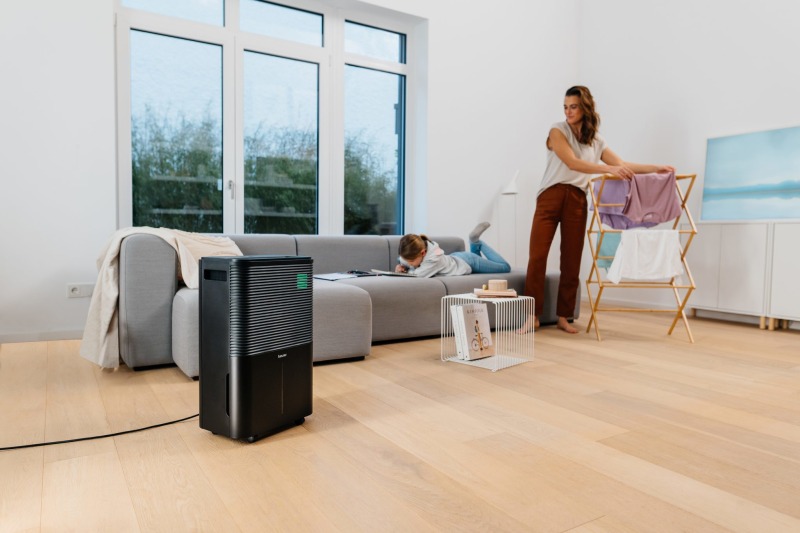
Not enough? Then a dehumidifier can help to keep the humidity within range for good after the mould has been removed. Our LE 250 air dehumidifier removes up to 20 litres of moisture from the room air per day and is designed for rooms of up to 60 m². In automatic mode, it keeps the humidity between 45 and 55 percent. A colour display shows you the current reading.
The LE 250 is also pleasantly straightforward in everyday use. It has a 4.0-litre water tank and a connection for a condensate hose. On top of that, there is a night mode, a timer from 1 to 24 hours and two fan speeds.
The order matters. The LE 250 does not remove existing mould. It regulates the humidity once the mould has been removed and the cause has been fixed, and so helps prevent mould, condensation and musty smells.
How to set up the LE 250 correctly:
- Keep windows and doors closed while the LE 250 is dehumidifying.
- Leave a clearance of at least 50 centimetres on all sides of the LE 250.
- Operate the LE 250 in a room with a floor area greater than 4 m².
- Use the LE 250 only in closed indoor rooms, not in laundry rooms or unventilated cellars, and not right next to a bath or shower.
- If you have a serious respiratory or lung condition, ask your doctor before using the LE 250.
We explain when a device is worthwhile in How useful is a dehumidifier in everyday life? and Dehumidifiers: which one suits your cellar and bedroom? You can find all models among our air dehumidifiers and thermo hygrometers.
When professionals take over and what your landlord needs to know
Professionals take over when the mould covers more than half a square metre.[1] Mould on the window, in the bathroom or behind the wallpaper is best removed by professionals. Whatever the location, the underlying issue always has to be tackled.[3]
If you rent your home, report the mould to your landlord or managing agent in writing as soon as possible.[1] This also applies if you have already removed a small patch yourself.[8]
Health matters too. Severe mould growth can cause irritation of the airways and allergic reactions.[2] If you have a lung condition such as asthma, damp and mould can make your symptoms worse.[9] If symptoms persist, it is best to talk to your doctor.
Do it yourself or call in a specialist: the decision
In the end, the decision comes down to three questions.
- How big is the area? Up to about half a square metre and only on the surface: remove it yourself. Larger or behind the wallpaper: professionals.
- Has the cause been fixed? No or not sure: deal with the cause first; if the moisture comes from the building, involve your landlord and specialists.
- How do you keep it dry? Keep an eye on the humidity with the HM 22, air and heat your home properly and use the LE 250 to regulate the humidity if needed.
Once all three questions are answered, you have taken the key steps against new mould. Here you can take a look at our LE 250 air dehumidifier.
Frequently asked questions
Can you remove black mould yourself?
The same rules apply to black mould as to any other mould. If it is only on the surface, no larger than about half a square metre and the cause has been fixed, you can remove it yourself wearing protective equipment. Larger areas are a job for professionals.
How do I get mould off a wall?
Dampen the affected wallpaper, strip it off and throw the cloth away. Then wipe the wall with 70 to 80 percent ethyl alcohol and let it dry. Wear gloves, a P2 respirator mask and protective eyewear while you do this.
Does vinegar kill mould?
No, vinegar is not a suitable way to treat mould. It contains organic nutrients that can even encourage the growth of fungi. For small patches on a wall, 70 to 80 percent ethyl alcohol is suitable.
Does a dehumidifier help with mould?
A dehumidifier such as the Beurer LE 250 does not remove existing mould. It helps to keep the humidity under control for good once the mould has been removed and the cause has been fixed. In this way, it helps prevent new mould, condensation and musty smells.
Sources
- verbraucherzentrale.de
- umweltbundesamt.de
- Understanding and addressing the health risks of damp and mould in the home - GOV.UK
- Damp and mould - Brentwood Borough Council
- Damp and mould in private rented homes - Shelter England
- Schimmel-Mythen: 5 Irrtümer, die Quatsch sind
- Condensation and how to reduce it - Chesterfield Borough Council
- umweltbundesamt.de
- Air pollution and allergies at home - Asthma + Lung UK


