

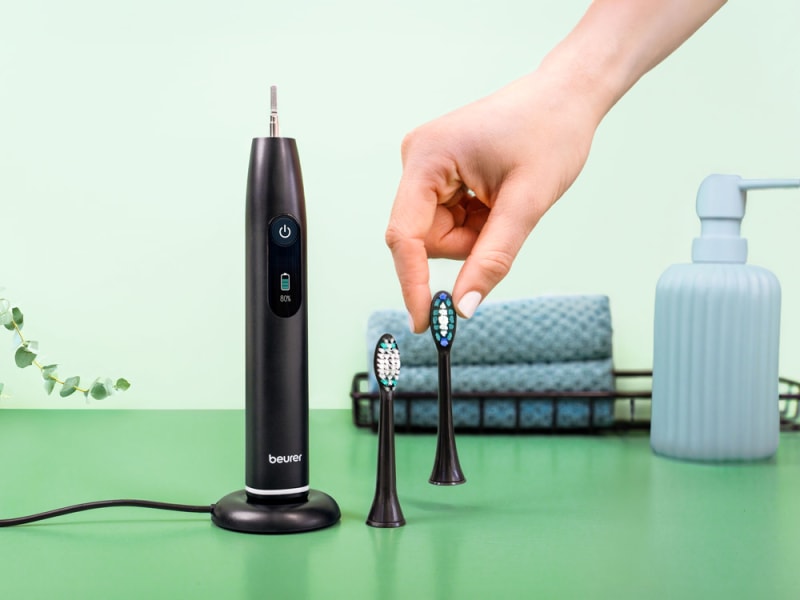
At the basin in the morning, you rarely give the brush head a second glance. It sits on the toothbrush, the toothpaste goes on and the timer counts down the 2 minutes. But the bristles do their share of the work every time you brush, and they wear down week by week. That is why there is a clear guideline for changing brush heads: about every 3 months, or sooner if you can see signs of wear.
With our SC brush heads for the SC 11, SC 30 and SC 50 sonic toothbrushes, you do not need to mark the date in your calendar. All SC heads have indicator bristles that change colour as soon as it is time for a new head. The adult brush heads come in four variants with medium or soft bristles, and on all of them the housing is made from 100% recycled materials, while the bristles are made from 100% renewable raw materials. For our rotating toothbrushes, there are matching TB heads in Clean and Sensitive versions. We show you how to spot a worn head, how to care for it until you change it and which replacement head fits your toothbrush.
The replacement interval: every three months as a guideline
For the brush head of an electric toothbrush, the replacement interval is about 3 months. Over time, the bristles wear down, no longer clean as thoroughly and can injure your gums, so it makes sense to replace the head at least every 3 months.A If the bristles start to bend outwards before then, the head is due sooner, and after three months at the latest.B
For our SC 30 and SC 50 sonic toothbrushes, we recommend replacing the brush head after 3 months. If the bristles are worn or frayed before then, you may need to replace it sooner. The same rhythm applies to the rotating toothbrushes in the TB range: for optimal brushing results, replace the brush head every 3 months.
Why replace the head even when it still looks fine? Even without visible wear, bacteria and germs gradually build up in the brush head. We also explain this in our guide to electric toothbrushes for thorough dental care.
Children change heads a little more often
Children's toothbrushes should be replaced every two to three months.C We explain from what age an electric toothbrush suits your child in our article on electric toothbrushes for children.
How to recognise a worn brush head
You can recognise a worn brush head by three signs: faded indicator bristles, frayed bristles and bristles that bend outwards. The first sign is a feature of Beurer SC brush heads; the other signs show on any head.
On the SC 30 and SC 50, the indicator bristles of the SC brush heads lose their colour over time. How quickly this happens depends on how you use the brush, and the faded colour tells you when it is time for a new head. The Wavy Soft and Wavy Clean heads for children also have indicator bristles that remind you to change the head.
Frayed bristles are the second sign. As soon as you see them, you should replace the head, even if the 3 months are not yet up.D The third sign is bristles that no longer stand straight but bend to the side.
| What you see | What it means | What to do |
|---|---|---|
| Indicator bristles faded (SC brush heads) | The recommended time has been reached | Fit a new head |
| Bristles frayed | The bristles are worn | Replace the head sooner |
| Bristles bend outwards | The bristles no longer clean as well | Replace the head sooner |
| Head looks fine, 3 months are up | Guideline reached | Replace the head |
Here is how to fit the check into everyday life. A quick look after brushing is all it takes. It is best to look at the head from the side, as bent bristles show up early that way.
What changing the head on time does for cleaning
A fresh brush head helps you remove plaque thoroughly from your teeth. Frayed or worn bristles no longer remove plaque as effectively. Bent bristles also clean less well and can injure your gums while you brush.A
Changing the head on time is therefore as much part of the routine as brushing itself. With a replacement set in the bathroom cabinet, the new head is to hand as soon as the indicator has faded. Our SC brush heads come in packs of four, the TB heads in replacement sets of 4 or 8.
Caring for the brush head between changes
Between changes, a few simple steps keep the brush head clean. On all our electric toothbrushes, from the SC 11 to the TB 50, you clean the head after every use in two steps:
- Pull the brush head off upwards.
- Rinse the brush head under running water, including the inside.
It only takes a few seconds.
On the SC 11, SC 30, SC 50, TB 15 and TB 50, you then also clean the handle under running water, but do not submerge it.
Afterwards, you should leave the toothbrush to dry standing upright with the head at the top, so that bacteria and fungi have nowhere to grow. A brush head also belongs to one person only, so you should never share it with anyone else.D
If several people share one handle, a simple system helps. Our TB Clean brush heads come with a protective cap and different coloured rings, so everyone in the household keeps their own head. If you are travelling, our article Can you take an electric toothbrush in your hand luggage? explains what to bear in mind when packing.
Choosing the right bristle hardness and head shape
For everyday use, soft or medium bristles with rounded ends are a good choice.E If you are unsure, medium bristles are a good compromise between cleaning power and gentleness.F
Our SC brush heads come in medium and soft, each with its own bristle profile:
- Classic Clean has a W-shaped bristle profile for gentle yet thorough dental care, medium hardness.
- Premium Plaque Eraser has spaces between the bristle tufts that optimise bristle vibration, medium hardness.
- Premium Whiten has raised central bristles for polishing the teeth, medium hardness.
- Premium Protection Plus has soft bristles for sensitive teeth and gums.
If your gums react easily, Protection Plus is the right choice.
Brush heads for children's teeth
For children, the brush head should be smaller, but still with soft bristles.E Our Wavy Soft heads are extra-small, rubberised brush heads for children's teeth from age 3, and the Wavy Clean heads are rubberised heads with soft bristles for children's teeth from age 6. Both fit our SC 11 children's toothbrush and see your child from milk teeth through to school age. For extra brushing fun, every replacement set includes SpongeBob stickers and a QR code for a printable toothbrushing calendar.
What a new brush head cannot do
A new brush head helps you remove plaque and food debris every day, but it does not remove tartar. Unlike plaque, tartar cannot be removed with a toothbrush, so your dental practice takes care of it at your check-up. Your dentist will recommend when your next check-up is due, and people with good oral health will probably need one only every 12 to 24 months.G
The brush head also reaches the spaces between your teeth only partly. For these areas you need other aids such as interdental brushes or floss.H Your dental practice can show you how to use them correctly.
Whatever toothbrush you use, you should brush for at least 2 minutes.A The built-in 2-minute timer on our toothbrushes helps you keep to the brushing time. If your gums bleed or you have any discomfort, it is best to speak to your dental practice.
Brush heads for Beurer toothbrushes
Which replacement head fits depends on how your toothbrush is driven. SC brush heads go with the sonic toothbrushes, TB brush heads with the rotating toothbrushes. We explain how sonic and rotating toothbrushes differ in our article Sonic or rotating toothbrush: which suits you?
The SC brush heads for adults fit all Beurer SC toothbrushes and Philips Sonicare sonic toothbrushes, except Philips One and Kids. The SC 50 comes with two heads to start with, Classic Clean and Premium Whiten. It also has an integrated pressure sensor that signals too much pressure with a ring that lights up red.
Fitting the new head
On the SC 30 and SC 50, place the new brush head on the handle from above until it clicks firmly into place. Make sure the head points in the same direction as the ON/OFF/mode button. Before that, simply pull the old head off upwards, just as you do for daily cleaning. If there are several heads in your household, assign the new brush head to the right person straight away.
For the TB 30 and TB 50 rotating toothbrushes, the TB Clean and TB Sensitive brush heads each come in a replacement set of 8. The TB Clean brush heads also fit all Oral-B toothbrushes, except the Oral-B Pulsonic series and the iO series. The TB 15 goes with the Eco heads: Clean Eco with medium and Sensitive Eco with soft bristles.
So which head fits your toothbrush? The overview shows you.
| Brush head | Fits | Bristle hardness |
|---|---|---|
| SC Classic Clean, Premium Plaque Eraser, Premium Whiten | SC 11, SC 30, SC 50 | medium |
| SC Premium Protection Plus | SC 11, SC 30, SC 50 | soft |
| Wavy Soft (from age 3), Wavy Clean (from age 6) | Beurer SC toothbrushes | soft |
| TB Clean | TB 30, TB 50 | – |
| TB Sensitive | TB 30, TB 50 | – |
| Clean Eco / Sensitive Eco | TB 15 | medium / soft |
Our complete range for your teeth is in the oral care category. If the indicator has faded or the head is fraying, the right replacement is quickly to hand: view SC brush heads.
Frequently asked questions
How do I know when to change my brush head?
On Beurer SC brush heads, the indicator bristles change colour. Either way, a head is due when the bristles are frayed or bend outwards.
How often should children change their brush head?
Children's toothbrushes should be changed every two to three months. The Beurer Wavy heads also show when it is time with indicator bristles.
Do Beurer SC brush heads fit other sonic toothbrushes?
Beurer SC brush heads fit all Beurer SC toothbrushes and Philips Sonicare sonic toothbrushes, except Philips One and Kids.
Which Beurer brush head suits sensitive gums?
For the SC range, it is the Premium Protection Plus brush head with soft bristles. For the TB 15, there is the Sensitive Eco brush head with soft bristles.
Sources
- Preventive dental care and oral hygiene for healthy teeth
- Electric toothbrushes - Oral Health Foundation
- kindergesundheit-info.de
- Toothbrushes - American Dental Association
- Guide to choosing the right toothbrush - Oral Health Foundation
- prodente.de
- Dental check-ups - NHS
- How to clean between your teeth effectively - Oral Health Foundation


