

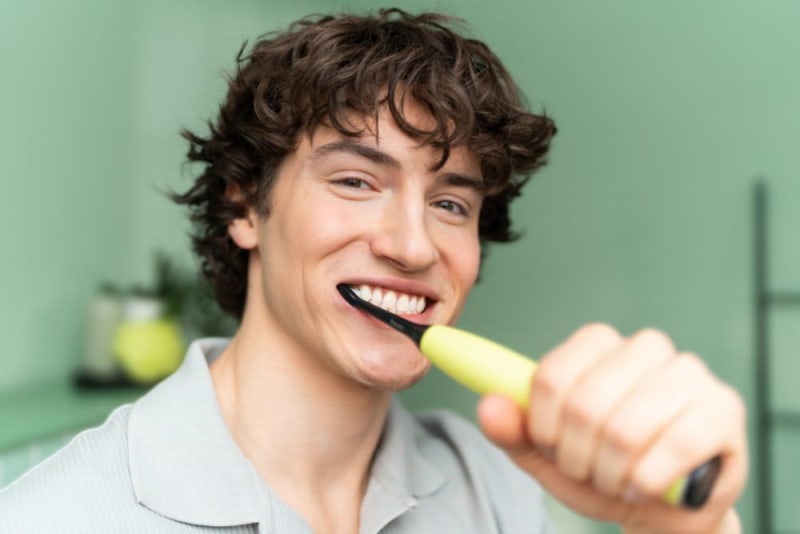
Your suitcase is almost packed, but your toothbrush is still in the bathroom. Can it come on the plane? Yes, but there are two things you should know: how much energy the battery stores and how to secure the device against being switched on by accident. For the second point, we gave the Beurer SC 50 a dedicated feature: the travel lock.
Hand luggage or checked bag: what applies to battery-powered toothbrushes
An electric toothbrush with a built-in lithium-ion battery is generally allowed in both types of luggage. Portable electronic devices like this are best carried in your hand luggage.[1]
They may go in checked baggage as long as you take measures to prevent accidental activation. The battery must not exceed 100 Wh.[1]
For checked bags, the dangerous goods rules of the International Air Transport Association (IATA) are even more specific. Devices in checked baggage must be completely switched off and protected from damage.[2] What does that mean for a toothbrush? It must not start up even if something in your suitcase presses the button.
In practice, this means:
| Piece of luggage | Electric toothbrush with a battery of up to 100 Wh | What to watch out for |
|---|---|---|
| Hand luggage | permitted, recommended by EASA | packed within easy reach and kept dry |
| Checked baggage (suitcase) | permitted | switched off completely, secured against activation, protected from damage |
Power banks and loose spare batteries are a different matter. Spare batteries, and power banks count as spare batteries, must be carried in hand luggage only.[2] This does not affect the toothbrush itself, because its battery is built in.
If you do pack a power bank for charging, it belongs in the cabin.[3]
Check the battery and its condition before packing
The 100 Wh limit sounds abstract, but working it out is easy.
To calculate the watt-hours of a battery, multiply the voltage by the ampere-hours.[1] The Beurer SC 50 has a lithium-ion battery with a capacity of 800 mAh and a nominal voltage of 3.7 V. That works out to 0.8 Ah × 3.7 V, so just under 3 Wh.
Here is what the calculation looks like for our electric toothbrushes with a built-in lithium-ion battery:
| Model | Battery | Calculation | Result |
|---|---|---|---|
| Beurer SC 50 | 800 mAh, 3.7 V | 0.8 Ah × 3.7 V | just under 3 Wh |
| Beurer SC 30 | 600 mAh, 3.7 V | 0.6 Ah × 3.7 V | just over 2 Wh |
| Beurer TB 50 | 1500 mAh, 3.7 V | 1.5 Ah × 3.7 V | just over 5.5 Wh |
All three are well below 100 Wh, so they are no problem. Only above 100 Wh do you need the airline's approval, and above 160 Wh lithium batteries are prohibited in passenger baggage.[1]
Whether it is a sonic toothbrush like the SC 50 or a rotating toothbrush like the TB 50, the drive type makes no difference for your flight.
More important than the calculation is the condition of the device. Damaged or defective batteries must not be carried.[3] So take a quick look at your toothbrush before packing.
If the Beurer SC 50 shows damage or does not work properly, stop using it. Our customer service team can help you. Also protect the SC 50's battery from excessive heat.
Activate the travel lock and pack the brush safely
The travel lock on our Beurer SC 50 prevents the toothbrush from switching on by accident, for example in your suitcase while travelling. That is exactly what the rules for checked baggage call for. Here is how to switch it on with the SC 50:
- Press and hold the ON/OFF/mode button for 5 seconds.
- While activating, the travel lock symbol flashes on the LCD display.
- As soon as the travel lock is active, the symbol briefly lights up steadily.
- If you press the button briefly while locked, the symbol lights up again. This is how you check before packing that the lock is engaged.
At your destination, press and hold the SC 50's ON/OFF/mode button again for 5 seconds. The symbol flashes and goes out, and the toothbrush is ready to use again.
As well as the programme, battery level and timer, the LCD display on our SC 50 also shows the travel lock. So you can see the status at a glance.
Our Beurer SC 30 also has a practical travel lock. Here too, you press and hold the ON/OFF/mode button for 5 seconds; when activating, the LED flashes green 5 times. To release it, press and hold the SC 30's button again for 5 seconds.
Battery life matters on the road, too. The SC 50's powerful battery lasts up to 22 days on one charge.
If you charge it fully before you leave, the charger can simply stay at home in the bathroom for a week's holiday or a short business trip. For longer trips, pack the magnetic charger.
It packs away compactly in your luggage and charges via its USB cable from a USB port or a USB mains adapter. The mains adapter is not included with the SC 50.
So take a USB mains adapter that delivers 5 V and a maximum of 1 A, because the SC 50 may only be charged with an adapter like this.
And the brush itself? Pack it dry and, when travelling, keep it clean and out of contact with other things in your luggage, for example in a resealable bag.[4] With our Beurer TB 50, a storage box is already included. It has room for the toothbrush and two brush heads. Its battery lasts up to 45 days.
The Beurer SC 50 sonic toothbrush is a Winner of the German Innovation Award 2026 (Excellence in Business to Consumer – Beauty & Care).[5]
Where airlines have stricter rules
The rules above are the general framework. Individual countries, airports and airlines may apply baggage regulations more restrictively. For information on transport conditions, contact your airline.[3]
So check your airline's baggage guidance before you fly, especially for flights outside Europe or with a stopover.
A second point concerns your toothpaste. Toothpaste counts as a liquid in your hand luggage, and most UK airports do not let you take liquids in containers larger than 100 ml through security.[6]
If the airport asks you to, put the containers in a single, transparent, resealable plastic bag that holds no more than 1 litre.[6] A travel-size tube fits in easily, while the large tube from the bathroom goes in your suitcase.
Your airline also decides how many bags you can take on the plane and what size they may be.[7] An electric toothbrush in its case takes up hardly any room there.
Checklist for your departure
With our checklist, your oral care is ready to travel in just a few minutes:
- Check your toothbrush: no damage, device working properly.
- On the Beurer SC 50 or SC 30, activate the travel lock: press and hold the ON/OFF/mode button for 5 seconds.
- Put the toothbrush in its case dry or, with the TB 50, in the supplied storage box.
- Prefer hand luggage. In your suitcase, the toothbrush stays completely switched off and safely packed.
- For long trips, pack the SC 50's magnetic charger and a USB mains adapter with 5 V and a maximum of 1 A.
- Power banks and loose spare batteries go in your hand luggage only.
- Toothpaste up to 100 ml goes in the transparent liquids bag.
- Check your airline's baggage guidance.
Is the whole family flying? If your child's toothbrush has a built-in battery, the same rules apply on board.
And if you brush gently at home, you will find tips in our guide “Electric toothbrush for sensitive gums”. The SC 50's 5 cleaning programmes, including Sensitive, come with you on your travels anyway.
You will find more models and matching brush heads in our oral care range. Looking for an electric toothbrush that locks for travel at the touch of a button and lasts up to 22 days on one charge? Take a look at the Beurer SC 50.
Frequently asked questions
Where should you pack an electric toothbrush when flying?
The best place is your hand luggage, because that is where portable devices with a lithium battery of up to 100 Wh primarily belong. The toothbrush may also go in your checked bag, but then completely switched off and secured against being switched on - with the Beurer SC 50, using the travel lock. Stricter rules of individual airlines take precedence.
Which electronic devices are not allowed in hand luggage?
Lithium batteries with more than 160 Wh are prohibited in passenger baggage - neither in hand luggage nor in checked baggage. Damaged or defective batteries are also not allowed. For batteries between 100 and 160 Wh, you need the airline's approval. An electric toothbrush like the Beurer SC 50, at just under 3 Wh, is far below these limits.
Which electronic devices are not allowed in checked baggage?
Power banks and loose spare batteries must not go in checked baggage; they belong exclusively in hand luggage. Devices with a built-in battery, such as an electric toothbrush like the Beurer SC 50, may go in your suitcase if they are switched off completely, secured against being switched on and protected from damage.
Sources
- easa.europa.eu
- IATA DGR Table 2.3.A - Provisions for dangerous goods carried by passengers or crew
- Electronic devices and replacement batteries - FOCA
- Travel Tips for Your Teeth - MouthHealthy (ADA)
- Beurer SC 50 - German Innovation Award 2026 Winner
- Hand luggage restrictions at UK airports: Liquids - GOV.UK
- Hand luggage restrictions at UK airports - GOV.UK


