

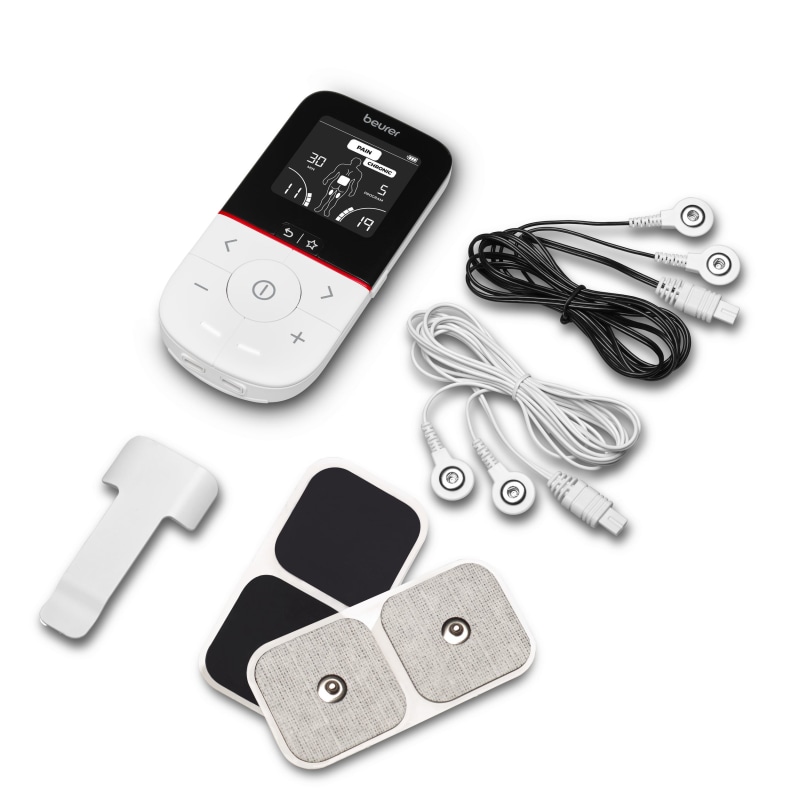
When your neck and shoulders ache again after every working day, a TENS device, short for transcutaneous electrical nerve stimulation, soon comes to mind. Many people then wonder whether their health insurer will cover the device and what the route to it looks like. Between the doctor's surgery and the device, however, lie a prescription, a contracted supplier and an approval, and each step has its own rules. We show you who prescribes a TENS device, what the prescription must state and where you submit it. At the end, you will see when buying a Beurer EM 49 or EM 56 directly is the alternative if you would rather not wait for a prescription and approval.
Can a GP prescribe a TENS device?
Yes, a GP can prescribe a TENS device, provided the practice holds a statutory health insurance licence. Care by licensed doctors is divided into GP care and specialist care.A Medical aids such as a TENS device can be prescribed at the health insurers' expense by licensed doctors when they are needed in the individual case.
Before the practice issues a prescription, the treating doctor must have assessed the insured person's condition in person.B You should therefore book an appointment and describe your symptoms there in detail. Where is the pain, how often does it come back and what have you already tried? These are exactly the points that count in the consultation.
Whether a prescription is issued is the doctor's individual decision. There is no fixed guarantee, not even for long-standing symptoms. It is best to ask directly in the consultation whether a TENS device is an option for you and how the trial works at the practice.
When a doctor prescribes a TENS device
A doctor prescribes a TENS device only after a positive trial and instruction at the practice. The trial is followed by a first period of use in which you try the device in your everyday life. The medical instruction, for example where the electrodes go and which settings are used, takes place under the doctor's guidance.
How long the trial lasts is not fixed across the board. The medically necessary length depends on the condition, other illnesses, any earlier provision and your living circumstances. Before a repeat prescription, a check-up should take place in which the doctor reads out the therapy memory of the prescribed device. This memory shows how regularly you have used the device.
In the statutory health insurers' directory of medical aids, which the GKV-Spitzenverband sorts into product groups, electrostimulation devices sit in product group 09, including pain therapy devices with a therapy memory. As the indication for these devices, the directory names chronic pain conditions whose cause cannot be treated.C Whether your own symptoms fall into this group is something your doctor will clarify in the consultation.
How TENS is generally used for recurring muscle tension is explained in our guide on TENS for muscle tension. For an overview of all devices and uses, see our pain therapy category.
What the prescription must state
A prescription for a TENS device must name the aid as precisely as possible and include every detail needed for your provision. These points belong on every prescription for a medical aid:
- Diagnosis: the reason why you need the device.
- Date: the day of issue, from which the deadline runs.
- Name of the aid: as listed in the directory of medical aids, if the device is included there.
- Quantity: how many devices or parts are prescribed.
For the name, the doctor can either state the product type from the directory of medical aids or give the seven-digit item number. The forms must be filled in completely; stamps and stickers are not allowed. If the practice later changes or adds a detail, the prescription needs the doctor's signature again, with the date.B
We recommend that you check the prescription briefly while you are still at the practice. If the diagnosis is on it, the date is filled in and the aid is clearly named, you will not have to go back for a correction.
Where to submit the prescription
You can submit the prescription for a TENS device to a supplier of medical aids that has a supply contract with your health insurer. The simplest route is via your own health insurer, because it can tell you which suppliers have such a contract. The supplier, for example a medical supply shop or a pharmacy, then generally chooses the specific device.D
With most health insurers, the route from the consultation to the device follows the same steps:
- Consultation with trial and instruction at the practice.
- Prescription with diagnosis, date, name and quantity.
- Choice of a supplier contracted to your health insurer.
- Review and approval by the health insurer.
- Technical instruction and handover of the device.
With Barmer, you use your prescription to choose a supplier from the insurer's contracted partners. In the supplier search, you find them under "TENS-Geräte" or "Elektrostimulation" together with your postcode. The contracted partner forwards your prescription to the insurer for review of medical necessity and cost-effectiveness and for approval. Qualified staff of the supplier or your treating doctor then show you how to use the device. If you feel better later on, you can return the device to the contracted partner.E
With Techniker Krankenkasse (TK), you send the prescription to a supplier that bills the costs directly to the insurer. The device is rented to you there for a fixed period.F We have summarised how the application works with other insurers in our guide to applying with AOK, TK, Barmer and DAK.
How long it takes from prescription to device
Two deadlines decide how quickly you get from prescription to device. The first deadline concerns you: if provision of the aid does not start within 28 calendar days of the prescription being issued, the prescription is no longer valid. If the application reaches the health insurer within this period, the deadline counts as met.B So the prescription must be with the supplier within 28 days; the delivery itself does not have to happen within this period.D
The second deadline concerns the health insurer. It decides on the application no later than three weeks after receiving it. If it obtains an expert opinion, for example from the Medical Service, it has five weeks. If the insurer cannot meet these deadlines, it must tell you in good time and give its reasons.G
| Stage | Deadline |
|---|---|
| Submit the prescription to the supplier | within 28 calendar days of issue |
| Decision by the health insurer | no later than three weeks |
| Decision with an expert opinion | within five weeks |
| Objection to a refusal | within one month of receiving the decision |
With TK, the doctor decides how long the rental lasts.F You should therefore send the prescription to the contracted partner as soon as possible so that you do not lose any time.
What you can do if your health insurer refuses
If your health insurer refuses your TENS device, you can lodge an objection. What matters is meeting the deadline. If the decision includes correct information on how to appeal, that is, how and by when you can object, the objection must reach the health insurer within one month of receipt. If this information is missing, the deadline is one year. It runs from the day you received the letter.
The objection must be made in writing. At first, a short note to the insurer is enough, saying that you disagree with the decision, are objecting and will send your reasons later. It is best to send this note by recorded delivery with proof of receipt or by fax with confirmation of receipt, so that you can prove it arrived in time.
For your reasons, it often helps to ask the prescribing doctor for a statement explaining why you need the aid. If the refusal is upheld in the decision on your objection, you can take the case to the social court. Support with objections and court cases is offered by social welfare associations such as Sozialverband VdK or Sozialverband Deutschland (SoVD).H
Without a prescription: using the Beurer EM 49 straight away
Without a prescription and without waiting, you buy the Digital TENS/EMS EM 49 or the EM 56 directly and keep it for good. Who wants to wait weeks for an approval when the tension in your neck is pulling now? The EM 49 can help relieve pain with TENS, supports your muscle training with EMS and gives you restful relaxation.. It offers 12 TENS, 32 EMS and 20 massage programmes, that is 64 preset applications. The matching AAA batteries are included.
The EM 49 makes getting started especially easy with its electrode position display: it helps you choose the programme and place the electrodes on your body. You can use the device on your back, neck and shoulders, among other areas, but also on your knees, hips, feet, arms and hands. We give a 5-year guarantee on the EM 49. You can use the Digital TENS/EMS EM 56 just as directly: like the EM 49, it has 2 channels, 4 electrodes and an electrode position display, and it comes with 22 preset applications, divided into 9 TENS, 5 EMS and 5 massage programmes. We also give a 5-year guarantee on the EM 56. Alongside the EM 49 and the EM 56, the EM 59 Heat and the EM 89 Heat are part of our TENS devices for pain therapy, and all four are medical devices. Which model suits you is compared in our guide Beurer EM 49 or EM 59 Heat, and our guide to buying a TENS device shows where you can get one.
Using the EM 49 does not replace a medical consultation. For any kind of pain or illness, you should ask your doctor first. If you have a cardiac pacemaker or another implanted electrical device, the EM 49 must not be used. The same applies during pregnancy and for seizure disorders such as epilepsy. Read the instructions for use before the first application, as they contain all the information on safety and contraindications. You can find all programmes and details on the Beurer EM 49 and the Beurer EM 56 pages.
Frequently asked questions
Can a GP prescribe a TENS device?
Yes. GPs with a statutory health insurance licence are part of care by licensed doctors and may prescribe medical aids such as a TENS device when it is needed in the individual case. Beforehand, they assess your condition at a personal appointment and test the device with you in a trial.
What must be on the prescription for a TENS device?
The prescription must state the diagnosis, the date of issue, the name of the aid as listed in the directory of medical aids, and the quantity. The form must be filled in completely, without stamps or stickers. Any later change needs a new signature from the doctor, with the date.
Where do I submit the prescription?
You submit the prescription to a supplier of medical aids that has a contract with your health insurer, for example a medical supply shop. Your insurer or its online supplier search tells you which suppliers these are. The supplier sends the prescription to the insurer for approval.
How long does it take to get the device?
The prescription must reach the supplier within 28 calendar days. After that, the health insurer decides within three weeks at the latest, or within five weeks with an expert opinion from the Medical Service. With instruction and delivery, you should therefore allow several weeks.
What if my health insurer refuses?
Then you lodge a written objection, usually within one month of receiving the decision. A short note is enough at first; the reasons follow later. A statement from your doctor makes them stronger. If the insurer upholds its refusal, you can take the case to the social court.

