

The first step in the morning, getting up after a film, the stairs to your flat. With knee osteoarthritis, you know these moments, but everyday life does not have to stop because of them.
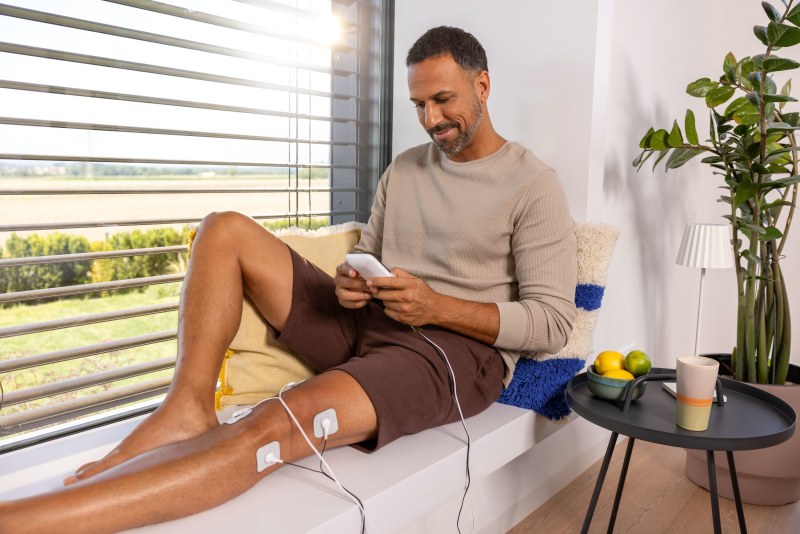
What helps with knee osteoarthritis pain is not a single remedy but a combination. Regular low-impact exercise, pain relievers applied to the skin, careful cooling during inflammation and warmth in phases without inflammation form the basis. Another pillar for use at home is TENS with our Digital TENS/EMS device EM 49 or the Digital TENS/EMS device with heat function EM 59 Heat.
What helps with severe knee osteoarthritis pain
A combination of different treatments is the most likely to help with severe knee osteoarthritis pain. Which options suit you is best discussed with your orthopaedic specialist. The pillars themselves are clear, and we set them out for you.
A typical sign of osteoarthritis is what is known as start-up pain, which you may recognise: it occurs when you go from rest to movement. Less painful and more painful phases can come and go in episodes.[1]
Other factors also play a role, including being overweight, joint misalignment and excessive strain from kneeling or physically demanding activities.[2]
This gives you the building blocks for your everyday life:
- Exercise: low-impact and regular
- Pain relievers: applied to the skin first, taken by mouth if needed
- Cold and warmth: depending on the phase
- TENS: for use at home
Why exercise remains the first pillar despite the pain
Exercise remains the first pillar because it nourishes and supports the knee. Regular low-impact exercise keeps the joint area well nourished and also trains the muscles that stabilise the joint.[3]
Resting understandably feels right when you are in pain, but in the long run your knee then misses exactly this support. Which type of exercise suits your knee is best discussed with your doctor or a physiotherapist.
What pain relievers can do and what to look out for
Pain relievers help you keep moving, and that is exactly their job. For first-time, occasional or relatively mild knee symptoms, a treatment applied to the skin, for example one containing diclofenac, may be considered first.[4]
Compared with tablets, pain relievers applied to the skin carry a lower risk of side effects and interactions, especially stomach and bowel problems. If that is not enough, non-steroidal anti-inflammatory drugs (NSAIDs) taken by mouth are available for self-medication.[4]
Ask your pharmacist or doctor which option is right for you.
When heat helps and when cold does
As a rule of thumb, whether heat or cold does you good depends on the phase. During acute inflammation, carefully cooling the joint can bring relief. Warming measures, on the other hand, are felt to be soothing in phases without inflammation.[3]
If your knee is warm, swollen and red, it is better to cool it. If it is calm but stiff, warmth is fine.
With our EM 59 Heat, you can add heat to the TENS application, which can feel pleasant and contribute to relaxation.
What to bear in mind after knee surgery
After knee surgery, patience is needed. Your doctor sets the framework, and that applies to exercise just as much as to any application at home.
For TENS: a TENS/EMS application must not be used if you have metal implants or joint replacements (endoprostheses), for example a knee replacement. TENS must also not be used after surgery when increased muscle contractions could interfere with the healing process. TENS must not be used if you have implanted electrical devices such as pacemakers, known cardiac arrhythmia or epilepsy, or if you are pregnant.
If you are unsure whether this applies to your knee, ask your doctor before using it for the first time.
Where electrical stimulation fits into everyday life
TENS comes in where you want to do something yourself at home, and that is exactly what we developed our devices for. With transcutaneous electrical nerve stimulation, gentle impulses are passed to the skin via electrodes. Joint pain, for example in the knee joint, is one of the intended applications of the EM 49.
Our EM 49 combines TENS for drug-free pain relief with EMS for muscle training and regeneration, and with massage for relaxation and well-being. It has 2 channels and 4 electrodes and runs on batteries. That makes it practical for the knee. TENS programme 3 of the EM 49 is intended for pain in the lower limbs.
Our EM 59 Heat is “Testsieger” in the F.A.Z. Kaufkompass TENS device test “Das beste TENS-Gerät” (as of 30 June 2026).
Its programmes can be set to intensities from very gentle to powerful, and the instructions for use give beginners plenty of information on how to use it. They also include a table showing which programme is suitable for which part of the body.[5]
Our guide “TENS device for the knee: pain relief and application tips” shows where the electrodes go on the knee. The comparison “Beurer EM 49 or EM 59 Heat” helps you decide which device suits you. You can find all models in our range of TENS devices for pain relief and under pain therapy at home.
You should read the instructions for use before the first application; it is worth it. The application does not replace medical treatment, but it can complement it in everyday life.
Would you like to try TENS at home? Take a look at the Beurer EM 49.
Frequently asked questions
What helps with severe knee osteoarthritis pain?
Most likely a combination of low-impact exercise, pain relievers applied to the skin and, if needed, taken by mouth, cold or heat depending on the phase, and TENS at home.
Does heat or cold help with knee osteoarthritis?
During acute inflammation, careful cooling can bring relief. In phases without inflammation, warmth is felt to be soothing.
Can I exercise with knee osteoarthritis?
Yes, low-impact exercise is actually an important pillar. It keeps the joint area well nourished and trains the muscles that stabilise the knee.
Can I use TENS after knee surgery?
Check this with your doctor. TENS must not be used after surgery when increased muscle contractions could interfere with the healing process, or if you have metal implants such as a knee replacement.


