

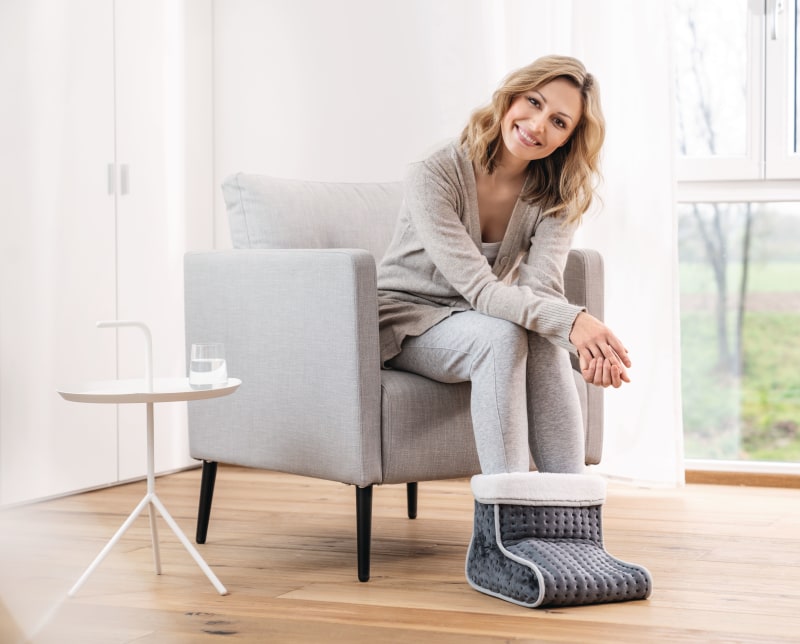
You are sitting at your desk in your home office or in front of the TV in the evening, and even though you are wearing thick socks, your feet simply will not warm up. You are not alone in this — especially in winter, many people know this feeling. But where do cold feet actually come from, and when should you take them seriously? We show you the most common causes, the warning signs that mean a trip to the doctor, and what you can do while sitting. And for the feet under your desk, we also have a simple solution. With the Beurer FW 20, you can pamper your feet with soothing warmth. Its inner lining is machine-washable for better hygiene.
Why your feet get cold so quickly
In most cases, cold feet are a natural reaction of the body and occur mainly during the winter months.A Often they are simply due to cold weather.B
Behind this is a protective mechanism. In the cold, the body reduces heat loss by constricting the blood vessels in the skin and in the arms and legs.C At the same time, it supplies mainly the vital organs such as the brain, lungs and heart with blood to keep them warm. In the hands and feet, the vessels constrict, blood circulates more slowly, and that is why we get cold there especially quickly.D
Why do I always have cold feet at my desk? When you are sitting, you barely move your legs, and your feet often stand on a cool floor for hours. You can read about what else cools your feet down in everyday life in the next section.
The most common causes in everyday life
If you compare your search for “cold feet causes” with your own everyday life, you will often find the answer straight away. Many reasons are easy to identify:
- Tight shoes: If your shoes are too tight or laced too tightly, this can impair circulation in your feet.
- Moisture and damp socks: Sweaty feet and damp socks cool your feet down. This is due to so-called evaporative cooling.C
- Tight cuffs: Socks with tight cuffs restrict blood circulation in the feet.B
- Thin soles: Thick soles prevent heat from being lost through the soles of your feet in winter.
- Smoking: Nicotine harms the circulation in your blood vessels, and less blood means less warmth.C
- Drinking too little: If the body gets too little fluid, the blood thickens and flows through the body less well.
Your mind plays a role, too. Psychological strain can change your circulation, which shows up, among other things, as cold hands or feet. Chronic stress also influences blood pressure and, over time, has a negative effect on blood vessels and circulation.C
Why women get cold feet more often
Women get cold hands and feet noticeably more often than men. One reason is that they more frequently have low blood pressure. Another is their lower proportion of muscle.D
Muscles generate heat. Relative to total body weight, a male body has more muscle mass on average. Heat loss also depends on the ratio of body surface area to body mass: the larger this ratio, the more heat the body gives off. Women generally have a lower total body mass than men, so they tend to lose more heat.C
Hormonal changes come into play as well. They, too — as during the menopause — are among the possible causes of constantly cold feet.A
When cold feet are a sign of an illness
Sometimes an illness is behind cold feet. Which one it is can only be clarified by a medical examination. The following examples show you why it is worth having constantly cold feet checked out.
Low blood pressure often leads to fatigue, to dizziness when standing up or standing for a long time, and frequently to cold hands or feet. With an underactive thyroid, sensitivity to cold can be increased. In peripheral arterial disease, a circulatory disorder of the limbs, pain occurs in the legs when walking and eases at rest.C Smokers and people with diabetes are particularly at risk of arterial circulatory disorders.B
In people with diabetes, nerve damage is often the reason why the feet feel cold. If your feet are constantly cold, a deficiency in vital nutrients should also be ruled out, such as an iron deficiency that leads to anaemia.A
A special form is Raynaud's syndrome. Typical signs are fingers that suddenly turn ice-cold and pale — more rarely toes as well — and then turn bluish.B Specialists distinguish between primary Raynaud's syndrome, which has no clear cause, and the secondary form, which develops as a consequence of another underlying condition.C
When you should have cold feet checked by a doctor
You should have chronically cold hands and feet checked by a doctor, even if the cause is usually an everyday one.D If you often have cold feet even at normal or warm temperatures, you should discuss this with your GP practice. This applies above all if other symptoms are added, such as abnormal sensations and pain, swelling, signs of paralysis or skin changes.C
If your fingers or toes suddenly turn ice-cold and pale and then bluish, you should have the symptoms checked by a doctor promptly.B
If a foot suddenly becomes cold and pale, especially when pain, numbness or movement problems are added, an acute vascular occlusion may be behind it. This is an emergency: call the emergency number 112 immediately.E
What helps against cold feet while sitting
Many tips against cold feet can be put into practice right at your desk or on the sofa. Foot exercises help with cold feet.C These include, for example, walking on your toes, circling your feet or rolling the soles of your feet on a small ball. When sitting, you should also avoid crossing your legs.B
From time to time, it is worth getting up. For your feet, simple exercises around the home work well: walk on your tiptoes, on your heels, or on the inner and outer edges of your feet. You should also drink enough and make sure your socks do not cut in and your shoes are wide enough.D
In the long term, too, you can do something. Regular movement helps good circulation in the feet and legs — ideally half an hour, three times a week. Good winter footwear has moisture-repellent rubber soles and is not too tight. That way, a warming layer of air forms inside the shoe.B
You will find more ideas specifically for the workplace in our guide Cold feet at the desk: what really helps in the office?.
Targeted warmth for your feet: FW 20 and FWM 45
Movement and the right clothing are one thing. But what do you do when you sit at your desk for hours and your feet still stay cold? Then targeted, soothing warmth directly on your feet is pleasant. With a foot warmer, you do not heat a whole room or a whole floor - only the foot warmer itself, and that takes little energy. Under your desk, it can help you get through the working day with cosily warm feet. Our foot warmers come in different designs.
Our Beurer FW 20 is a breathable foot heater with 3 temperature settings. Its rapid heating warms up quickly during the first 10 minutes. The Beurer Safety System with temperature monitoring and safety cut-out is on board, and the automatic switch-off stops the heat supply approx. 90 minutes after switching on. The temperature settings are illuminated, the top is made of fleece fibre and the foot pocket of teddy plush, and the FW 20 fits feet up to shoe size 47 (EU).
To warm up faster, place the foot warmer on a carpet or a similarly insulating surface. If you use it for several hours, the lowest temperature setting is recommended to avoid overheating your feet and possibly burning your skin. After approx. 90 minutes, the automatic switch-off turns the FW 20 off anyway. You can wash the removable teddy lining at 30 °C on an extra gentle cycle; the foot warmer itself must not be washed. When cleaning, follow the instructions for use and the care label of your foot warmer. Only use it again once the device and the teddy lining are completely dry. The FW 20 comes with a 3-year warranty and is not a medical device.
Would you like a massage along with the warmth? Then our Beurer FWM 45 is a good match. The massage foot warmer treats your feet to soothing warmth and a pleasant massage. It has 2 massage settings and 2 heat settings, and you can use heat and massage separately. The FWM 45 also fits feet up to shoe size 47 (EU). Its removable teddy lining is washed by hand; the foot warmer itself must not be washed.
| Beurer FW 20 | Beurer FWM 45 | |
|---|---|---|
| Type | Foot warmer | Massage foot warmer |
| Temperature settings | 3 | 2 |
| Massage | no | 2 settings, can be used separately from the heat |
| Rapid heating | yes, during the first 10 minutes | no |
| Automatic switch-off | after approx. 90 minutes | no information |
| Shoe size | up to 47 (EU) | up to 47 (EU) |
| Teddy lining | Washing machine, 30 °C extra gentle cycle | Hand wash |
Whether a foot warmer or another warmth solution suits you better, we show you in Foot warmer or heated slippers: what helps against cold feet? and in What can you use instead of a hot water bottle?. You will also find an overview of all Beurer heat products with us.
Who must not use a foot warmer
The following rules apply to the FW 20 and the FWM 45:
- FW 20 and FWM 45 must not be used by people who are insensitive to heat. This also applies to other vulnerable people who cannot react to overheating. These include, for example, people with diabetes, people with disease-related skin changes or scarred skin areas in the area of use, as well as people after taking pain-relieving medication or alcohol.
- FW 20 and FWM 45 must not be used on very young children (0 to 3 years), because they cannot react to overheating.
- Children over 3 and under 8 years of age may only use the foot warmers under supervision. A supervising adult always sets the switch to the minimum temperature setting and makes sure it is operated safely.
- The electric and magnetic fields of the foot warmers may in some circumstances interfere with the function of a cardiac pacemaker. With the FWM 45, they are at max. 5000 V/m electric field strength, max. 80 A/m magnetic field strength and max. 0.1 milli-Tesla magnetic flux density. You should therefore ask your doctor and the manufacturer of your pacemaker before use.
- The foot warmers must not be used to warm animals and must not be used with shoes. You should not stick pins into them and should not use them folded or pushed together.
Read the instructions for use of your foot warmer before using it for the first time — you will find all the guidance there in full. Take a look at the Beurer FW 20
Frequently asked questions
What can cold feet be a sign of?
Cold feet are usually a natural reaction to cold, tight shoes or damp socks. Sometimes low blood pressure, an underactive thyroid, a circulatory disorder or Raynaud's syndrome is behind them. If your feet are constantly cold, you should have this checked by a doctor.
Which deficiency causes cold feet?
Persistently cold feet can have various causes. An iron deficiency with anaemia is one of the causes that should be ruled out by a doctor. Whether a nutrient deficiency or an illness is behind it is something your GP practice can clarify.
Can cold feet be a symptom of low blood pressure?
Yes, low blood pressure often leads to cold hands or feet, often together with tiredness and dizziness when standing up. Women more often have low blood pressure and therefore also get cold feet more often.
What can you do about poor circulation in your feet?
Regular exercise, ideally half an hour three times a week, foot exercises and wide shoes without constricting socks help in everyday life. If you have complaints such as pain when walking, you should mention them at your GP practice.
Why do I always have cold feet at my desk?
When sitting, you barely move your legs, and your feet rest on a cool floor for a long time. Foot exercises while seated help, and with a foot warmer like the Beurer FW 20 you can keep your feet pleasantly warm under the desk.

