

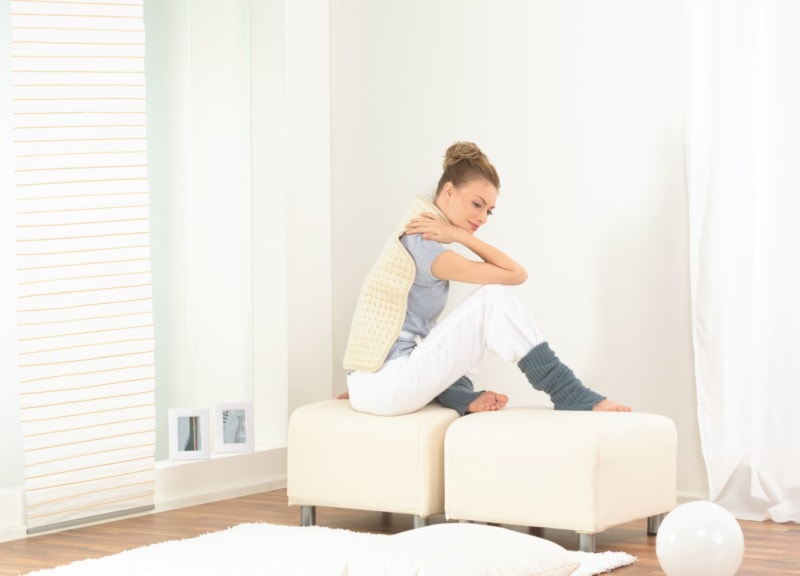
You get home from an autumn run, your fingers are cold and your neck is stiff from the chilly air. Now you want one thing above all: warmth. Heat pads have been part of the Beurer range since we were founded in 1919, and after sport they make for a cosy evening. But when is warmth the right choice, and when is cold better? We show you where a heat pad fits into an active person’s everyday life, how to warm up properly before training and which of our heat pads suits you.
Where a heat pad fits into your sporting routine
A heat pad belongs to the quiet time after training, at home. Our heat pads give you soothing, targeted warmth exactly where you want it on your body. After long autumn walks, a run through the woods or a winter outing in the snow, they are quickly ready to use and warm you up again.
Our Beurer HK 58 Cosy is a good companion for this. With its form-fitting design and individually adjustable hook-and-loop fastener, this back & neck heat pad can be used in many ways on your neck, shoulders or back. Adjust the abdominal belt and the soft hook-and-loop fastener at the neck so that it sits comfortably while you read a book on the sofa. The fleece fibre cover and fleece fibre heated pad are breathable, snuggly and skin-friendly.
The setting matters: the HK 58 is only intended for domestic/private use, not for commercial use. So it does not come with you to the sports hall or the touchline, but waits for you at home. You can find an overview of all designs among our heat pads.
Before training: warming up through movement
Before training, the warmth belongs in your muscles, and it comes from movement. Athletes should warm up for about 10 to 15 minutes before training. For a general warm-up, easy, slow cycling, jogging, skipping or shadow boxing get your circulation going.A
Why are these minutes worth it? A good warm-up, tailored to your sport, prepares your muscles, tendons and ligaments for the strain ahead. A strain, by contrast, usually occurs when muscles are overtired or insufficiently warmed up.B A US study shows that a proper warm-up can reduce the risk of sports injuries.A
The heat pad stays switched off at this stage. It does not replace this preparation, so you should always keep your warm-up active and only start your actual training afterwards. During training itself, it makes sense to increase the load gradually and to take breaks in between.C
After training: soothing heat at home
Now comes the cosy part. You’ve showered, your sports bag is in the corner, and the heat pad is waiting on the sofa. Especially after a session in the cold, warmth on your neck and shoulders feels particularly pleasant. It can help you relax as you start your evening at a gentle pace.
So that the warmth arrives quickly, the HK 58 has a fast heating function that allows the pad to warm up faster in the first 10 minutes. With 6 temperature settings, you can find the warmth that feels right for you. The fastest way to warm it up is to set the highest temperature setting first and then go back to your preferred setting.
There are a few points to bear in mind when using it:
- You should lay the heating pad out flat so that no creases form.
- If you use the HK 58 for several hours, set the lowest temperature level to reduce the risk of overheating and possible skin burns.
- The automatic switch-off of the HK 58 stops the heat supply approx. 90 minutes after it is switched on.
If you’d rather wrap your whole body in warmth in the evening, reach for a heated overblanket. Our heated blankets give you cosy warmth on the sofa, in bed or at the table, while a heat pad warms one specific part of your body.
Sore muscles: what causes them and what makes you feel better
If you get back into sport after a break, you often feel it in your muscles the next day. Unfamiliar movements, such as stopping and starting again in ball games, are often the reason. Muscle soreness usually sets in after about 24 hours. Overexertion causes tiny tears in the muscle fibres.D
The good news: sore muscles do not cause lasting damage. The discomfort usually eases within a few days. You should avoid intense sport during this time, but light exercises or gentle jogging are well suited.D
And what makes you feel better on days like these? Besides gentle movement, it is above all some quiet time on the sofa. The warmth of a heat pad feels pleasant and gives you a sense of comfort and security. That turns your rest day into a little break before you get back into training.
Fresh sports injury: cool first with the RICE method
With a fresh sports injury, a different order applies. Here, cold takes priority. The RICE method sums up first aid in four steps.
R for rest: If something cracks, hurts or feels strange during sport, it is time for a break. Injured muscles, tendons, ligaments and joints are rested immediately. I for ice: The second important first-aid measure is cooling. Cool the injured area with a cooling pack wrapped in a cloth. Check the skin regularly and stop cooling if you feel pain, numbness or notice unusual skin discolouration. If symptoms are severe or you suspect a serious injury, have it checked by a doctor.E You should never place ice or cold packs directly on the skin, but always wrap them in a cloth to avoid cold damage.C
C for compression: a compression bandage helps prevent major swelling. Apply an elastic or self-adhesive bandage with moderate tension. E for elevation: then raise the affected part of the body above heart level if possible, so that swelling and bruising spread less. If a broken bone is suspected, the injured person should be moved as little as possible, and it is best to call a doctor.E
The heat pad stays in the cupboard during this phase. It is not a first-aid tool, but belongs to the quiet hours at home.
HK 58 Cosy or HK 55 Easyfix: which heat pad suits you
Which heating pad suits you depends above all on where you want to feel the warmth. Both models feature rapid heating and an automatic switch-off that stops the heat supply after about 90 minutes. They differ in shape, fastening and the number of temperature levels.
With its form-fitting design, the HK 58 Cosy wraps around your neck and shoulders at the same time and reaches down to your back. For anyone who wants to warm their upper back after training, it is a very good choice. The Beurer HK 55 Easyfix is a multifunctional heat pad that is quick to attach thanks to its integrated rubber strap with hook-and-loop fastener. It can be used universally and is OEKO-TEX certified.
| Beurer HK 58 Cosy | Beurer HK 55 Easyfix | |
|---|---|---|
| Design | Back & neck heat pad | Multifunctional heat pad |
| Fastening | Abdominal belt and soft hook-and-loop fastener at the neck | Integrated rubber strap with hook-and-loop fastener |
| Size | 62 x 42 cm | 59 x 30 cm |
| Temperature settings | 6 | 3 |
| Material | Fleece fibre cover and fleece fibre heated pad | Velour heated pad |
| Switch-off | after approx. 90 minutes | after 90 minutes |
| Washing | Heated pad and cushion cover at 30 °C | Heated pad at 30 °C |
The HK 58 weighs 580 g, has a 2.3 m power cable and runs on mains power. So you have plenty of room to use it between the sofa and the socket. Beurer gives a 3-year guarantee on the heat pad. Our guide on which heat pad suits your back, neck and tummy gives you more help choosing a design.
If you have been using a hot water bottle, it is worth looking at the differences. Heat pads give constant warmth with overheating protection, while a hot water bottle is often too hot at first and then quickly too cold. You can also easily scald yourself when filling it with boiling water, whereas you simply plug the heat pad in. Our guide on hot water bottles versus heat pads compares them in detail.
Caring for your heat pad after sport
If you regularly use your heating pad after sport, you will also want to keep it clean. But how often can it go in the washing machine? With the HK 58, you remove the textile cover and clean it according to the symbols on the label. Before cleaning, unplug the mains plug and detach the switch from the heating pad via the plug-in coupling. Wash the heat pad at 30 °C on the particularly gentle wool wash cycle. Remove the cover and clean it according to the care label.
You should wash the heat pad itself sparingly: it should be washed in a washing machine a maximum of 10 times during its life. The cover, on the other hand, can be cleaned more often as shown on the label, which spares the heat pad. With the HK 55 Easyfix, the heated pad is machine-washable. Only wash it with the hook-and-loop fastener closed, otherwise the heated pad or other textiles may be damaged.
Our guide to Beurer heat products has more tips on comfort, design and use.
Who must not use this device
To keep the warmth after sport safe, clear rules apply to the HK 58:
- The heating pad must not be used by people who are insensitive to heat, or by other vulnerable people who cannot react to overheating. This includes, for example, people with diabetes, people with disease-related skin changes or scarred skin areas in the area of use, and people after taking pain-relieving medication or alcohol.
- The heating pad must not be used on very young children (0 to 3 years), because they cannot react to overheating.
- Children older than 3 and younger than 8 years may only use the heating pad under supervision. The control must always be set to the minimum temperature.
- According to the instructions for use, the electric and magnetic fields are far below the stated limit values. Nevertheless, consult your doctor and the manufacturer of your cardiac pacemaker before use.
- The heating pad is intended only for warming the human body.
- Do not stick needles into it and do not use it folded or pushed together.
Before using your heat pad for the first time, read its instructions for use, where you will find all the safety information in full. Then nothing stands in the way of the cosy part after training. View the Beurer HK 58 Cosy
Frequently asked questions
Which is better, a heating pad or a hot-water bottle?
A heating pad provides constant warmth with overheating protection, while a hot-water bottle often starts out too hot and then quickly becomes too cold. You also do not need to fill in boiling water, because the heating pad is simply connected to the power supply.
Which heating pad really gets hot?
Under standardised measuring conditions, an average core temperature of 65 to 70 °C is determined for heating pads. This is not a value for skin temperature during use. Choose a temperature that feels pleasant and observe the instructions for use. The values of individual products are not comparable with one another. Thanks to rapid heating, the HK 58 warms up within the first 10 minutes.
How long does the heating pad run at a stretch after training?
The automatic switch-off of the HK 58 stops the heat supply approx. 90 minutes after it is switched on. If you use it for longer, we recommend the lowest temperature level.
How often may I wash the heating pad after sport?
Wash the heat pad of the HK 58 at 30 °C on the particularly gentle wool wash cycle no more than 10 times during its service life. Unplug the mains plug beforehand and remove the switch. Let the heating pad and the plug-in coupling dry completely before you reattach the switch. Never switch the heating pad on to dry it. Clean the removable textile cover according to the symbols on the label.

