

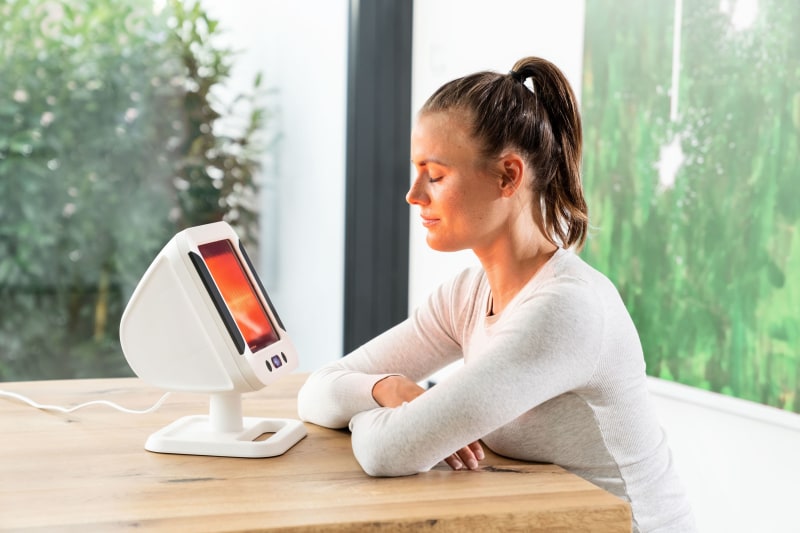
Red light or infrared: usually the same device
If you are torn between red light and infrared, you are almost always looking for the same device: a lamp with soothing infrared heat. “Red light lamp” is the common everyday term for this, but not a product name. Our classic devices are called “infrared lamp”, for example the IL 35; the larger IL 50 and IL 60 models are called “infrared heat lamp”.
On our German website, both terms are even used side by side. The IL 11 infrared lamp has a German subtitle that translates as “red light lamp with protective grille for colds & muscle tension”, and the IL 21 has one that translates as “red light lamp for soothing heat for colds & muscle tension”. The question “red light lamp or infrared lamp?” is therefore not decided by the name, but by what the device can do.
And what matters for recurring tension in the neck, shoulders and back? Above all, the area a lamp warms. The Beurer IL 60 infrared heat lamp operates at 300 watts and has a large treatment area of approx. 30–40 cm, so the heat also reaches larger areas of the body, such as the back, evenly. It also features a timer adjustable in one-minute increments with automatic switch-off and a ceramic glass screen that provides 100% UV protection.
How infrared differs from visible red light
Infrared is invisible heat radiation that comes directly after visible red light. Germany’s Federal Office for Radiation Protection (BfS) classifies it as optical radiation. Its wavelength range borders visible light and extends from 780 nanometres to 1 millimetre.A The International Commission on Non-Ionizing Radiation Protection (ICNIRP) also describes infrared as heat radiation, with wavelengths beyond visible red light.
The spectrum is divided into three ranges: IR-A from 780 to 1400 nanometres, IR-B from 1400 to 3000 nanometres and IR-C from 3000 nanometres to 1 millimetre.A Natural sources of infrared are the sun and fire, while artificial sources include infrared lamps.B
All five Beurer lamps emit infrared in the IR-A and IR-B ranges, i.e. between 780 and 3000 nm. For the IL 11, the dominant wavelength is 1100 nm, putting it in the IR-A range.
So the red glow you see is not the heat itself. With infrared sources, bright light is often present, and people naturally shy away from intense heat and glaring light.B You feel the heat from the infrared, even if you cannot see it.
The differences at a glance
The three terms differ primarily in how they are used, and only then in their design. The table shows what each one means and which Beurer lamp it applies to.
| Term | What it means | Design and features | Beurer example |
|---|---|---|---|
| Red light lamp | Everyday term for a heat lamp with infrared; not a product name | Depending on the device | IL 11 and IL 21 have the term in their subtitle |
| Infrared lamp | Product name for the classic lamps | Incandescent bulb (IL 11) or pressed-glass bulb (IL 21, IL 35); the IL 35 features a timer for 5, 10 or 15 minutes | IL 11, IL 21, IL 35 |
| Infrared heat lamp | Product name for the large models | Halogen lamp with aluminium reflector and ceramic glass screen; timer from 1 to 15 minutes, fan and UV protection | IL 50, IL 60 |
Comparing the IL 11 and the IL 60 shows how big the difference in features can be. The IL 11 operates at 100 watts, and its shade can be adjusted to five positions. It is suitable for colds, tension or muscle soreness, but does not have a timer with automatic switch-off or UV protection. The IL 60, on the other hand, comes with a timer from 1 to 15 minutes, UV protection, a fan, 300 watts and a significantly larger treatment area. You will find all models in our overview of infrared lamps and red light lamps.
How the heat of an infrared lamp works
An infrared lamp warms you by giving off heat directly to your body via infrared light. With the IL 60 infrared heat lamp, you warm specific areas of skin in a targeted way: blood flow to the skin in the treatment area increases, and the metabolic rate in the warmed area goes up.
Red light is a well-known way of using heat. Infrared heat from a lamp is used alongside hot packs, paraffin baths and hydrotherapy. Heat increases blood flow, temporarily reduces muscle spasms, and can also help with pain relief.C
What does this mean for your tense neck? The heat of an infrared lamp can, as a complementary measure, help tense muscles in the neck, shoulders or back feel more comfortable. It does not replace a medical assessment if the complaints persist, but it fits well as a calm heat ritual, for example after a long day at the desk.
What an infrared lamp is suitable for
Depending on the model, an infrared lamp is suitable as an accompanying treatment for tension, colds and other complaints. For the IL 60, these are:
- muscular tension, for example periarthropathic soft-tissue diseases such as myalgia, myogelosis, myotendopathies or fibrositis
- arthralgia in osteoarthritis
- rheumatic joint complaints, but not during inflammatory flare-ups
- ear, nose and throat conditions, for example acute rhinitis
- acne
If you have a cold, please note: red light does not fight an infection. As a supportive measure, however, the heat can relieve the feeling of pressure and tension, for example around your nose.
You can use the IL 60 not only in the colder months. It can be used all year round for muscle tension and facial care.
Where the terms blur in shops
In shops, both terms often appear right next to each other because customers search for both. At Beurer, our category is also called "Infrared lamps & red light lamps", and two of our infrared lamps have "red light lamp" in their subtitle. In all cases, it means the same thing: infrared heat.
So how can you tell which lamp is right for you? Instead of going by the name, look at the features you can read about on every product page:
- Design: Design: Design: incandescent bulb, pressed-glass bulb or halogen lamp with ceramic glass panel.
- Timer with automatic switch-off: It ends the application automatically after the set time.
- Treatment time display: This shows you how much longer the application will run.
- UV protection and ventilation: Both are on board with the infrared heat radiators IL 50 and IL 60.
- Irradiation area and tilt: For the application, the reflector should be adjustable so that the heat ideally reaches the entire desired treatment zone.
- Medical device and protective eyewear: All Beurer infrared lamps and heat radiators are certified medical devices, and every model comes with protective eyewear included.
What you should bear in mind before use
Before every application, you should know the information on distance, duration and eye protection precisely. Read the instructions for use of your device before the first application; the following notes apply to the IL 60.
Distance: as a rule, the distance to the infrared lamp depends on your individual sensitivity to heat and the treatment in question. The greater the distance, the larger the treatment area and the milder the heat. Choose a distance that ensures the heat feels pleasant on your skin at all times. If you feel tingling, itching, burning or an excessive sensation of heat, stop the treatment.
Eyes and duration: never look directly into the infrared light without protective eyewear, and do not use the device continuously for longer than 15 minutes, as it could otherwise overheat. The protective eyewear only protects against infrared radiation.
Metal: before switching on, remove metal items such as belt buckles, necklaces, bras, jewellery or piercings from the treatment area, as they can get very hot.
Who can use the device: the IL 60 is intended for use by yourself at home, and is suitable for all adults who do not have a sensory impairment and are fully conscious. If your symptoms have not eased after six to eight treatments, stop using the device and speak to a doctor.
Do not use the IL 60:
- if you have acute rheumatoid arthritis or infectious arthritis
- if you have circulatory disorders
- if you have decompensated heart failure or severe cardiac arrhythmia
- if you have had an acute or recent myocardial infarction
- if you have uncontrolled diabetes mellitus, hyperthyroidism or adrenal cortical insufficiency
- if you have infections, open wounds or severe swelling
- during radiotherapy, including for three months after the treatment
- if you have sensation disorders in the treatment area
- on people who are insensitive to heat
- if you have restricted or increased sensitivity to heat, for example due to diabetes, paraplegia, drowsiness, dementia or concentration disorders, illness-related skin changes, or scarred areas of skin in the treatment area; on children and older people; and after taking medication or drinking alcohol
- if you have an implant, especially in the area of the body to be treated; if in doubt, ask a doctor
- during pregnancy near your abdomen
The Beurer IL 60 at a glance
The infrared heat radiator IL 60 is our model for anyone who wants to warm larger areas such as the neck, shoulders or the whole back on a regular basis. With its large irradiation area, the IL 60 distributes the heat pleasantly evenly across the entire treatment zone.
- Design: halogen radiator with aluminium reflector and ceramic glass panel, 300 watts
- Timer: treatment duration individually adjustable from 1 to 15 minutes, with automatic switch-off after the set time expires and a treatment time display
- Safety: automatic safety switch-off and built-in overheating protection
- Comfort: active ventilation and a reflector that can be tilted from 0 to 40 degrees
- UV protection: The ceramic glass panel provides 100 % UV protection
- Scope of delivery: infrared heat radiator and protective eyewear
- Classification: medical device with a 3-year warranty; the infrared bulb, like all bulbs, is excluded from the warranty
After the application, the fan of the IL 60 keeps running for another 5 minutes to cool the device down. Do not unplug it during this time. Once the fan stops, unplug the device.
To the product page of the IL 60.
Frequently asked questions
What is the difference between a red light lamp and an infrared lamp?
As a rule, none: red light lamp is the everyday word, infrared lamp the product name. Both mean a heat lamp with infrared. The red glow is visible light; the heat comes from the invisible infrared. What matters for your choice are the design, timer, automatic switch-off and UV protection.
Is red light good for a cold?
The IL 60 can be used for colds and can be used alongside treatment for ear, nose and throat conditions such as acute rhinitis. Red light does not fight an infection, but the heat can relieve the feeling of pressure. Do not use the IL 60 during an infection, not even as a complementary measure.
Is red light good for bronchitis?
Whether red light is right for you if you have bronchitis is best discussed with your doctor beforehand. There, it can be assessed whether a complementary heat application makes sense in your case. The IL 60 is intended as a complementary application for ear, nose and throat conditions and muscular tension.
Do I need protective eyewear with a red light lamp?
Yes, protective eyewear belongs to every application. All Beurer infrared lamps and heat radiators come with protective eyewear included, and you should never look directly into the infrared light without it. Wear it for the entire application, even if you keep your eyes closed.

