

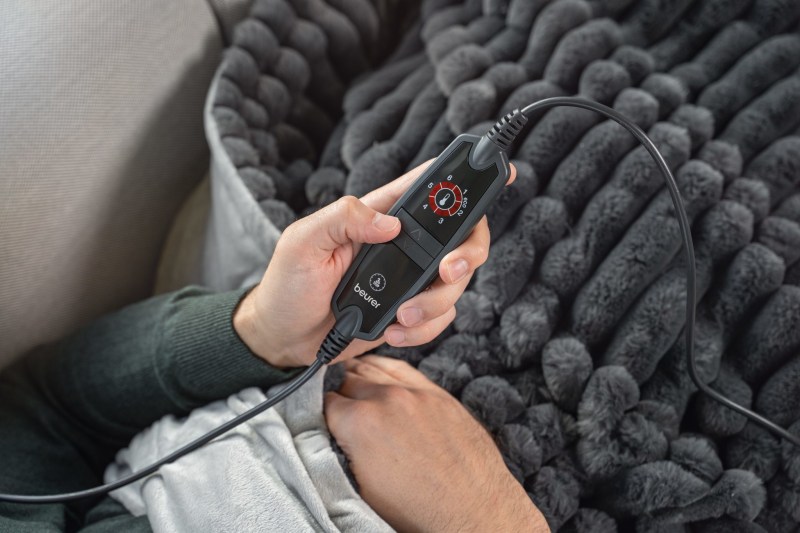
As soon as autumn arrives, many of us bring the heated blanket out onto the sofa in the evening. But how much electricity does that warmth actually use while you watch TV or read? We work through heated blankets and electricity consumption step by step for you: for an hour, an evening and a whole winter. Our example is our HD 75 heated overblanket, with 6 temperature settings and an automatic switch-off after 3 hours.
How many watts a heated blanket needs
Depending on size, a heated blanket needs 100 to 150 watts: that is the power drawn by Beurer heated blankets. For a heated overblanket for the sofa, we give an average power consumption of approx. 100 watts on the highest setting. The Beurer HD 75, for example, falls within this range.
The wattage describes the power, i.e. how much energy the blanket is drawing at that moment. Your electricity bill, on the other hand, shows kilowatt hours. These only come from combining the power with the time the blanket is running.
Why is so little power enough for cosy warmth? The trick lies in how the heated overblanket warms you. Because it lies directly against your body, it heats you rather than the whole room. Little energy is lost this way, and the warmth arrives right where you feel it on the sofa.
You can find the wattage of your own model in the data sheet on the product page. The HD 75 Cosy Taupe data sheet gives 100 watts, the HD 75 Nordic Taupe data sheet 100 to 110 watts. For our example calculation, we use a round 100 watts.
Calculating the consumption yourself: watts times hours
You work out the electricity consumption of a heated blanket with a simple formula: power in kilowatts times hours of use gives kilowatt hours. A 1-kilowatt fan heater running for a quarter of an hour therefore uses 0.25 kilowatt hours of electricity.A Multiply that by the price per kilowatt hour and you have the amount in pence.
For the HD 75 on its highest setting, the calculation looks like this:
- Divide the wattage by 1,000: 100 watts are 0.1 kilowatts.
- Multiply the result by the hours: 0.1 kilowatts times 1 hour gives 0.1 kilowatt hours.
- Multiply the kilowatt hours by the electricity price: 0.1 kilowatt hours times 26.32p gives around 2.6p.
For the electricity price, we use 26.32p per kilowatt hour. This is the electricity unit rate under the energy price cap set by Ofgem for 1 October to 31 December 2026. The figure is an average for customers paying by Direct Debit.B
The best approach is therefore to use the unit rate from your own electricity bill. That way the result matches your household exactly, and you can use the formula for any other appliance with a wattage rating too.
What an evening and a winter under a heated blanket cost
The electricity for a typical evening under the heated overblanket comes to around 2p, and for a whole heating season around 150p. The calculation is based on the usage assumptions in the carbon footprint of the HD 75. It assumes 1.933 hours per day of use, 68.72 days of use per year and an average power of 43 watts. It assumes use on setting 4 of 6, based on a small set of real usage data. Dr Hans-Ulrich Streit of the Terra Institute verified the footprint independently.
So in everyday use, the blanket rarely runs at full power. And who doesn't want to know what that means for a cosy evening in front of the TV? The table shows every figure as a calculation, always at 26.32p per kilowatt hour.
| HD 75 use | Calculation | Consumption | Cost of electricity |
|---|---|---|---|
| 1 hour on the highest setting | 100 W × 1 h ÷ 1,000 | 0.1 kWh | around 2.6p |
| Calculated maximum: 3 hours on the highest setting, until the automatic switch-off | 100 W × 3 h ÷ 1,000 | 0.3 kWh | around 7.9p |
| A typical evening | 43 W × 1.933 h ÷ 1,000 | 0.083 kWh | around 2.2p |
| A heating season of 68.72 evenings | 0.083 kWh × 68.72 | 5.7 kWh | around 150p |
The 68.72 evenings fit comfortably into one winter: in Germany, the heating season usually begins on 1 October and ends on 30 April.C In this calculation, the HD 75 therefore runs on roughly every third day of the heating season.
For comparison, a two-person household in Germany uses between 1,900 and 3,200 kilowatt hours of electricity a year on average.D The 5.7 kilowatt hours of a heating season under the HD 75 make up about 0.2 to 0.3 per cent of that.
Heated blanket, fan heater or turning up the heating
A heated blanket gets by on around a tenth of the power of a 1-kilowatt fan heater. An appliance with a higher wattage heats faster, but uses correspondingly more electricity.A The 1-kilowatt fan heater from the worked example uses 0.25 kilowatt hours in a quarter of an hour, which at 26.32p comes to around 6.6p. The HD 75 on its highest setting takes two and a half hours to draw that much electricity. That is because 0.25 kilowatt hours divided by 0.1 kilowatts equals 2.5 hours.
But a heated overblanket does not replace your heating — it complements it on the sofa. Wherever it feels comfortable, the room temperature in your living area should ideally not exceed 20 °C, and every degree less saves heating energy.E Just one degree less room temperature reduces consumption by 6 percent. However, the room temperature should not fall below 16 °C, as otherwise there is a risk of mould.F
So the two complement each other well: the heating keeps the living room at a comfortable 20 °C or one degree lower. The heated overblanket adds extra warmth to your body during an evening in front of the TV. We have collected more ideas about heating in our guide to saving on heating costs. If it is mainly your feet that get cold, our article on foot warmers and heated slippers will help.
Setting the temperature and running time economically
The temperature setting determines how much electricity the blanket actually uses. You can see this in the difference between 100 watts on the highest setting and an average of 43 watts on setting 4. On the HD 75, the settings mean the following:
- Setting 1: minimum heat
- Settings 2 to 5: individual heat setting
- Setting 6: maximum heat
The fastest way to warm up the HD 75 is to set the highest temperature setting first. Once you feel comfortably warm, you can switch to a lower setting and save electricity. If you use the blanket for several hours, we recommend the lowest temperature setting to avoid your body overheating.
The running time also has a built-in limit. The automatic switch-off of the HD 75 stops the heat supply approximately 3 hours after it is switched on, and the HD 82 works the same way. If you forget to switch it off during your evening in front of the TV, the automatic switch-off stops the heat supply approximately 3 hours after it is switched on. Even so, always switch the overblanket off yourself after use. Even in the calculated worst case of three hours on the highest level, the electricity costs come to around 7.9p. For longer use, however, we recommend the lowest temperature level.
HD 75 and HD 82: power and features
The Beurer HD 75 and the Beurer HD 82 are two heated overblankets measuring 180 x 130 cm. Both have 6 temperature settings and a 3-year guarantee. You already know the power of the HD 75 from the calculation: its data sheet gives 100 watts. The overview shows where the two models differ:
| Feature | HD 75 | HD 82 |
|---|---|---|
| Size | 180 x 130 cm | 180 x 130 cm |
| Temperature settings | 6, via the sliding switch | 6, via the LED push-button control |
| Automatic switch-off | after approx. 3 hours | after approx. 3 hours |
| Surface | soft fleece fibre, breathable | luxurious, extra-cosy outer material, breathable and skin-friendly |
| Guarantee | 3 years | 3 years |
With its cosy fibre surface, the HD 75 makes for snuggly hours on the sofa. The overblanket meets the requirements of OEKO-TEX STANDARD 100. The sensor technology of the Beurer safety system prevents the overblanket from overheating by switching it off automatically in the event of a fault.
The HD 82 is the choice for anyone who likes things really fluffy. The HD 82 is equipped with the Beurer safety system. Its sensor technology prevents the overblanket from overheating by switching it off automatically in the event of a fault. In addition, an automatic switch-off stops the heat supply approximately 3 hours after it is switched on. The HD 82 was named test winner by BILD Kaufberater, “Heizdecken im Test 2026: Testsieger & Preistipps” (01/11/2026), 1st place out of 8 heated overblankets tested. The HD 82 Helsinki/Stockholm was tested.
If the two of you like to snuggle up on the sofa together, it is worth looking at the larger models in our range of heated overblankets. For a cold bed, on the other hand, a heated underblanket is designed to lie underneath the sheet. Our guide to which heated underblanket fits your bed helps you find the right size for your mattress. What else to look out for when buying a blanket is covered in our guide to heated blankets and key buying criteria.
Would you like to get to know the heated overblanket from our calculation better? Then take a look at the Beurer HD 75.
Who must not use a heated blanket
Some people must not use the HD 75 and the HD 82. They include:
- People who are not sensitive to heat
- Other vulnerable people who may not be able to react to overheating, e.g. people with diabetes, people with skin alterations due to illness or scarred tissue in the application area, or after taking pain relief medication or alcohol
- Very young children (0 to 3 years old), as they are unable to respond to overheating
Children older than 3 and younger than 8 may only use the blanket under supervision, and the control must always be set to the minimum temperature. The electrical and magnetic fields emitted by the blanket may interfere with the function of a pacemaker, even though they are well below the limits. If you have a pacemaker, you should therefore consult your doctor and the manufacturer of your pacemaker before using the blanket.
Never use the blanket folded, rucked or wet, and do not insert pins. Before first use, read the instructions for use for the HD 75 or the instructions for use for the HD 82, which contain all the safety notes for your model.
Frequently asked questions
Does a heated blanket use a lot of electricity?
No, a heated blanket gets by on little electricity. Depending on size, Beurer heated blankets use 100 to 150 watts, whereas a fan heater like the one in our worked example runs on 1,000 watts.
How much does it cost to run a heated blanket for an hour?
On the highest setting at 100 watts, an hour's electricity comes to around 2.6p at 26.32p per kilowatt hour. On a medium setting, it is correspondingly less.
Is a heated blanket cheaper than turning up the heating?
The heated overblanket warms your body directly and uses only a few pence worth of electricity in an evening. It can help you avoid turning the living-room heating up higher than necessary, because every degree less saves heating energy.
How many watts does a heated blanket use?
Depending on size, Beurer heated blankets have a power rating of 100 to 150 watts. You will find the exact figure for your model in its data sheet; for the Beurer HD 75 Cosy Taupe it is 100 watts.

