

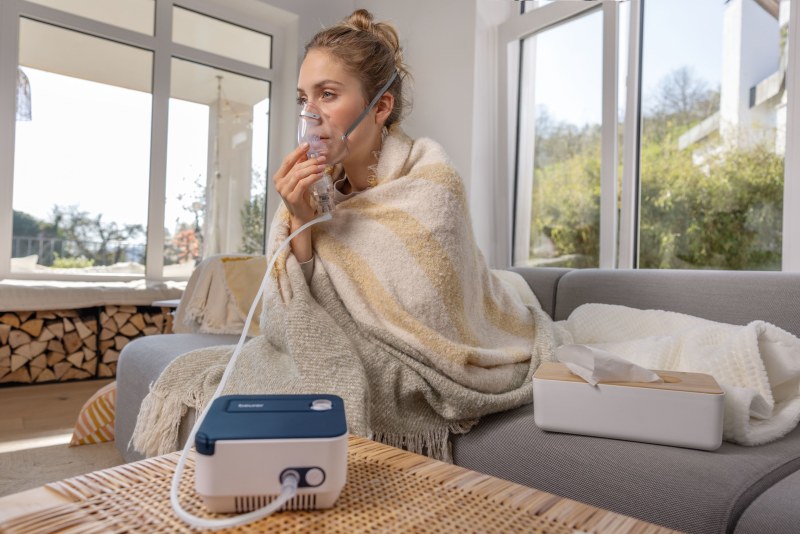
The infection has been dragging on for days, the cough has settled in, and the bowl of hot water just isn't doing it any more. That is when a device that nebulises in a targeted way, instead of simply letting steam rise, is worth it. The short answer first: to inhale saline solution, you need a nebuliser, meaning a compressor or mesh device; water vapour from a bowl contains no salt and at best works on the upper airways. This guide shows you how compressor nebulisers, mesh nebulisers and steam inhalers differ, and when the Beurer IH 57 with vibrating membrane fits your everyday life.
Inhaling means breathing in steam or a finely dispersed aerosolA, B. For colds, coughs and stubborn mucus, it is a tried-and-tested home remedy: the moist particles moisten the mucous membranes and can help to loosen thick mucusC. The route the aerosol takes decides where it arrives. That is why the first question about a device is not about the technology but about the route: mouth or nose.
For coughs and complaints in the lower airways, the mouthpiece is the first choice. Breathed in through the mouth, the aerosol reaches the bronchi, where it can soften stubborn mucus. For pressure and pain in the sinuses, the mask is the better choice: breathed in through the nose, the aerosol lands where the inflamed mucous membranes are. Which attachments come with your device and exactly how to breathe are explained in its instructions for use; read them carefully before you use the device for the first time.
- Cough and congested bronchi: use the mouthpiece and breathe in slowly through your mouth so that the aerosol reaches deep into the airways.
- Sinus pressure and a runny nose: put on the mask and keep breathing calmly through your nose.
- Sit upright and take your time: inhalation works best when you breathe in a relaxed, focused way instead of doing it in passing.
- Read the instructions for use before the first session: they tell you which attachment is intended for which use.
And grandma's bowl of hot water? Steam from a bowl does moisten the mucous membranes, but it does not carry salt into the deeper airways. For a real saline inhalation, you need a nebuliser that turns the solution into tiny droplets the breath can carry alongD. If you would like to go through the process step by step, our guide to inhaling correctly covers the basics again in detail.
Compressor, mesh and steam side by side
Three designs share the nebuliser market: the compressor nebuliser with a mains cable, the compact compressor with a rechargeable battery and the mesh nebuliser with a vibrating membrane. Alongside them is the steam vaporiser, which does not nebulise any medication at all, but heats water and releases warm steam. The table shows the differences using four specific devices.
| Device | Technology | Power supply | Particle size (MMAD) | Nebulisation performance | Noise level | Test verdict |
|---|---|---|---|---|---|---|
| Beurer IH 28 Pro | AC compressor (compressed air) | Mains cable | 3.07 µm | approx. 0.35 ml/min | nominal 52 dB(A) | |
| Beurer IH 60 | DC compressor (compressed air) | Rechargeable battery | 4.12 µm | approx. 0.25 ml/min | max. 45 dB(A) | |
| Beurer IH 57 | Vibrating membrane (mesh) | Rechargeable battery | 4.519 µm | two levels: ≥ 0.2 and ≥ 0.4 ml/min | max. 45 dB(A) | Test winner at Stiftung Warentest, "SEHR GUT" (1.5), in the test of 6 hand-held nebulisers, test issue 01/2025 |
| Beurer SI 31 | Warm water vapour | Mains connection | No aerosol | Not applicable | Pleasantly quiet |
The table is quicker to read than it sounds. The mains-powered IH 28 Pro is the device for the family and the household: powerful, with an extensive atomiser set, but tied to the socket. The IH 60 trades a little nebulisation performance for compact dimensions and battery runtime. The IH 57 nebulises via a vibrating membrane, also runs on a rechargeable battery and stays quiet while doing so. Finally, the SI 31 is not a nebuliser in the medical sense at all: it releases warm water vapour and so mainly moistens the upper airways.
What can go into the nebuliser and what cannot
With the IH 57, the liquid goes straight into the medication container: either isotonic saline solution from the pharmacy or a medication prescribed by your doctor. The mesh nebuliser nebulises medications with a viscosity of less than 3; thicker solutions do not belong in the device. Your doctor or pharmacist can tell you which medications are suitable for you.
- Suitable: isotonic saline solution and medications prescribed by a doctor.
- Not suitable: oil-based medications and essential oils. In people with oversensitive airways, they can trigger acute bronchospasm, and they attack the medication container.
- SI 31: only clear water in the container, no medications and no inhalation liquids.
The difference from the bowl is no minor detail: for a saline inhalation, compressor, mesh and ultrasonic nebulisers turn the solution into tiny droplets, so small that they travel deep into the airways with the breathD. So if you want to inhale saline solution, there is no way around a nebuliser.
The SI 31 plays in a different league, and that is intentional: the steam vaporiser is not a medical device; it uses warm water vapour to moisten the room air, the skin and the upper airways. It is designed as a soothing companion during the cold season, not as a replacement for nebulising saline solution or medication.
Particle size, noise level and inhalation time
Particle size sounds like a lab value, but in practice it decides where the aerosol arrives. The finer the droplets, the deeper they can travel into the airways. The basic rule: the inhalation device is chosen so that the active ingredient reaches the site of the inflammationE. To treat the lower airways, you therefore need a device that reliably produces fine particles, such as a compressor or mesh nebuliser.
The Beurer IH 57 does part of the work for you: its intelligent aerosol technology stops nebulisation while you breathe out, so less aerosol escapes unused into the room. After a total nebulisation time of 15 minutes, the device switches off by itself. At a maximum of 45 dB(A), it stays quiet; for comparison, the mains-powered IH 28 Pro is rated at a nominal 52 dB(A). Both values are quiet enough for use in the evening, for example while watching a film on the sofa.
The SI 31 works on a different timescale: the device is ready to use in 3 to 5 minutes, and a session lasts 5 to 15 minutes. The steam leaves the attachment at around 43 °C; keep your face at a distance from the inhalation attachment, because hot steam can cause burns.
Mains, rechargeable or battery power on the go
The power supply sounds like a side note, but it decides where you can inhale. The Beurer IH 28 Pro runs on a mains cable: the classic household device for a fixed spot. If you want to take the device with you, for example on a business trip or on holiday, go for a model with a rechargeable battery.
- Beurer IH 60: small, light and quiet, with a rechargeable battery and expressly designed for travel; it treats the upper and lower airways.
- Not for continuous use: after 30 minutes of operation, the device must be switched off for 30 minutes.
- IH 57: runs on a rechargeable lithium-ion battery, so it also works without a socket.
- IH 28 Pro: mains-powered, but with high nebulisation performance and an extensive atomiser set.
For everyday use at home, the question hardly matters: the socket is never far away. But as soon as half-days out of the house, the workplace or a train journey come into play, the battery becomes the deciding factor. Then the question of mains or battery is settled faster than any technical detail.
Where a nebuliser is no substitute for your doctor
Using the IH 57 does not replace a medical consultation or treatment. That is not there as a formality, but because the therapy comes before the device: what you inhale, how often and for how long is something to discuss with your doctor beforehand. Not every medication is available for every inhalation systemF.
The choice of inhalation system depends on the active ingredient, on the devices available for it and on how safely you can use the systemG.
And the steam vaporiser? The SI 31 is not a medical device. It uses warm water vapour to moisten the upper airways and the room air. If symptoms persist for a long time, do not improve or even get worse, they need medical treatmentH.
Which Beurer device suits which routine
Three routines, three answers. If you are looking for a device for the whole family that stays in one place and comes with an extensive atomiser set, the mains-powered Beurer IH 28 Pro is a good choice. If you are often on the move and want a light device for your bag, take a look at the Beurer IH 60. And if you are looking for warm steam as a soothing companion during the cold season, without nebulising medication, the Beurer SI 31 is the right choice.
For regular inhalation of saline solution or prescribed medication, at home and on the go, we recommend the Beurer IH 57. It nebulises via a vibrating membrane, treats the upper and lower airways, runs on a rechargeable battery and cleans itself after use. Its quality assessment speaks for itself: the Beurer IH 57 is the test winner at Stiftung Warentest with the grade "SEHR GUT" (1.5) in the test of 6 hand-held nebulisers, test issue 01/2025.
- Family and household device on mains power: Beurer IH 28 Pro with AC compressor and an extensive atomiser set.
- Travel companion with rechargeable battery: Beurer IH 60, small, light and quiet.
- Regular nebulisation of saline solution or medication: Beurer IH 57 with vibrating membrane, rechargeable battery and self-cleaning function.
- Soothing warm steam for the upper airways: Beurer SI 31, without nebulising medication.
If you would like a closer look at the Beurer IH 57, its product page has all the technical specifications, the accessories and the usage notes. For an overview of the whole range, from compressor to steam vaporiser, see the Beurer nebulisers category. And once you have made your choice: view the Beurer IH 57.
Frequently asked questions
Is a nebuliser better than an inhaler?
A nebuliser is a special type of inhaler that turns liquids into a fine aerosol. For inhaling saline solution or medication when a cough sits deep in the chest, an electric nebuliser such as the Beurer IH 57 is better suited than a simple steam inhaler.
Which is better, a compressor or an ultrasonic nebuliser?
Compressor nebulisers offer very reliable performance for the whole family. Ultrasonic devices are quieter but have largely been replaced by modern mesh technology (vibrating membrane). The Beurer IH 57 with mesh technology combines very quiet nebulisation with high efficiency.
What is the best steam inhaler?
A good steam inhaler produces pleasantly warm water vapour safely and consistently. The Beurer SI 31 moistens the upper airways with warm water vapour during the cold season and works whisper-quietly; 2 cm above the inhalation attachment, the steam is approx. 43 °C, so keep your face at a distance from the attachment.
What device do I need to inhale saline solution?
To carry isotonic saline solution effectively deep into the airways, you need a jet nebuliser (compressor) or a mesh nebuliser. Ordinary steam inhalers only evaporate the water, while the salt stays in the container.
Which rechargeable nebuliser is suitable for travel?
A rechargeable nebuliser should be light, compact and leak-proof. The Beurer IH 57 (mesh) and the Beurer IH 60 (compressor) both run on a rechargeable battery; the IH 60 is small, light and expressly designed for travel.


