

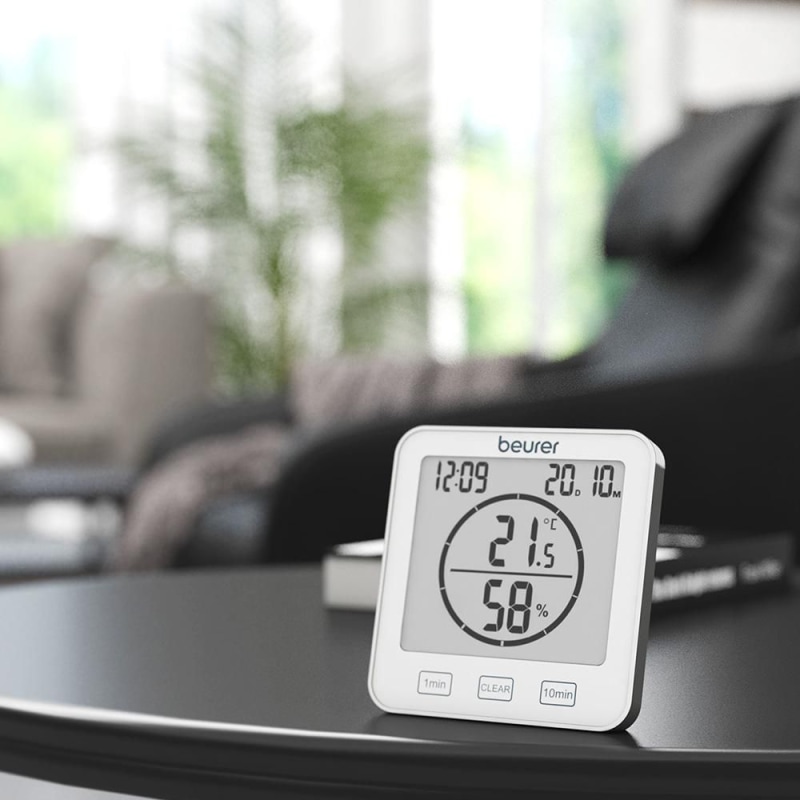
In the morning the windows are steamed up, the bathroom smells musty and the washing is drying in the living room. By then at the latest, you will be asking yourself what humidity level is actually normal and whether your own reading is still fine. A comfortable indoor climate comes with a temperature of around 18 to 22 degrees and a relative humidity of 40 to 60 per cent.A But which value applies in your case depends on the room, the season and the insulation of your home. We show you how to interpret your readings and how to keep an eye on them with the Beurer thermo hygrometer HM 22.
Which values are normal in living spaces
Normal humidity in living spaces means a relative humidity of between 40 and 60 per cent.B Below 30 per cent the air is so dry that it can irritate the mucous membranes, although mould does not form at that level.A
The upper end is where it becomes critical. If the relative humidity stays above 60 per cent for several days, this can encourage mould growth. The exact value depends on the type of building and its insulation standard.C
A stricter limit applies to older homes in winter. In homes with little or no insulation, humidity should normally stay below 50 per cent during the heating season.D If your home is poorly insulated, it is therefore better to read the 40 to 60 per cent range from the lower end.
| Reading (relative humidity) | What it means |
|---|---|
| below 30 % | very dry, can irritate the mucous membranesA |
| 40 to 60 % | normalB |
| above 60 % for days | too humid, mould is encouragCed |
| above 65 to 70 % in the long term | too high for living spacesE |
Why the range between 40 and 60 per cent matters
To read the range between 40 and 60 per cent correctly, you need to know the temperature. At 0 degrees, one cubic metre of air can hold a maximum of just under five grams of water, whereas at 20 degrees it can hold a good 17 grams. Relative humidity shows what percentage of this maximum the air currently contains.F
An example shows how strong this effect is. If you let in cold outdoor air at 0 degrees with 90 per cent relative humidity while airing, it warms up to 20 degrees indoors. Its relative humidity then drops to only around 30 per cent.A This is why briefly airing your home in winter lowers the humidity so reliably.
The opposite is also true: the same amount of water vapour gives a higher percentage in a cool room. Cooler indoor air therefore increases the risk of the relative humidity rising and moisture settling on cool surfaces.C A bedroom that is hardly heated will quickly show higher readings than the warm living room next door.
There is a reason for both ends of the range. Below 35 per cent, air that is too dry can irritate the airways, and above 65 per cent the moisture encourages mould growth.B Between 40 and 60 per cent you stay clear of both limits, and that is the real advantage of this range.
How to interpret the values in each room
The values differ from room to room because each room produces a different amount of moisture. In the living room, the general range of 40 to 60 per cent applies. For the bedroom, 45 to 55 per cent is considered the optimal range, and values above 60 per cent encourage mould growth there.G
Bedroom
In the bedroom, humidity rises by itself at night, because a person releases up to half a litre of water per night. You should therefore air the bedroom thoroughly as soon as you get up and heat it to at least 16 to 18 degrees during the day.A
Bathroom and kitchen
In the bathroom and kitchen, humidity shoots up for a short time when you shower or cook. A brief peak is normal here. What matters is how quickly it falls again. You should open the windows wide immediately after a bath, shower or cooking to let the moist air escape.H In the bathroom in particular, it makes sense to make the humidity visible with a hygrometer and to air the room accordingly.I
Room temperature
Humidity and temperature always go together. The recommendation is not to let the temperature in your home drop below 19 to 20 degrees during the day, while 18 degrees is enough at night.C
| Room | Normal humidity | What to look out for |
|---|---|---|
| Living room | 40 to 60 % | heat evenly, air regularly |
| Bedroom | 45 to 55 % | air in the morning, at least 16 to 18 degrees during the day |
| Bathroom | briefly higher after a shower | open the window wide straight away, then check again |
| Kitchen | briefly higher when cooking | air during and after cooking |
Why a single reading tells you little
A single reading tells you little because the humidity in a room is not the same everywhere. If the relative humidity in the middle of the room is 50 per cent, it can still be too high on cold surfaces such as uninsulated outside walls or at thermal bridges. From around 70 to 80 per cent directly in front of a wall, mould can grow there without the wall feeling damp or any condensation being visible.A
How the building is constructed also matters. In a well-insulated building, a value of around 60 per cent may cause no problems for a while. With poor insulation, even 40 per cent can be too much at thermal bridges and in room corners on cold days.A
Mould only grows when the humidity stays too high for days and weeks.C That is why the trend tells you more than a single figure, and we recommend taking readings on several days in a row.
How to measure correctly with the Beurer HM 22
With the Beurer HM 22, it can take 10 minutes after switching on before the temperature and humidity are displayed correctly. After it has been moved to another room, it also needs 10 minutes to give reliable readings. It is best not to place the HM 22 in direct sunlight or too close to heat sources such as stoves or radiators. You should also protect it from splashing water and sharp changes in temperature. Between 40 and 80 per cent, the HM 22 measures humidity to an accuracy of ± 5 per cent relative humidity, and below and above that range to ± 8 per cent.
If a room has a cold outside wall, a second measuring point near the wall is worthwhile. It shows whether the difference from the middle of the room is large, so you can air or heat the room more precisely.
At what reading you should take action
You should take action if the humidity stays above 60 per cent for a longer period. In poorly insulated homes, this already applies from 50 per cent during the heating season. At the latest when the windows steam up on the inside, you should act. In all rooms, you should air the room more often once relative humidity rises above 60 per cent at the latest.I
In the long term, your hygrometer should not show more than 65 to 70 per cent. If you measure more than 80 per cent directly at the wall, an immediate step is to air the room briefly and thoroughly several times a day.E In addition, the room temperature should be set so that the humidity on the ceiling and walls does not rise above 80 per cent, and 16 degrees is usually enough for this.J
What helps if airing and heating alone are not enough? We show you how to lower humidity for good in our guide to reducing humidity. Which dehumidifier suits your room is explained in our article on dehumidifiers for basements and bedrooms. If the air is persistently too dry instead, our overview of humidifiers will help.
If you already find mould on the window, in the bathroom or under the wallpaper, it is better to have it removed by professionals. The cause then also needs to be identified and fixed.K
Keeping an eye on humidity with the Beurer HM 22
With the Beurer HM 22, you can keep an eye on the humidity. There is no more need to guess. The thermo hygrometer shows you temperature, relative humidity, date and time on a large, easy-to-read display. Thanks to its fold-out stand and the wall fastening on the back, it fits on the coffee table just as well as on the wall in the hallway. In the kitchen, the timer function with acoustic signal is handy, and you can set it for up to 99 minutes.
The HM 22 measures humidity from 20 to 95 per cent and temperature from minus 10 to 50 degrees. We give a 3-year guarantee on the device. In the test “Hygrometer-Test: Auf diese Modelle können Sie sich verlassen” by stern Kaufkosmos (24.03.2026), it came 2nd out of 5 hygrometersL tested. The test describes the HM 22 as follows (translated from German): “Narrowly beaten, but also reliable and recommendable without reservation is the Beurer HM 22, which has a timer on board as a small extra (for example for the kitchen).”
Would you rather assess your readings at a glance? Then the Beurer HM 16 is a good choice for you. It rates temperature and humidity with a smiley display and shows you the maximum and minimum of both values. This also lets you see how high the humidity rose during the night.
If you want to compare several rooms, one device per room helps, because you can then see the differences between the bathroom, bedroom and living room directly. You will find all models among our hygrometers, and further devices for a good indoor climate in our air quality range. We have summed up how accurately different devices measure in our hygrometer test.
Would you like to know whether your home is in the normal range? Then it is best to start in the rooms that concern you. The Beurer HM 22 is an easy-to-use companion for the living room, bedroom and kitchen.
Frequently asked questions
What is a normal humidity level?
In living spaces, a relative humidity of 40 to 60 per cent is normal, at room temperatures of around 18 to 22 degrees. In the bedroom, the optimal range is 45 to 55 per cent. In poorly insulated homes, the value should stay below 50 per cent in winter.
Is 70% humidity high?
Yes, 70 per cent humidity is high for living spaces. In the long term, your hygrometer should not show more than 65 to 70 per cent, and even above 60 per cent over several days, mould is encouraged. You should then air your home briefly and thoroughly more often and check that the rooms are heated enough.
What humidity level is best for asthma?
With asthma too, a relative humidity of 40 to 60 per cent in your rooms makes sense. Air that is too dry, below 35 per cent, can irritate the airways, while air that is too humid, above 65 per cent, encourages mould. How best to manage your indoor climate with asthma is something to discuss with your doctor.
Sources
- verbraucherzentrale.de
- daab.de
- umweltbundesamt.de
- umweltbundesamt.de
- umweltbundesamt.de
- Understanding humidity - Met Office
- daab.de
- Damp and mould – West Yorkshire Healthier Together (NHS)
- A Brief Guide to Mold, Moisture and Your Home – US EPA
- co2online.de
- Understanding and addressing the health risks of damp and mould in the home – UKHSA / GOV.UK
- stern.de

