

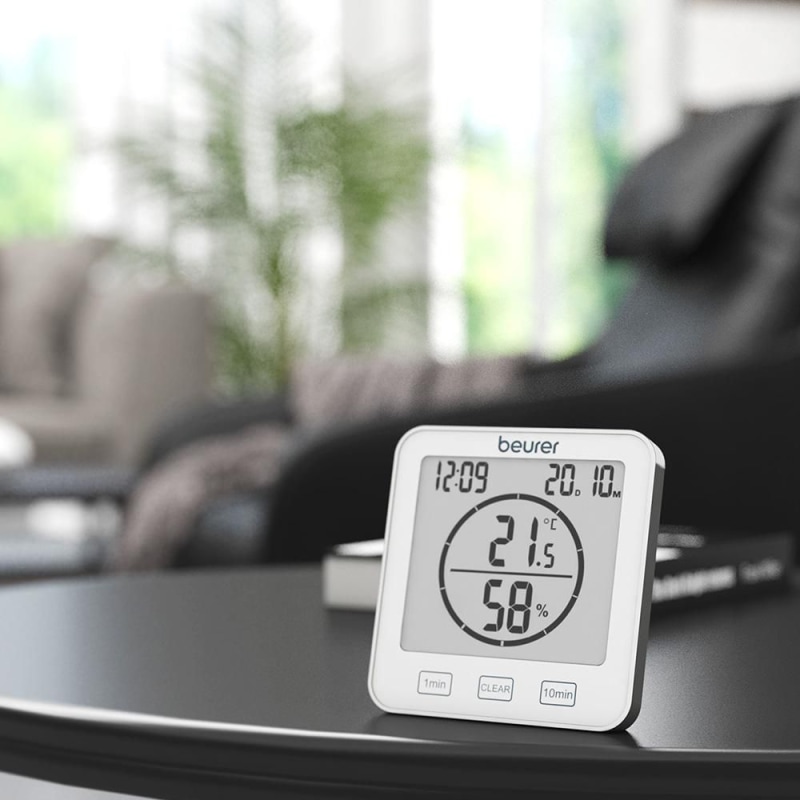
The window is steamed up in the morning, the corner behind the wardrobe smells musty, and you wonder how humid the air in your home really is. A thermo-hygrometer gives you the answer in numbers. But the reading depends on where the device is placed. We show you which hygrometer location gives reliable readings, how long our Beurer HM 22 needs after being moved and how to interpret the reading afterwards.
Where a hygrometer is best placed in your home
A hygrometer works well in a spot a little away from the exterior walls. It should not stand or hang too close to a window, a radiator or a ventilation system.A A shelf on an interior wall, a chest of drawers in the room or the coffee table are therefore good places for a reading that applies to the whole room.
Our Beurer HM 22 always shows you the current room temperature and humidity. Thanks to its handy size, it is suitable for many living spaces, such as the living room, bedroom, kitchen or office. With the fold-out table stand and the wall mount on the back, you can place it discreetly and flexibly. That way you can find a spot almost anywhere that meets the rules for a good location.
Why the location changes the reading
A hygrometer measures the relative humidity exactly where it stands. How much water vapour is really in the air can only be worked out together with the temperature. That is why a thermo-hygrometer always shows both values.
The temperature in a room is not the same everywhere. If the relative humidity in the middle of the room is 50 percent, it can still be too high at cold surfaces such as uninsulated exterior walls or thermal bridges. How strongly the temperature shifts the value is shown by a winter example. Cold outdoor air at 0 degrees with 90 percent relative humidity has only about 25 percent left after being warmed to 20 degrees in the room.B
In practice, a device placed directly on the cold exterior wall shows a different reading from one in the middle of the room. Both readings are correct; they simply describe different spots. For an overview of the whole room, a spot a little away from the wall is the better choice.
Which spots distort the measurement
Some spots give the device a false picture of the room because heat, cold or moisture from outside reaches the sensor there. That is why you should protect the Beurer HM 22 from these influences:
- direct sunlight, for example on a windowsill
- heat sources that are too close, such as stoves or radiators
- strong temperature fluctuations
- splashing water, for example right next to the washbasin
- knocks, dust and chemicals
Never use the HM 22 underneath a cover such as a blanket or pillow, and never outdoors. The same protection advice on sunlight, temperature fluctuations and heat sources that are too close applies to the HM 16, as set out in the HM 16 instructions for use.
A typical mistake is placing it on a radiator or right next to one. The warm air makes the relative humidity there seem lower than in the rest of the room. By the window the opposite often happens, because the glass cools the air.
Which rooms are worth measuring
You get the most out of measuring where the risk of mould is greatest. Bedrooms are often the coldest rooms in the home. If the doors are left open, moisture from the other rooms drifts in and settles on the cool walls.A Condensation, and later mould, tends to appear where the air barely moves: in corners, on north-facing walls near windows and behind wardrobes and cupboards.C
In the cellar, you can mount the hygrometer at floor level in a corner, because moist air collects there in particular. In the living spaces, by contrast, it is best placed a little away from the exterior walls.A
You can keep an eye on the kitchen and bathroom too. The HM 22 is also designed for the kitchen and has a timer function for short measurements. In the bathroom, choose a spot that splashing water cannot reach. Which values are normal in which room is explained in our guide to normal humidity levels for every room.
Standing or hanging: Beurer HM 22 and HM 16
Whether you stand your hygrometer up or hang it depends on the room. On a chest of drawers or a shelf, the fold-out table stand is enough. If there is no free surface away from the window and radiator, hang it on an interior wall.
Our thermo-hygrometers give you both options:
| Beurer HM 22 | Beurer HM 16 | |
|---|---|---|
| Standing | fold-out table stand | fold-out table stand |
| Hanging | wall-mounting fixture on the back | hook for wall fastening |
| Readings shown | temperature, relative humidity, date, time | temperature, humidity, smiley indicator, maximum and minimum |
| Display | 8.2 x 7.2 cm | 7.5 x 5.4 cm |
| Extra | timer up to 99 minutes | maximum and minimum display |
The HM 22 has a large, easy-to-read display and measures temperatures from -10 to 50 °C and humidity from 20 to 95 per cent. In the stern Kaufkosmos test “Hygrometer-Test: Auf diese Modelle können Sie sich verlassen” (24.03.2026), the HM 22 came 2nd out of 5 hygrometers tested.D
The HM 16 additionally gives you quick orientation on the indoor climate with a smiley. You can find the exact ranges for this in the instructions for use. This way you can see at a glance how much the values fluctuated over the day. You can find all models among our Thermo-Hygrometers from Beurer.
Give it time to settle after moving it
After a change of location, a hygrometer needs a little time for its sensor to adjust to the new surroundings. With the Beurer HM 22, this takes 10 minutes. After initial use, too, it may take up to 10 minutes until the HM 22 shows the correct temperature and humidity. In a changing environment, the HM 16 needs 15 minutes.
Want to check several rooms with a single device? Then you should wait for the adjustment time after each move and only take the reading afterwards. That way you compare reliable readings rather than in-between values. It is best to note down each room’s reading together with the time. Once you have found the right spot, you should read the hygrometer daily to see how the indoor climate changes.A
Why two hygrometers show different readings
You have two devices at home and they don’t show the same reading? There are usually three reasons for this. First, they are in different places, and even being close to an exterior wall or radiator changes the reading. Second, the device may not have finished adjusting after being moved. Third, every device has a measuring tolerance: the HM 22 and HM 16 each measure humidity between 40 and 80 per cent to within ± 5 per cent. So two devices can differ by a few percentage points.
For a fair comparison, you should place both devices side by side, for example the HM 22 and the HM 16 on the same shelf. Wait for the adjustment time of both devices, then read both displays. If the difference is within the tolerance, it is normal and not a sign of a faulty device. How accurately hygrometers measure and what the tolerance means is explained in detail in our hygrometer test guide.
How to interpret your reading
Once the hygrometer is in the right place, the most important question follows: is your reading okay? A comfortable indoor climate is around 18 to 22 degrees Celsius with a relative humidity of 40 to 60 per cent. If the humidity is regularly above 50 per cent in winter, the risk of mould rises. If the reading stays above 50 per cent for a longer time, you should ventilate, at the latest when the windows steam up on the inside. In poorly insulated buildings, even 40 per cent can be too much at thermal bridges and in room corners on cold days.B
We also recommend a range of 40 to 60 per cent relative humidity indoors. Within this range, the risk of mould stays low, and even a simple hygrometer helps you keep track of it.E Over time, the hygrometer should not show more than 65 to 70 per cent. If you measure more than 80 per cent directly at the wall, you should air the room briefly with the windows wide open several times a day as an immediate measure.F
Tracking humidity with a hygrometer is also a recommended way to spot damp problems early.E If you still see condensation regularly, our tips on preventing condensation on windows will help. If you have already spotted patches, first read our guide on whether you can remove mould in your home yourself.
With the right spot and a little patience after moving it, your thermo-hygrometer shows you every day how the air in your home is doing. Our HM 22 supports you with a large display, date, time and timer. View the Beurer HM 22
Frequently asked questions
Where is the best place to put a hygrometer?
Ideally somewhere a little away from the exterior walls, for example on a shelf on an interior wall or on a chest of drawers in the room. Windows, radiators and ventilation systems should not be too close.
Where should I hang a hygrometer so that it reads accurately?
On an interior wall, a little away from exterior walls, windows and radiators, and out of direct sunlight. In the cellar, a corner at floor level is a good spot because moist air collects there.
How long does a hygrometer need after being moved?
The Beurer HM 22 needs 10 minutes after a change of location before it shows reliable readings. The Beurer HM 16 needs 15 minutes. Only take a reading after that.
Can I put a hygrometer in the kitchen?
Yes, the Beurer HM 22 is also designed for the kitchen and has a timer function for short measurements. Just don’t place it right next to the hob or in direct sunlight.
Why do my two hygrometers show different readings?
Usually they are in different spots, the adjustment time has not yet passed, or the measuring tolerance of the devices plays a part. Place both side by side and compare them after the adjustment time.


