

The window is misted up in the morning, and the corner behind the bed smells a little musty. You may know this, especially in the heating season. A person gives off up to half a litre of water per night.A But where does that moisture go when the window stays shut?
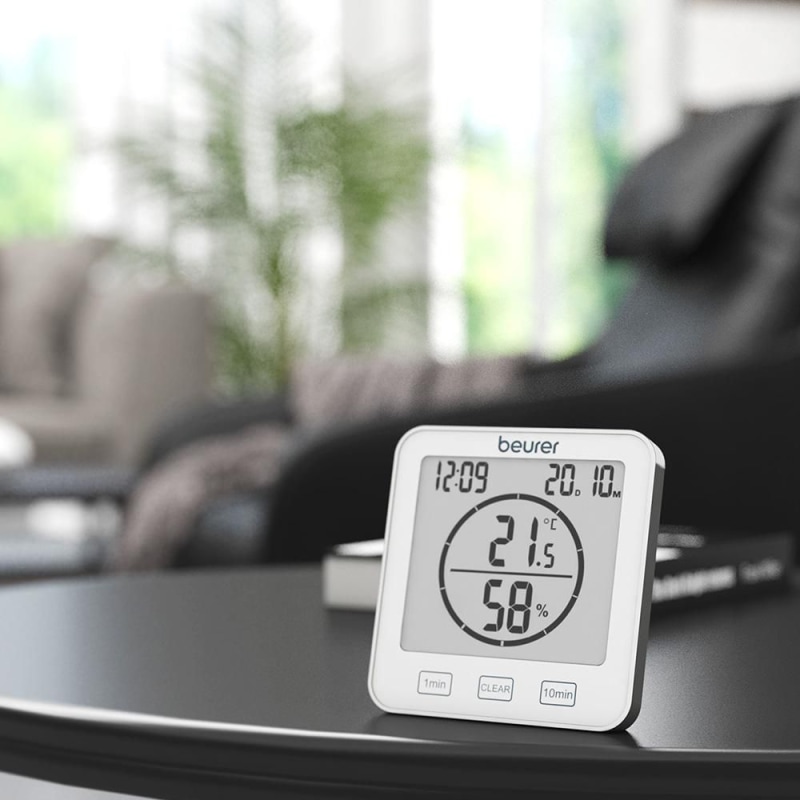
For the bedroom, a humidity range of 45 to 55% is considered ideal. Here you can find out how to measure the level, how to air the room properly and when you need more than ventilation. Our HM 22 thermo hygrometer always shows you the current room temperature and humidity, plus the date and time, on an easy-to-read display.
Which range is right for the bedroom
In the bedroom, the recommended range is 45 to 55% relative humidity. Above 60%, the risk of mould growth rises, so indoor humidity should stay below that level.B
For the home as a whole, experts give a slightly wider range. A comfortable indoor climate comes with around 18 to 22 °C and a relative humidity of 40 to 60%.A The bedroom sits in the middle of this range, because it is cooler and a lot of moisture is added overnight.
There is a lower limit too. If the air is too dry, meaning below 35%, it can irritate the airways.C Below 30%, mould does not grow, but the dry air can irritate the mucous membranes.A How to deal with dry air is something we cover in our guide What helps against air that is too dry in your home?
| Relative humidity | What the level means in the bedroom |
|---|---|
| below 35% | air that is too dry and can irritate the airways |
| 40 to 60% | general comfort range in the home |
| 45 to 55% | recommended range for the bedroom |
| above 60% | encourages mould growth |
What the right level means for your sleep
A particularly large amount of water vapour builds up in the bedroom overnight, because we sweat and breathe while we sleep.D The air in the room takes up this moisture, and the reading on the hygrometer rises until morning.
Temperature plays a part too. Warm air can hold more moisture than cold air. In turn, colder room air raises the risk of higher relative humidity.D A cool bedroom therefore reaches high levels faster than a warm living room.
For good sleep, you should make sure the bedroom stays between 16 and 18 °C. The room should also be well ventilated and dark while you sleep.E Even so, the bedroom should not get completely cold. We recommend airing it thoroughly after you get up and heating it to at least 16 to 18 °C during the day as well.A
Measure, ventilate and adjust
Measuring the level
Without measuring, humidity is just a guess. That is why you should check the relative humidity regularly, ideally with a hygrometer.B One look in the evening and one in the morning show you how much the level rises overnight.
After you switch on the Beurer HM 22, it takes up to 10 minutes before temperature and humidity are displayed correctly. After a change of location, the HM 22 also needs 10 minutes to give reliable readings. It is best not to place it in direct sunlight or too close to heat sources such as a radiator, because strong temperature fluctuations also distort the reading.
Ventilating properly
The best time to air your bedroom is before you go to bed and after you get up in the morning, with the window wide open for a short, thorough airing. In the morning, 5 to 10 minutes is enough. The air exchange is even greater if you open windows on opposite sides at the same time to create a through-draught. A window left on tilt all the time, on the other hand, is not a good solution. The wall along the window can cool down quickly, and condensation can form on the cold surface, which encourages mould.F You can read more about this in our guide How can you prevent condensation on windows?
Yet with the first airing, not all of the night's moisture is gone. Sometimes opening the window several times is not enough to get rid of the moisture stored in duvets or in the surfaces of walls and furniture. A ventilation system can handle this even air exchange. If you don't have one, it helps to air out vigorously several times a day.A
If your hygrometer shows more than 60%, that is the point at which you should air the room more often.D Where possible, you should not dry laundry indoors at all, and that includes overnight in the bedroom.F
Doors and furniture
The door to a cooler bedroom should always stay closed. Otherwise warmer, and therefore more humid, air from other rooms condenses on the cool surfaces. Outside walls, room corners and the areas behind and under the bed are often affected.F If your home is poorly insulated, you should move the bed and solid furniture a few centimetres away from the outside wall in winter.D
When airing is not enough
If the level stays too high despite airing, a dehumidifier helps you bring it down. The automatic mode of our LE 250 air dehumidifier regulates the humidity to 45 to 55%, exactly the bedroom range. In night mode, the LE 250 switches off all LEDs and button tones so that your sleep is not disturbed. Whether a device is worthwhile for your bedroom is something we look at in Is a dehumidifier in the bedroom really useful?
Keeping the level steady through the seasons
Humidity in the bedroom changes with the seasons, and so does the right way to air it. If you adapt your routine, you can keep it in the target range all year round.
Autumn and winter
In the cold season, depending on temperature and wind, it is enough to air out 2 to 3 times a day for about 5 minutes per room.F During the heating season, it makes sense to stay toward the lower part of the target range. With cold exterior walls, the risk of mould otherwise rises already above 50 percent.A
At the same time, heating dries out the indoor air in winter.C So both can happen in the bedroom: fairly dry air during the day and a high reading in the morning after the night. A regular look at the hygrometer shows you exactly that.
For temperature, there is a clear guide in winter. During the day, the temperature in your home should not drop below 19 to 20 °C; at night, you can turn it down to 18 °C.D
Spring and summer
In the warm season, you air the room a little longer, 10 to 20 minutes each time depending on temperature and wind. The reason is that air is exchanged more slowly when the temperature outside and inside is roughly the same.F
When damp is a building problem
Sometimes good airing alone is not enough. Even if the relative humidity in the middle of a room is 50%, it can still be too high on cold surfaces such as uninsulated outside walls or at thermal bridges. How low the level should be depends on the condition of the building and the outdoor temperature. With poor insulation, even 40% can be too much at thermal bridges and in room corners on cold days.A
Values above 60 percent should only occur briefly, for example after showering or cooking. A persistent 65 to 70 percent or more is a clear warning signal.G If the relative humidity stays above 60 percent for days and weeks, this can promote the growth of mould within just a few days. The exact value can vary depending on the building type and insulation standard.D
How can you tell that the cause lies in the building? These are typical signs:
- The reading in the room is fine, yet moisture still forms on an exterior wall or in a corner.
- Dark patches appear behind the bed or behind a piece of furniture.
In that last case, you should air the room briefly and thoroughly several times a day as an immediate measure. If you do find mould, it is better to have it removed by professionals, and the cause needs to be fixed too.H What you can do yourself on small areas is explained in Can you remove mould in your home yourself?
The Beurer HM 22 in the bedroom
With our HM 22, you always have the current room temperature and humidity in view. The thermo hygrometer also shows the date and time on an easy-to-read 8.2 x 7.2 cm display. With its fold-out stand, the HM 22 sits on your bedside table, and with the hook on the back it hangs on the wall.
The HM 22 measures humidity in a range of 20 to 95%. Between 40 and 80%, its measurement accuracy is ± 5% relative humidity, which is exactly the range that matters in the bedroom. As an extra, the HM 22 has a timer function for short-term measurements that you can set for up to 99 minutes. We give a 3-year guarantee on the HM 22.
The HM 22 also did well in testing. In the German stern Kaufkosmos test "Hygrometer-Test: Auf diese Modelle können Sie sich verlassen" (24 March 2026), the Beurer HM 22 came 2nd out of 5 devices tested. The verdict, in translation: "Narrowly beaten, but also reliable and recommendable without reservation is the Beurer HM 22, which also has a timer on board as a small extra (for the kitchen, for example)." How different devices compare is shown in our guide Hygrometers put to the test: which one measures accurately?
Would you like to know whether your bedroom is in the target range and check the level morning and evening? Then take a look at our HM 22 thermo hygrometer. You will find more models among our hygrometers and in our air quality range.
Frequently asked questions
Is a humidity level of 70% in the bedroom too high?
Yes, 70 percent is too high for a bedroom. The recommended range is 45 to 55 percent, and values above 60 percent promote mould growth. If you measure 70 percent in the morning, you should air out vigorously right away. If the value stays high for days, it is worth taking a closer look at ventilation, temperature and cold wall surfaces.
How do I get the humidity down in my bedroom?
The quickest way to lower the humidity in your bedroom is to air out vigorously with the window wide open, in the evening and right after getting up. Keep the door to other, warmer rooms closed and heat the room to at least 16 to 18 degrees during the day. If that is not enough, a dehumidifier can help bring the level down further.
Can mould develop at 40% humidity?
In a well-insulated room, this is unlikely at 40 percent. With poor insulation, however, even 40 percent can be too much on cold days at thermal bridges and in room corners. The moisture directly on wall surfaces cannot be measured reliably with a room hygrometer. If you suspect moisture in the wall, it is best to have it professionally assessed.


