

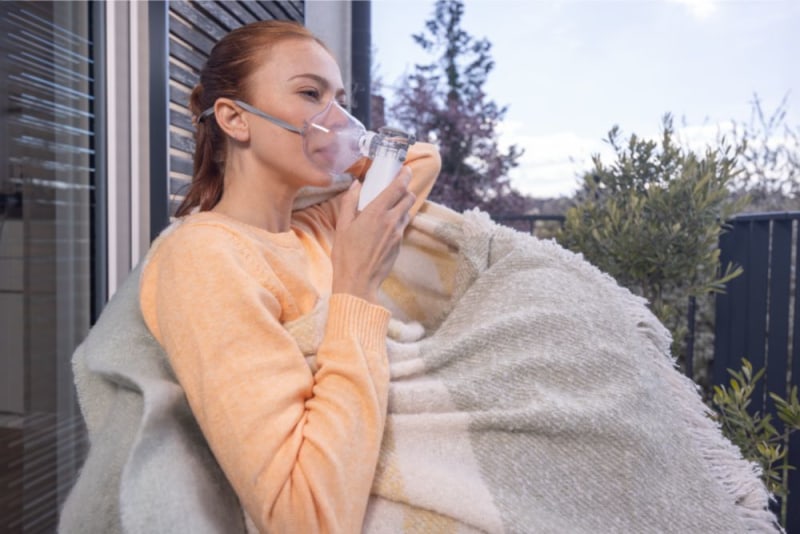
First your throat feels scratchy, then the cough sets in, and suddenly it drags on for days. That is often exactly how bronchitis starts, right in the middle of cold season. But how long should you expect the cough to last, and what can you do about it yourself? Here we explain how acute bronchitis runs its course, what can ease the symptoms and when it is better to get medical advice.
How long acute bronchitis lasts
How long does bronchitis last? Uncomplicated bronchitis usually clears up within about one to two weeks with no lasting effects. If the cough stays dry, without phlegm, acute bronchitis is usually over after just 8 to 10 days.A
The individual symptoms do not all go away at the same pace. Cold symptoms such as a runny nose or fever usually improve noticeably within a few days. It can take several weeks, though, for the cough to clear up.B After the inflammation, the bronchi simply need some time to recover.
In 90 per cent of cases, acute bronchitis is caused by viruses.C It is the lower airways that become inflamed.B That is why the illness often comes together with a cold or shortly after one.
There is quite a lot you can do during this time to make the weeks of coughing more comfortable. Above all, that means inhaling saline solution. Our quiet mesh nebuliser, the Beurer IH 57, makes this easy at home because it is handy and quiet.
How to recognise bronchitis
Bronchitis shows itself mainly through the cough. It usually starts as a dry, tickly cough and later often turns into a chesty cough as mucus loosens from the airways. The colour of the phlegm can change over the course of the illness, for example from whitish to yellowish-green.
The cough often troubles you particularly at night and keeps you awake. Severe coughing can cause pain behind the breastbone. If the bronchitis comes together with a cold, it is often accompanied by a mild fever, a runny nose, a sore throat and hoarseness.D
Why do you cough so much in the first place? The viruses damage the cells of the bronchial lining and also paralyse its tiny hairs, the cilia. The cilia can then move mucus and germs out of the bronchi only slowly or not at all, while more mucus is produced at the same time. With coughing fits, the body tries to get rid of this mucus. Coughing releases fine, often invisible droplets through which the germs are passed on to others.C
So coughing is also a way of clearing the airways, and this is exactly where it can help if the mucus comes loose more easily.
What helps with bronchitis
So what helps in the first few days? Acute bronchitis usually clears up on its own, but you can give your body good support along the way. If you feel weak and unwell, you should take it easy for a few days. Hot tea or broth is usually felt to be soothing.B
If you have a fever, bed rest is part of it. That way your body saves its strength for fighting the infection.
Inhaling can help with stubborn mucus. Inhaling neutral inhalation solutions can noticeably ease the symptoms of acute bronchitis because it helps loosen mucus. Physiological saline solution is recommended.E This makes the mucus easier to cough up.
Honey may also relieve the cough a little.F Whether and which medications, such as cough suppressants, are an option for you is best discussed with your doctor.
Inhaling saline solution: how to do it properly
To get the saline solution to where the cough sits, you need a nebuliser that turns it into a fine mist. Which technology suits your everyday life is explained in our guide to which nebuliser is right for you. Here we show you how to use one, taking our mesh nebuliser as the example.
How to inhale with the IH 57:
- Open the cover of the medication container and fill it with isotonic saline solution or the medication you have been prescribed.
- Add between 0.5 and 8 ml. If the prescribed amount of a medication is less than 0.5 ml, it is topped up with isotonic saline solution.
- Connect the mouthpiece or the mask securely to the medication container. With the IH 57, inhaling through the mouthpiece is the most effective method.
- Hold the device as upright as possible and switch it on.
- Breathe in slowly and deeply, hold your breath for 5 to 10 seconds and then breathe out quickly.
With the IH 57 there is no need to watch the clock, because the device switches itself off automatically after 15 minutes of nebulising time. One benefit of inhaling is that the mucus becomes easier to cough up. Which medication you inhale, and how often and for how long, is decided by your doctor. Please always agree the inhalation solution with your doctor. If you inhale several medications one after the other, you should rinse the medication container under warm running water after each use.
Clean the medication container of the IH 57 and the mouthpiece or mask you have used after every application, and disinfect the accessories regularly, as described in the instructions for use. The integrated self-cleaning function supports you in this, but it does not replace cleaning and disinfection. Also replace the accessories regularly, ideally once a year.. You can find more tips on the technique in our article on how to inhale correctly.
The Beurer IH 57 for bronchitis
Our Beurer IH 57 with vibrating membrane technology is suitable for treating the upper and lower airways, for example as a complementary treatment for colds and respiratory diseases. It offers a short inhalation time thanks to high nebulisation performance and works whisper-quietly, at no more than 45 dB(A). That is pleasant in the evening in bed or on the sofa, because inhaling then disturbs no one.
The IH 57 nebulises at two levels. In the factory setting it runs at the high nebulisation rate, and if needed you can switch to the lower rate during use. To do this, press and hold the On/Off switch for 3 seconds until the LED indicator flashes blue. A continuously lit blue LED shows you that the device is nebulising correctly. A mouthpiece, an adult mask and a children's mask are included in delivery. Self-treatment is possible from 12 years of age; younger children from 2 years inhale with it under supervision.
The device also helps you with cleaning, because the IH 57 has an integrated self-cleaning function. The IH 57 is a medical device, and we give a 5-year guarantee. It has also performed well in testing: test winner at Stiftung Warentest, SEHR GUT (1.5), 6 handheld nebulisers tested, test issue 01/2025.
And what if a child needs to inhale? There is a separate device for that. Our Beurer IH 24 Kids is a child-friendly nebuliser in a dog design with compressed-air technology. It nebulises from 6 months of age, and its snug-fitting silicone mask is suitable for delicate children's skin. Children always inhale under supervision, and your paediatrician's practice is the best place to discuss which mask fits. You can find more devices among our nebulisers for children and in our guide to nebulisers for children.
You can find an overview of all models among our Beurer nebulisers.
What to avoid when you have bronchitis
Some habits can slow down your recovery. Top of the list is avoiding tobacco smoke.G You should also avoid sport and other strenuous physical activity for as long as you feel unwell.
When inhaling, the rule is: not every liquid belongs in the nebuliser. Essential oils, cough syrups, gargling solutions, drops to be used as a rub or in a steam bath, and viscous substances must never be nebulised with the IH 57. They can trigger a sudden cramp-like narrowing of the bronchi with shortness of breath (bronchospasm) and damage the device. Inhale only isotonic saline solution or medications prescribed by a doctor. Ask your doctor or your pharmacy about this.
It is also worth taking a closer look at medications. Because the symptoms are usually caused by viruses, antibiotics hardly help with acute bronchitis. Whether and which medications, such as cough suppressants, are an option for you is best discussed with your doctor. After all, the cough has the important task of coughing up mucus.
Also think of the people around you, because the germs are contagious. To protect others from infection, it is best to cough into the crook of your elbow, keep your distance and recover at home if possible.B
When a cough should be checked by a doctor
Acute bronchitis usually passes without complications. But there are warning signs you should not wait out. A cough that lasts longer than eight weeks should be checked by a doctor.G
You should also see a doctor about:
- a very high fever, or a fever that comes back after a fever-free phase,
- feeling very ill, with chills and night sweats,
- blood in the mucus you cough up,
- increasing shortness of breath with wheezing.
For people with a weakened immune system or a chronic heart or lung condition, it can make sense to get medical advice even with milder symptoms. If you have had a cough and phlegm for several months, you may have chronic bronchitis, which is often caused by smoking.B
Chronic bronchitis, chronic obstructive pulmonary disease (COPD) and asthma are separate conditions, and with them you should always plan inhalation together with your doctor. You can read how asthma shows itself in our article on the typical symptoms and triggers of asthma.
Breathe freely again, sooner
Acute bronchitis mainly needs time, and with rest, warm drinks and no tobacco smoke you give your body good conditions to recover. Inhaling saline solution can help you loosen mucus and make the weeks of coughing more comfortable.
With the IH 57 this is quiet and takes little effort, in the morning before work just as much as in the evening on the sofa. Keep an eye on the warning signs, and have your cough checked if it does not get better.
Frequently asked questions
How do you know that you have bronchitis?
Typically there is a cough that starts as a dry tickly cough and later often turns into a cough with phlegm. A runny nose, sore throat, hoarseness and a mild fever are also common. The cough often comes at night. If your symptoms are unclear, you should have them checked in a doctor's practice.
How do you get rid of bronchitis?
An acute bronchitis usually subsides without treatment within one to two weeks. You can relieve the symptoms by taking it easy, avoiding tobacco smoke and inhaling with physiological saline solution. However, the cough can linger for a few more weeks.
What should you not do when you have bronchitis?
You should avoid smoking as well as sport and physical exertion for as long as you feel ill. Essential oils, cough syrups or rubs do not belong in an inhaler.
How long should you stay at home with bronchitis?
There is no fixed number of days. Recover from the bronchitis at home if possible for as long as you feel ill and are coughing heavily, to protect others from infection. If you are in employment, you may be able to obtain a sick note for this.

