

Three classes: real measurement, estimation, trend warning
Smartwatches promise convenient round-the-clock tracking of your vital signs, but when it comes to determining blood pressure, the available models work on fundamentally different principles. If you want to use a smartwatch to look after your health, you should know the three technical classes today's wearables fall into: true oscillometric measurement with a mini cuff, optical estimation using pulse wave analysis, and purely AI-based trend warnings.
Classic oscillometric measurement at an artery has for decades been the recognised foundation on which certified medical devices for home use are built.[1] An inflatable cuff builds up a targeted counter-pressure to capture the oscillations of the vessel wall precisely and derive the systolic and diastolic pressure from them. Modern devices such as our Beurer BM 81 use what is known as inflation technology, which determines blood pressure gently while the cuff is still inflating. Smartwatches, by contrast, often try to manage without this mechanical pressure, which leads to substantial differences in how meaningful the readings are.
How the three technical approaches differ
To read the values on your display correctly, it helps to look at the underlying measurement and estimation methods:
- True measurement via an inflatable air cushion: a tiny air tube sits in the watch strap and inflates like a miniature cuff. The method works physically, on the oscillometric principle, and needs no prior calibration with an external device.[2]
- Optical estimation via photoplethysmography (PPG): sensors on the underside of the watch shine light into the tissue and analyse the pulse waveform and the pulse transit time.[3] Because no real pressure is measured, the watch has to be calibrated regularly with a certified upper arm cuff.
- Trend warning through pattern recognition: the watch gives no absolute millimetres-of-mercury (mmHg) values at all. Instead, algorithms analyse heart data over several weeks and raise an alert when statistical patterns point to chronically elevated blood pressure.[4]
For reliable long-term documentation as part of a medically supervised treatment, physical measurement with a pressure cuff remains essential, because optical approximation methods often capture physiological blood pressure fluctuations only inadequately.
What manufacturers actually allow their watches to do
The major technology providers pursue very different strategies with their wearables, and these show in the features they enable and in the obligations that come with using them. While some manufacturers rely on hardware with an integrated air cushion, others avoid concrete figures and focus on software-based notifications. The technical approach directly determines the regulatory status the feature holds in Germany and the restrictions that apply in everyday use.
Huawei uses a genuine oscillometric mini cuff in its Watch D2, integrated directly into the watch strap and inflated at every measurement.[5] The feature is available in Germany and is CE-certified as a medical device under the European Medical Device Regulation (MDR).[5] Samsung relies, in models such as the Galaxy Watch7, on the built-in PPG sensor and the Samsung Health Monitor app, which is registered as a software medical device as well but requires recalibration with an upper arm cuff every 28 days.[6] Apple takes a cautious route for models from the Series 9 onwards under current operating systems: no blood pressure values in mmHg are shown at all; instead the watch issues notifications only where there are signs of a sustained hypertension pattern over 30 days.[4]
| Manufacturer | Feature name | Measurement principle | Regulatory status |
|---|---|---|---|
| Huawei | Ambulatory blood pressure measurement (Watch D2) | Oscillometric with inflatable air cushion | Medical device under the MDR (CE0197) |
| Samsung | Blood pressure app (Samsung Health Monitor) | Optical PPG analysis (calibration every 28 days) | Software medical device in the EU |
| Apple | Hypertension notifications | Pattern recognition via optical heart sensor | Notification feature for suspected patterns |
The overview makes it clear that with optically measuring watches you always need a separate blood pressure monitor just to keep the estimate accurate, while pure notification systems prompt you to re-measure with a cuff as soon as anything looks unusual.
What a trend warning is worth in everyday life
Trend warnings and optical measurements on wearables sharpen your awareness of cardiovascular health in everyday life, but they are never a medical diagnosis. For people who have never monitored their blood pressure before, an automatic notification from a smartwatch can be a valuable prompt to rethink their lifestyle or to see a doctor promptly.[3] An isolated warning on the watch display, however, tells you nothing you can act on about how high the blood pressure actually is in millimetres of mercury.
In “Blutdruckmessung mit Galaxy Watch7: Messung mit Manschette schlägt Messung mit Smartwatch” (29 July 2025), Stiftung Warentest found that purely optical watches often fail to capture natural blood pressure fluctuations reliably in everyday life and, under physical exertion in particular, can deviate noticeably from reference measurements.[7] Tests by Computer Bild together with doctors also found deviations of up to 6 mmHg systolic and 5 mmHg diastolic with optical sensors.[8] A suspicious reading on the watch only gains clinical relevance once it has been cross-checked and confirmed on the upper arm with a device approved in Europe as a medical device.
Why a notification is no substitute for a measurement log
If your watch signals an unusual pattern, never adjust medication on your own and do not panic. Medical guidelines require structured series of measurements, taken over several days under standardised resting conditions, before hypertension can be assessed.[1] A smartwatch can give you the reason for such a week of measuring, but it does not deliver the raw data on which medical decisions can be really based.
If you notice a conspicuous trend, the best approach is to use a certified upper arm device, record your values in the morning and in the evening, and take that log to your next doctor's appointment. It can help to turn a vague suspicion into a well-founded record.
Cross-checking the watch's reading on the upper arm
To check a smartwatch's estimates or notifications reliably, a correct reference measurement on the upper arm is the decisive step. The German Hypertension League points out that measurements at heart level on the brachial artery are the least susceptible to posture errors.[1] As a rule of thumb, every ten centimetres below heart level raises the measured systolic value by about 8 mmHg and the diastolic value by around 6 mmHg for purely physical reasons[1], which is a common source of error with wrist measurements in everyday life.

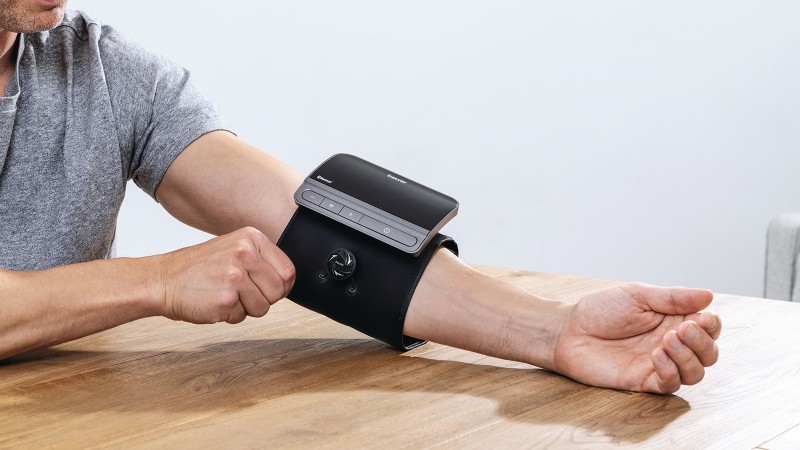
For exactly this cross-check we developed the BM 81 easyLock upper arm blood pressure monitor. The compact all-in-one device works entirely without connecting tubes, without cables and without a conventional hook-and-loop fastener. The innovative easyLock twist lock lets you position the cuff precisely and secure it in one movement. The integrated cuff position check confirms automatically that the device sits correctly on your arm and gives a green light for a reliable measurement.
Compact design for everyday use and cross-checking
Weighing just 327 grams, with a universal cuff for upper arm circumferences of 24 to 40 centimetres, the BM 81 is easy to handle. Its economical battery operation allows around 300 measurements per set of batteries, so you can check an irregularity from your watch at any time without a socket. Thanks to inflation technology, the device measures quickly and gently while the cuff inflates, without putting unnecessary pressure on your upper arm.
- Before cross-checking, make sure always to rest for 5 minutes, and avoid talking or moving.[1]
- Fit the easyLock cuff of the BM 81 two finger widths above the crook of your elbow, on the bare upper arm.
- Start the measurement and keep your arm relaxed at table height, so the device sits at heart level.
- Compare the measured mmHg value with your watch's estimate and save the result to build up a record.
This standardised routine gives you a solid basis of data that puts unclear signals from your smartwatch straight into perspective.
Why the watch observes heart rhythm but does not diagnose
Modern smartwatches often advertise ECG functions or automatic heart rhythm monitoring, but here too a clear medical distinction is needed. Optical sensors on the wrist detect changes in blood volume and can derive irregularities in the pulse from them.[3] A smartwatch's single-lead ECG or an optical pulse wave algorithm cannot detect circulatory disorders of the heart muscle such as an impending heart attack, and never replaces a clinical 12-lead ECG in medical diagnosis.[3]
The Beurer BM 81 has a built-in arrhythmia detection that, according to the product specification, warns of possible heart rhythm disturbances. The symbol is purely indicative: it shows that irregularities appeared in the pulse during the measurement, and it expressly does not amount to a specific diagnosis such as atrial fibrillation.
The limits of rhythm monitoring on the wrist
For users, it is essential to know what the sensors can detect and where their limits lie:
- Optical pulse measurement gives indications of an irregular beat, but can be disrupted by the watch slipping, by cold skin or by tattoos on the wrist.[6]
- A single-lead ECG on the watch records the heart's electrical activity at one point in time through two contacts, but shows no complex heart conditions and no ischaemia.[3]
- The arrhythmia detection on a blood pressure monitor works as an additional check during the routine pressure measurement.
If your watch or your blood pressure monitor shows rhythm warnings repeatedly, the same rule always applies: stay calm, keep a record of them, and have them assessed by a doctor promptly.
Why health features are missing depending on the country
When you buy a smartwatch, you may find that certain health features such as blood pressure estimation or ECG recording simply do not appear in the menus in some countries. The reason lies in the strict legal frameworks for medical devices, which differ considerably from country to country. A function that merely counts steps or roughly estimates sleep phases counts in law as a pure wellness application. Check thoroughly the availability in your country before making a decision.
As soon as a function determines concrete vital signs, is meant to analyse disease risks or serves as decision support for medical questions, it is classified in law as a medical device. In the European Union, such applications must meet the requirements of the Medical Device Regulation and carry a CE marking with a notified body.[1] In the USA, formal clearance by the Food and Drug Administration (FDA) is mandatory.[8]
Regulatory hurdles protect patients
Which function is enabled in which country therefore depends on its approval in that market:
- Software as a Medical Device (SaMD): apps alone, such as the Samsung Health Monitor, are subject to medical device law and are certified separately.[6]
- Different assessment routes: certification in South Korea or Europe does not automatically mean clearance by the FDA in the USA, which is why US models often carry a different range of functions than European ones.[8]
- Hardware classification: conventional upper arm blood pressure monitors such as our Beurer models go through the full conformity assessment under European medical device law from the outset.
These strict requirements are not a bureaucratic obstacle; they are what keeps health data transparent, safe and reproducible for the people using it.
Which device suits which usage profile
Which setup is right for you depends on what you want from monitoring your health. A smartwatch is an excellent digital companion for active people who want to watch their general well-being and keep an eye on subtle trends. If your doctor has asked you to keep a reliable blood pressure log, or you are managing existing hypertension with medication, you need a stand-alone medical device for the upper arm. Among our upper arm blood pressure monitors we offer solutions for exactly that, combining modern connectivity with tested measurement technology.
If you record your values over several weeks and bring them to your doctor's appointment, the Beurer BM 81 easyLock is the companion for your smartwatch. The device holds two user memories with 120 memory slots each and calculates, at the touch of a button, the average of all stored measurements as well as the morning and evening blood pressure of the last 7 days separately. Via Bluetooth®, every reading transfers automatically to the free “beurer HealthManager Pro” app. Nine Beurer blood pressure monitors in total support this direct Bluetooth synchronisation, so you can see your history as clear graphs and export it as a PDF report for your next appointment.
The ideal interplay of watch and upper arm device
Use the strengths of both worlds for your heart health: wear your smartwatch as a practical prompt in everyday life, but rely on validated measurement technology for the record. Cross-check the watch's warning on your upper arm and document the trend in the “beurer HealthManager Pro” app: with the BM 81 easyLock that comparison is quick, cable-free and carries the reliability of a medical device.
Frequently asked questions
How reliable are blood pressure measurements with a smartwatch?
Smartwatches with an inflatable cuff deliver reliable data. Devices that measure purely optically can show large deviations and have to be recalibrated regularly with a certified upper arm device. For accurate monitoring, Stiftung Warentest recommends conventional measuring devices.
Which smartwatch can measure blood pressure?
At present only very few models measure blood pressure directly, through an air cushion in the strap. Other common smartwatches use optical sensors for an estimate that needs regular calibration. Some watches give no readings at all and only send prompts.
Can I detect heart rhythm irregularities with my smartwatch?
A smartwatch can observe irregularities in your heartbeat through optical sensors or a single-lead ECG. That data gives useful pointers for everyday life. It does not replace a medical diagnosis and is no reliable detection of complex rhythm disorders.
What does a trend warning from a smartwatch mean?
A trend warning tells you the watch has registered conspicuous patterns in your vital data over a longer period. It is not a medical diagnosis but a prompt. You should have the values checked with a genuine medical device.
Why are health features available differently depending on the country?
Health measurement functions count as medical devices in many regions. Manufacturers have to provide strict evidence for them and apply for approvals such as the CE marking in Europe. Without that clearance the function may not be switched on in that country.