

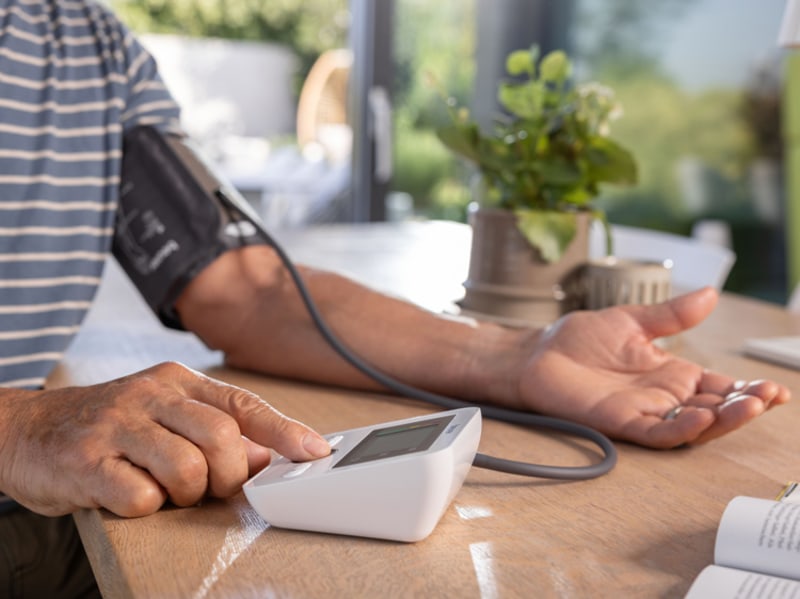
You have just measured your blood pressure, as a check-up or because a reading at the pharmacy caught your eye, and the display shows two numbers, one above the other. Which of the two numbers actually matters more? The answer depends on how old you are and which value is raised. In this article, you will find out what the systolic and diastolic values measure, which one tells you more and when, and how our Beurer BM 27 helps you classify your readings.
What the systolic and diastolic values are
The systolic value is the upper number on the display, and the diastolic value is the lower one. The systolic value shows the pressure at which the heart pumps blood into the arteries. The diastolic value describes the pressure between two heartbeats.A So the difference between systolic and diastolic lies in the timing: one value relates to pumping, the other to the pause.
The first number in a blood pressure reading is always the upper value. After measuring, our Beurer BM 27 shows the systolic pressure, the diastolic pressure and the pulse. In addition, a risk indicator classifies the measurement results on a coloured scale. These standard values are a general guideline set by the World Health Organization (WHO).
Both numbers belong together. In Germany, both values are always taken into account when diagnosing high blood pressure, as both can independently indicate a risk of a heart attack or stroke.B
That is why you should check both values regularly.
How the two values are created during a heartbeat
Both values are created during a single heartbeat. When the left ventricle contracts, it pumps blood into the main artery. During this contraction and ejection phase, the pressure in the vessels rises briefly. The highest pressure at this moment is the upper or systolic value. The technical term systole comes from Greek and means “contraction”.
After this, the heart relaxes. The ventricles relax so that blood can flow from the lungs into the heart. Because no blood is pumped during this time, the pressure in the vessels slowly falls until the next surge of blood. The lowest pressure in this phase is the lower or diastolic value, and diastole means “expansion”.B
With a blood pressure of 120 over 80 mmHg, the pressure constantly pulses in waves between 120 and 80 mmHg.B How high the wave is depends on two things: the pumping function of the heart and the elasticity of the vessel walls.C
What mmHg means as a unit
Blood pressure is the pressure that blood exerts on the vessel walls. It is measured in millimetres of mercury, mmHg for short, and is always stated as two values. It is written as “120 over 80 mmHg” or “120/80 mmHg”, with the upper value always first. To put this into context, 1 mmHg corresponds to a pressure of about 133 pascals or 0.00133 bar.C
How does an upper arm blood pressure monitor get the two numbers? The cuff is inflated and compresses the artery. As it slowly deflates, the pulsating artery transfers small pressure fluctuations to the cuff, and from this the device calculates both values and the pulse. The Beurer BM 27 measures using Deflation Technology, meaning it measures as the cuff pressure is released.
If you want to measure at home, you will find the right devices among our upper arm blood pressure monitors. Our guide How to measure your blood pressure correctly shows you step by step how to put on the cuff and take a measurement.
Which value tells you more at which age
When assessing risk, the upper value is usually considered the most important. The systolic value provides particularly reliable information about the danger of cardiovascular diseases. A long-term study of over 100,000 adults, published in the journal Hypertension, followed people for an average of 26 years. It confirms systolic blood pressure as a very good indicator of risk, regardless of age, gender and other factors.D
However, that does not mean you can ignore the lower value. For people under 50, diastolic blood pressure also provides important additional information. Younger adults in particular should therefore keep an eye on both values, not just the upper one.D
The picture shifts over the years. As you get older, it is mainly the upper value that is raised, because age-related arteriosclerosis reduces the elasticity of the large vessels.B You can read what an isolated raised upper value means in the next section.
High blood pressure very rarely causes symptoms, so it is important to check your values regularly.E Our article Interpreting blood pressure readings correctly explains how to put individual readings into context for your appointment with your doctor.
What an isolated raised value means
Sometimes only one of the two values is too high. If repeated measurements show elevated systolic values while the diastolic values are not elevated, isolated systolic hypertension may be present. If only the diastolic values are elevated, this may be isolated diastolic hypertension. Classification is a matter for medical assessment. Isolated systolic hypertension occurs most often in older people.
The main cause of isolated systolic hypertension is age-related arteriosclerosis of the main artery and the large blood vessels. It is the most common form of high blood pressure in people over 70, accounting for around 75 per cent of cases. Because it is linked to an increased risk of serious cardiovascular disease, it is treated consistently.B
If only the lower value is high, this is called diastolic hypertension. It is more common in younger people with high blood pressure. Possible triggers include secondary causes such as kidney disease, an overactive thyroid or pauses in breathing during sleep, known as sleep apnoea.B So if your diastolic value is too high, you should have it assessed by a doctor.
A lower value in the normal range does not cancel out a high upper value. The same is true the other way round. It is best to note both numbers and discuss how they change over time with your doctor.
Worked example: two values, one classification
What happens when the two values fall into different ranges? Under the classification used here, the higher category reached by either the systolic or the diastolic value determines the classification. So if the systolic value is in the grade 1 range and the diastolic value is in the normal range, the reading counts as grade 1.
The ranges for adults look like this: A blood pressure below 120/80 mmHg is optimal. Under the classification used here for measurements taken in a doctor's practice, 130–139 mmHg systolic and/or 85–89 mmHg diastolic is high-normal. Grade 1 begins at 140–159 mmHg systolic and/or 90–99 mmHg diastolic. The categories follow the classification presented by the German Hypertension League; other guidelines may use different category names and boundaries. A diagnosis requires a medical assessment of repeated measurements.F
Three sample readings make the rule easy to grasp:
| Example reading (mmHg) | Upper value is in | Lower value is in | Classification |
|---|---|---|---|
| 145 over 82 | grade 1 | normal | grade 1 |
| 126 over 88 | normal | high normal | high normal |
| 118 over 76 | optimal | optimal | optimal |
The rule is therefore simple. In the first reading, the lower number looks normal, but the upper one determines the classification. In the second reading, it is the other way round: here the lower value pushes the classification up. This is exactly how the Beurer BM 27 works. If the systolic and diastolic values fall into different categories, its risk indicator always shows the higher range.
A single reading is only ever a snapshot.
A single elevated reading is usually not enough to diagnose high blood pressure. You should re-measure very high values after a short rest and have them checked by a doctor promptly. If you experience symptoms such as chest pain, shortness of breath, signs of paralysis or speech difficulties, call 999 or 112 immediately. High blood pressure cannot be determined from a single measurement; it takes readings taken at different times. The doctor will also take into account the values you measured at home.F A home device provides readings for monitoring your blood pressure over time and discussing it with your doctor; it does not make a diagnosis.
We explain why two consecutive readings can differ in our article Different blood pressure readings.
The limit also depends on where you measure. In a doctor's practice, the upper limit of normal blood pressure for adults is 140/90 mmHg, measured as an average over two days.F If you measure in a relaxed state at home, your values should be below 135 over 85 mmHg, as an average over several consecutive days.B You will find an overview of all the ranges in our article Understanding blood pressure values: table, normal values and classification.
Recording both values with the BM 27
If you record both values over several days, you can see which one stands out for you. We recommend noting the date, time, both values and your pulse for every measurement, because blood pressure fluctuates over the course of the day.C The Beurer BM 27 does part of this work for you. It calculates the average of all stored readings as well as the morning and evening blood pressure for the last 7 days. Morning covers readings taken between 5.00 and 9.00, evening those taken between 18.00 and 20.00.
The BM 27 stores 30 readings for each of 4 users. A blood pressure record is included for documenting your readings. If you would like to document your values digitally, you can capture the displayed readings with your smartphone camera using the 'Scan & Save' function in the 'beurer HealthManager Pro' app.
The large, clear display and the colour-coded classification of your readings make them particularly easy to read. A cuff fit check helps you put the cuff on your upper arm correctly, and the cuff fits upper arm circumferences from 22 to 42 cm. We give a 5-year guarantee on the device.
To keep your readings comparable, you should follow a few rules with the BM 27:
- Always measure when you are sufficiently physically at rest.
- You should not eat, drink, smoke or exert yourself physically for at least 30 minutes before the measurement.
- Rest for 5 minutes before the first measurement.
- Sit comfortably, support your back and arm, place your feet flat on the floor and do not cross your legs.
- The cuff sits at heart level, and during the measurement you should neither speak nor move.
- Allow at least 1 minute between two measurements.
The BM 27 is designed for self-measurement by adults at home. The readings you take yourself are for information only and do not replace a medical examination, so you should discuss them with your doctor. Only your doctor can give you personal target values for well-controlled blood pressure.
Two comparisons have recognised the BM 27. In its review 'Die besten Blutdruckmessgeräte', the F.A.Z. Kaufkompass names the BM 27 as its price tip; the review was last updated on 10 June 2026. At netzwelt.de, it is the best value-for-money model in the comparison 'Blutdruckmessgeräte im Vergleich 2026: Diese 10 Modelle sind günstig, zuverlässig und einfach zu bedienen' dated 14 April 2026, selected from 10 tested devices. You can read what else the device can do in our article Beurer BM 27 in comparison. You will find further models among our blood pressure monitors.
Our advice: don't judge a single reading; record both values over several days instead. With the morning and evening averages of the Beurer BM 27, you can see how your readings develop at a glance.
Frequently asked questions
Which blood pressure value is more dangerous, the upper or the lower one?
Usually it is the upper, systolic value. Below the age of 50, however, the lower value also counts, so you should keep an eye on both.
How much Dia/mmHg is normal?
In the classification mentioned, the diastolic value is in the optimal range below 80 mmHg; the systolic value also counts for the overall assessment. Very low values, especially when accompanied by symptoms such as dizziness or fainting, should be discussed with a doctor.
What should blood pressure be in 14-year-olds?
Up to the age of 16, different limits apply than for adults, depending on sex, age and body height.G In 14-year-olds, blood pressure values are assessed medically based on factors including age, sex and body height. Values from the 90th to below the 95th percentile are considered high-normal; from the 95th percentile onwards, further medical evaluation is needed. For older adolescents, additional limits may apply depending on the guideline. The BM 27 is intended for adults. The Beurer BM 27 is designed for self-measurement by adults.
How high may blood pressure be after exercise?
Blood pressure fluctuates with different activities, and that is normal. To obtain a meaningful reading with the Beurer BM 27, you should avoid physical exertion for 30 minutes before the measurement and rest for 5 minutes before the first measurement.

