

Why low readings can be intentional with heart failure
Low blood pressure readings mean something different with heart failure than with a healthy circulation. High blood pressure is one of the biggest risk factors for developing chronic heart failure with reduced pumping function, but once the condition exists, the signs are reversed: in studies from recent decades, the patients with the lowest blood pressure had the highest risk of death, especially with a systolic value below 110 mmHg and a diastolic value below 60 mmHg[1].
Some of these low readings are a result of the treatment itself. Heart failure treatment includes diuretic and vasodilating medicines, among others, and their use can also cause low blood pressure[2]. The dose is adjusted step by step: a beta blocker started at a low dose can be increased over time, and it was the group with the lowest blood pressure at the start of treatment that benefited most from this treatment in the approval studies[1].
- Before the condition, high blood pressure counts as a risk factor; after the diagnosis, the assessment changes.
- Blood-pressure-lowering medicines used in heart failure treatment often lower blood pressure as well.
- Whether a low reading is a problem is therefore decided case by case, not by a fixed threshold.
The German Hypertension League (Deutsche Hochdruckliga) makes clear that there is no set optimal target blood pressure for patients with heart failure[3]. According to Adlbrecht and Wurm, asymptomatic changes in blood pressure have no effect on treatment success, and the specific heart failure treatment should be prescribed and titrated upwards regardless[1]. So a low reading is not automatically a problem, but it is not automatically harmless either. What matters is the trend, and that is exactly what you can record at home.
What home measurement adds to the treatment
Measuring at home provides trend readings that the surgery does not have. A single reading says little, because blood pressure varies over the day and from one day to the next. Home measurement becomes meaningful through regularity and averages over several days, usually in the morning and evening. It is these trend readings that help in a conversation with your doctor, not the one unusual single reading.
That is why the BM 96 calculates the average of the morning and evening blood pressure for the last 7 days, as well as the overall average of all stored readings. You do not have to add up the readings yourself and can use the averages directly in your conversation at the surgery. Important note: The ECG function must not be used by persons with pacemakers or other implanted medical devices.
Close monitoring is considered essential, particularly with low blood pressure and impaired kidney function[1]. The limit is important: a home blood pressure monitor provides readings for tracking the trend and for the conversation with your doctor; it does not make a diagnosis and does not replace a medical assessment.
When and how often to measure with heart failure
Home measurement is usually done in the morning and evening over several days, for example for two weeks before a doctor's appointment. This creates a record that covers both times of day and from which averages can be calculated. A fixed routine helps keep the readings comparable:
- Measure under similar conditions, sitting down, after a short rest.
- Rest your arm so that the cuff is at about heart level.
- Wait at least 1 minute between consecutive measurements.
- Check that the date and time on the device are correct, so that each measurement is assigned correctly.
For this, the BM 96 has memory for 2 users with 60 readings each, and every measurement is stored with the date and time. If you also measure for a relative, or want to keep your own readings separate, you can keep two separate records without copying anything down by hand.
How closely you need to be monitored in your case is decided by your doctor's surgery. Adlbrecht and Wurm also stress that close monitoring is important, particularly with low blood pressure[1]. If your doctor agrees a different measuring interval with you, their instruction applies.
Recording readings and tablet intake for your appointment
For your appointment, what counts is not individual readings but a carefully documented record, including when you took your tablets. Only the combination of reading, time and tablet intake shows whether a low reading occurs shortly after the morning tablet, for example, or independently of it. The BM 96 transfers the readings via Bluetooth® to the associated app or via USB cable to a PC, and a blood pressure record booklet and an attachment for the treating doctor are included in delivery. Important note: The ECG function must not be used by persons with pacemakers or other implanted medical devices.
- The reading with date and time, as the device stores it.
- When you took your tablets and which medicine, as a separate note.
- Symptoms such as dizziness or light-headedness, if they occur around the time of the measurement.
- The averages the device has calculated for the last 7 days.
We explain in detail how to set up digital documentation in our guide to documenting blood pressure with an app. Your records provide the basis on which the surgery makes such decisions.
Warning signs that mean low readings need a doctor's assessment
Not every low reading is harmless; certain symptoms need a doctor's assessment. The Ratgeber Herzinsuffizienz (a German heart failure guide) lists the typical signs of low blood pressure that should be taken seriously even if you are already keeping an eye on your readings[2]:
- Dizziness and light-headedness, for example when everything goes black.
- Lack of energy in the morning, when getting going is unusually hard.
- Headaches, often stabbing or throbbing.
- Cold hands and feet.
- A racing heart and a feeling of tightness in the chest.
Dizziness, ringing in the ears and light-headedness call for caution: in the worst case, people faint, which can have life-threatening consequences when driving, for example[2]. A fainting episode should therefore always be discussed with a doctor, even if it only happened once. The German Heart Foundation (Deutsche Herzstiftung) also answers the question of whether the organs receive enough blood when blood pressure is low in its consultation service[4].
With symptomatic low blood pressure, the dose may need adjusting; this is done exclusively by your doctor[1]. If symptoms from the list above appear, take your documented readings to your doctor promptly instead of waiting for things to improve on their own.
What the arrhythmia symbol and the ECG recording tell you
The arrhythmia symbol on the monitor is an indication, not a diagnosis. It points to a possible irregular heart rhythm. The advice is to measure your blood pressure again and to seek medical advice if it appears repeatedly. Assessing what lies behind such an irregularity remains the job of your doctor.
The BM 96 goes one step further than a warning alone: with its single-channel ECG and the ECG stick, the device records your heart rhythm. Good to know: the ECG and the blood pressure measurement run one after the other, not at the same time. You share the recording with your doctor, who assesses it. Please note that the ECG function must not be used by persons with pacemakers or other implanted medical devices.
A look at the causes shows why such a recording can be useful: the causes of heart failure include permanent cardiac arrhythmias such as atrial fibrillation[5]. Blood pressure readings and an ECG recording from one device give the surgery two matching sources of information, which it assesses itself.
The Beurer BM 96 for blood pressure and ECG
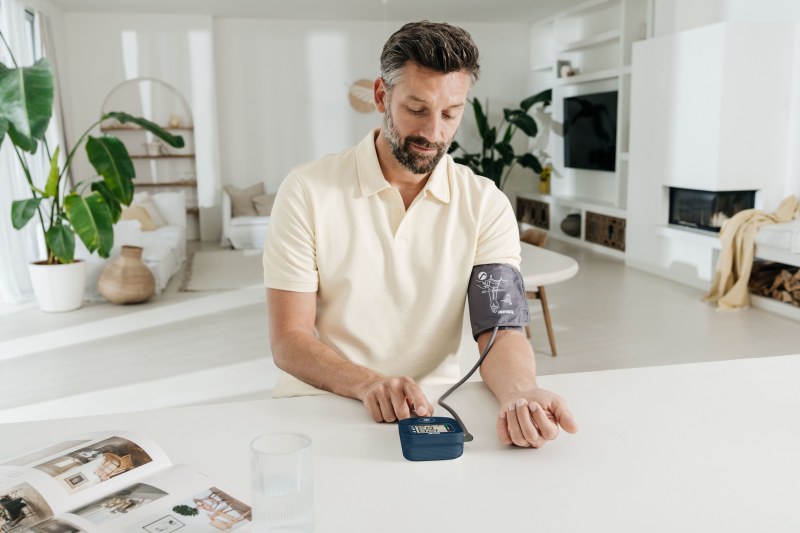
If you have heart failure and want to document your blood pressure and heart rhythm in one record, you need a device that records both. The BM 96 is an upper arm blood pressure monitor with ECG function and combines both measurements in one device. The features at a glance:
- Universal cuff for upper arm circumferences from 22 to 42 cm.
- Cuff position control for fitting the cuff correctly on the upper arm.
- Large, clear, illuminated display.
- 5-year warranty.
Cuff size is the most common avoidable source of error in blood pressure measurement: a cuff that does not fit your upper arm circumference distorts the readings. Upper arm devices are considered the more robust design for home use because the cuff sits at roughly heart level; you will find the right design in our category of upper arm blood pressure monitors. The category page for all blood pressure monitors gives an overview of all designs.
So you leave this page not with an overview but with a plan: measure in the morning and evening for two weeks, note down when you take your tablets, and take the averages from the BM 96 to your next appointment. On the BM 96 product page you will find all the functions of this combined blood pressure monitor and single-channel ECG, plus details on connecting it to the "beurer HealthManager Pro" app.
Frequently asked questions
What does low blood pressure mean with heart failure?
With heart failure, a low reading is often a side effect of the treatment. Diuretic and vasodilating medicines, which are part of heart failure treatment, often lower blood pressure as well. A low reading without symptoms is therefore not a warning sign on its own. Your doctor will assess what your reading means.
Can low blood pressure cause a stroke?
Low blood pressure is generally not considered a classic risk factor for stroke. In people with heart failure, however, studies show that very low systolic values can be linked to a higher risk of cardiac events. If low readings keep recurring together with dizziness or light-headedness, have them checked by a doctor rather than just watching them.
What should I do if blood pressure medication lowers my blood pressure too much?
Never stop taking medicines or change the dose yourself; that is decided exclusively by your doctor. Note down your readings and any symptoms for one to two weeks and take the record to your appointment. Only with this trend can the treatment be adjusted sensibly without compromising your heart failure treatment.
How often should I measure my blood pressure with heart failure?
Home measurement is usually done in the morning and evening over several days, for example for two weeks before a doctor's appointment. The BM 96 stores 60 readings per user with date and time and calculates the morning and evening blood pressure for the last 7 days. How closely you need to be monitored in your case is decided by your doctor's surgery.