

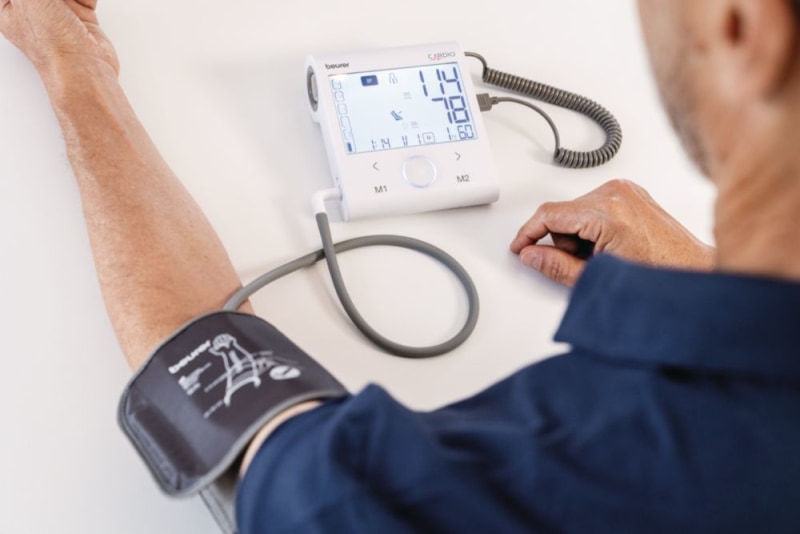
The display shows 160 over 100, and suddenly the evening is no longer calm. Blood pressure of 160 over 100: what should you do when you see a reading like this for the first time? A single number is not a diagnosis, though. With the Beurer BM 96 you can measure again at rest: the resting indicator shows whether the reading corresponds to your blood pressure at rest. The risk indicator classifies it by colour into the categories, so you can base your next decision on a reliable reading. Here you will learn how to interpret the reading and which symptoms make the difference. We also show you when your GP surgery, NHS 111 or 999 is the right number to call.
What a blood pressure of 160 over 100 means
At 160 over 100 mmHg, the reading falls into grade 2 hypertension. Values between 160 and 179 mmHg systolic and 100 to 109 mmHg diastolic are classed as grade 2, and even higher values as grade 3.A
If the upper and lower values fall into two different ranges, the higher one always counts. This is exactly how the risk indicator of the BM 96 shows it on the display. This is how the BM 96 classifies your readings:
| Category on the BM 96 | Systolic (mmHg) | Diastolic (mmHg) | Action |
|---|---|---|---|
| Level 3: severe hypertension | ≥ 180 | ≥ 110 | Seek medical attention |
| Level 2: moderate hypertension | 160–179 | 100–109 | Seek medical attention |
| Level 1: mild hypertension | 140–159 | 90–99 | Regular monitoring by doctor |
| High normal | 130–139 | 85–89 | Regular monitoring by doctor |
| Normal | 120–129 | 80–84 | Self-monitoring |
| Optimal | < 120 | < 80 | Self-monitoring |
A one-off or occasional reading above the thresholds does not yet mean high blood pressure.A A home monitor provides readings for tracking trends and for the conversation with your doctor. The diagnosis is made by your GP surgery on the basis of repeated measurements on different days. If the diagnosis is confirmed, drug treatment is generally recommended from grade 2 onwards.B
Our guide to understanding blood pressure readings: table, normal values and classification explains how the other ranges fit together.
The line between a spike and an emergency
A blood pressure spike begins where the upper value is above 180 mmHg and the lower value above 110 mmHg. If it is short-lived, there is no indication that organs are being damaged. A spike is usually a serious situation, but not an emergency.C
An emergency exists when severely elevated blood pressure damages the brain and other organs, such as the heart, lungs or kidneys. This can lead to a stroke, a heart attack or fluid in the lungs, among other things. Such an emergency belongs in hospital.C
When blood pressure suddenly rises above 180 over 110 mmHg without physical exertion, experts also speak of a hypertensive crisis.D A reading such as 160 over 100 mmHg lies below this threshold. Even so, it belongs in your doctor's office promptly.
Which accompanying symptoms make the difference
Whether high blood pressure is dangerous is decided above all by the symptoms that come with it. How serious the situation is does not depend only on how high the reading is. What matters is how sensitive organs such as the heart, brain, kidneys and eyes react. People usually notice such spikes, but not always.B
During a blood pressure spike, these signs can occur:
- red face or cheeks
- headache
- dizziness
- nausea
If no serious symptoms occur alongside, it is very likely a blood pressure spike.C In a hypertensive emergency, it is not decisive whether the readings have exceeded a certain limit. What matters is whether symptoms are already present.D
The following overview summarises which route fits which situation. It does not replace a medical assessment, but it gives you orientation for the first few minutes.
| Your situation | The next step |
|---|---|
| 160 over 100 mmHg, no symptoms | call your GP surgery; when it is closed, NHS 111 |
| Over 180 over 110 mmHg, no or mild symptoms such as a headache | stay calm, measure again after about 30 minutes |
| Second reading no better or symptoms persist | call or visit your GP surgery |
| Unsure whether it is an emergency | call NHS 111 |
| Shortness of breath, severe chest tightness, paralysis, problems with vision or speech | call 999 straight away |
What to do in the next half hour
In the next half hour, the most important thing is to stay calm and then measure again. Try to relax and think about something else. After about 30 minutes, measure again. If the readings have not improved or the symptoms persist, you should call or visit your GP surgery.C
There is a good reason for staying calm. During a hypertensive crisis, the body releases more stress hormones. If you stay calm and do not panic, you counteract a further rise. Blood pressure can already improve on its own within 15 to 30 minutes. If it suddenly rises sharply instead and does not settle down again, you should see a doctor promptly.D
And at 160 over 100 without symptoms? In that case, you should definitely call your GP surgery. If you cannot reach it, NHS 111 can help.E
How to measure again with the BM 96
For the second measurement to be meaningful, a few fixed rules apply to the BM 96, which you can also find in the BM 96 instructions for use:
- Do not take a measurement within 30 minutes of eating, drinking, smoking or exercising.
- Rest for 5 minutes before the first measurement and wait at least 1 minute between two measurements.
- Sit upright and comfortably, lean back and place your feet next to each other flat on the floor.
- The cuff is at heart level, and you do not move or talk during the measurement.
- Repeat any readings you are unsure about.
Our guide measuring blood pressure correctly: a step-by-step guide to reliable readings at home explains how to put the cuff on properly.
Why blood pressure is not lowered abruptly
High blood pressure is deliberately not lowered abruptly during treatment. Doctors make sure that blood pressure does not drop too quickly, in order to avoid a rollercoaster ride of readings.D
Without alarming accompanying symptoms, raised blood pressure can usually be managed well. Your doctor can then lower it slowly.B
You should not adjust blood pressure medication that has already been prescribed without talking to your doctor first.D The readings from the BM 96 are for your information and do not replace a medical examination. It is best to discuss them with your GP and not draw your own conclusions about the dose.
A common trigger of a blood pressure spike is blood pressure medication that is not taken regularly or is skipped. Stress, emotional problems, alcohol, drugs or pain can also drive blood pressure up.C Our tips for lowering blood pressure explain how it can come down into a healthy range in the long term.
When to call 999 straight away
You should call 999 straight away if high blood pressure comes with signs of organ damage. Possible signs of an emergency include:
- shortness of breath
- severe tightness in the chest
- confusion
- paralysis
- vision or speech problems
- seizures
- loss of consciousness
In that case, call 999 or make sure that someone else does.C
But what if you are not sure? A blood pressure spike cannot always be told apart from an emergency easily. If you are unsure, you should get expert advice as quickly as possible, from your GP surgery or from NHS 111. If you think it is an emergency, call 999 straight away.C
Pregnant women in particular need medical help quickly at such high blood pressure readings, and immediately if they feel very unwell or very unsure.C Our guide to measuring blood pressure during pregnancy explains what matters at this time.
Measure again at rest with the BM 96 and record your readings
With the Beurer BM 96, you measure blood pressure and pulse fully automatically on the upper arm and keep a record of every reading for your appointment with your doctor. That helps after an unusual reading: you can measure again calmly once the excitement has passed and show how your readings develop.
How do you know whether a reading is meaningful? A common mistake when measuring is taking the measurement when your circulation is not at rest, because then the upper and lower values differ from your blood pressure at rest. The resting indicator of the BM 96 therefore shows whether your circulation was sufficiently at rest during the measurement. If it was, the reading corresponds to your blood pressure at rest. If the symbol for insufficient rest appears, you should measure again after at least 5 minutes of rest and relaxation.
The large, clear display and the colour classification of the readings make the BM 96 easy to read. The universal cuff fits upper arms from 22 to 42 cm, and the cuff fit check helps you put it on correctly. Two users can each store 60 readings in the memory. The device also calculates the average of your morning and evening blood pressure over the last 7 days.
The weekly average matches a threshold that experts use for home measurement. For home measurement, the threshold is 135 over 85 mmHg, measured over 7 consecutive days.F Via Bluetooth®, the BM 96 transfers your readings to the “beurer HealthManager Pro” app. There you keep your personal blood pressure diary and export your readings for your GP surgery. If you prefer to keep a record on paper, a blood pressure diary is included.
With the ECG stick, the BM 96 also records an electrocardiogram (ECG), in other words your heart rhythm. The ECG and blood pressure measurements run one after the other, not at the same time. Interpreting the ECG curve remains a task for your doctor. During a blood pressure measurement, the BM 96 also gives indications of possible irregularities in your heart rhythm, without making a diagnosis. You should discuss such an indication with your GP. Our guide to the arrhythmia indicator on blood pressure monitors explains what the symbol means.
The BM 96 is a medical device with a 5-year guarantee. You can find more models among our upper arm blood pressure monitors and in the overview of all blood pressure monitors. We recommend measuring again at rest after an unusual reading and keeping a record of your readings with the BM 96. That way you will have a clear record of your readings at your next doctor's appointment.
Frequently asked questions
Which blood pressure value is dangerous, the upper or the lower one?
For classification, the higher of the two values always counts. If the upper value falls into grade 2 and the lower one into grade 1, the reading counts as grade 2. High blood pressure becomes dangerous above all when symptoms such as shortness of breath or chest tightness come with it.
Do you feel dizzy when your blood pressure is too high?
Dizziness can be a sign of a blood pressure spike, as can a headache, nausea or a red face. After half an hour of rest you should measure again, and if the symptoms persist, call your GP surgery.
Can you detect heart problems from blood pressure?
A blood pressure reading on its own does not show heart disease. A blood pressure monitor with an arrhythmia indicator gives indications of possible irregularities in your heart rhythm, but does not make a diagnosis. The Beurer BM 96 also records an ECG curve, which your doctor interprets.
Is 160 over 100 already an emergency?
Without accompanying symptoms, this reading belongs with your GP promptly, but on its own it is not an emergency. Call 999 if emergency signs such as paralysis, speech problems or severe chest tightness appear.

