

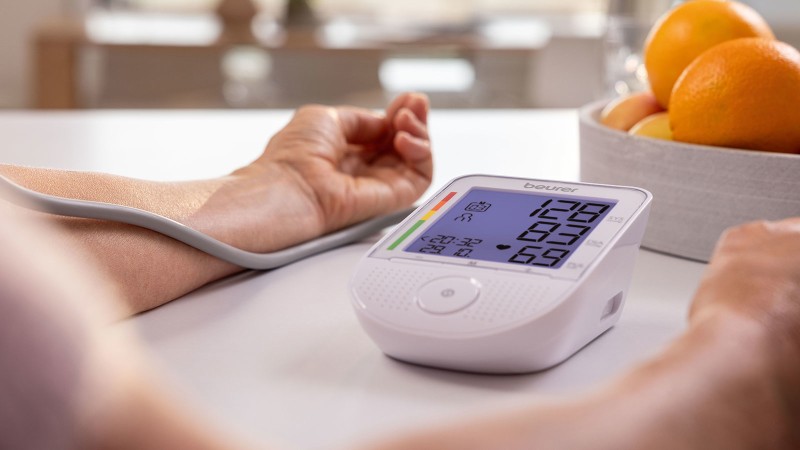
Have you taken a reading that caught your eye, or do you want to know where you stand, just to be safe? Then you are probably looking for a “blood pressure chart for men”. The good news: you don't need a separate chart. The same classification applies to men as to women, and we'll show you how to place your reading in it. With the Beurer BM 49, you can see the classification right on the device: its coloured risk indicator reflects the same classification.
Which blood pressure readings count as normal
A blood pressure of 120 to 129 mmHg systolic and/or 80 to 84 mmHg diastolic counts as normal; a reading below 120/80 mmHg is optimal.[1] This classification applies to adult men just as it does to women.
| Range | Systolic (top number) | Diastolic (bottom number) |
|---|---|---|
| Optimal | below 120 mmHg | below 80 mmHg |
| Normal | 120 to 129 mmHg | 80 to 84 mmHg |
| High normal | 130 to 139 mmHg | 85 to 89 mmHg |
| Hypertension grade 1 | 140 to 159 mmHg | 90 to 99 mmHg |
| Hypertension grade 2 | 160 to 179 mmHg | 100 to 109 mmHg |
| Hypertension grade 3 | higher | higher |
But where you measure matters, because the surgery and your home each have their own limit. High blood pressure is present when readings taken at the doctor's surgery on two different days are 140/90 mmHg or higher.[2] At home, the threshold is an average of 135/85 mmHg, ideally measured over 7 days.[3] Our guide to understanding blood pressure readings explains the general classification in more detail.
Why the thresholds are not split by sex
The thresholds are not split by sex because the classification applies to all adults. What does differ is how common it is: in England, 32 percent of men and 27 percent of women have high blood pressure.[4]
You are more likely to get high blood pressure as you get older.[5] In most people, blood pressure naturally rises with age.[6] Separate thresholds for men do not follow from this, so the chart stays the same.
Sex-specific risk factors include pregnancy, early menopause and hormone replacement therapy, all three of which affect women.[1]
For you as a man, this means you read the same chart as your partner, and because men are affected more often, it is all the more worthwhile to keep a regular eye on your own readings.
Placing your reading in the chart
The rule is simple: you classify your reading by whichever value is higher. If the systolic value is in grade 1 and the diastolic value is in the normal range, grade 1 applies. An example: 145/82 mmHg falls into grade 1 because of the top number, even though the bottom number is normal.
Here is how:
- Read off the top (systolic) and the bottom (diastolic) value.
- Find the range for each value in the chart.
- Take whichever range is higher. That is your classification.
- Only compare readings taken under the same conditions: home with home, surgery with surgery.
Our Beurer blood pressure monitors, such as the Beurer BM 49, also show this classification with their coloured risk indicator. So you can see on the display which range your reading falls into, which saves you looking it up in the chart.
For your first measurement, it makes sense to measure on both arms, and the higher readings are the ones that count.[6] Our step-by-step guide to measuring blood pressure at home explains how to get reliable readings.
Spotting risk factors in everyday life
Typical everyday risk factors for high blood pressure are being overweight, eating a lot of salt, drinking too much alcohol and not getting enough exercise.[6] Smoking, stress, noise and air pollution can also contribute to high blood pressure.[1]
You can influence many of these factors yourself; others, such as your age, are a given. High blood pressure does not usually cause any symptoms and can therefore go undetected for a long time.[6] As many as 5 million adults in the UK have undiagnosed high blood pressure.[7]
How often you should have your blood pressure checked depends on your age: from the age of 40, and especially if you have risk factors, blood pressure should be checked once a year.[2] The only way to find out if you have high blood pressure is to get it checked.[8] That is why we recommend keeping an eye on your readings.
When a reading should be checked by a doctor
A single raised reading is not a diagnosis. High blood pressure is diagnosed by a doctor on the basis of repeated measurements on different days, not by a home device.[6]
If your readings at home are repeatedly 135/85 mmHg or above, have them checked at your surgery and take your readings with you. If your blood pressure is over 135/85 mmHg when you measure it at home, you may be diagnosed with high blood pressure.[7]
If you already take blood pressure medication, you have treated high blood pressure. A normal reading while on medication does not mean that you no longer have hypertension. Always decide about your medication together with your surgery, never on the basis of a single reading.
The Beurer BM 49 for measuring at home
Our Beurer BM 49 is a talking upper arm blood pressure monitor that measures blood pressure and pulse fully automatically. It classifies every reading with its risk indicator on a coloured scale. So straight after measuring, you can see which range of the chart your reading falls into. All you need to do is measure, read and classify.
- Voice output: the BM 49 reads out the measured values in German, French, Italian or Dutch. The volume is adjustable, and the voice output can be switched off.
- Two users: 60 readings each for two people, handy if you both measure.
- Averages: the device calculates the average of all stored readings and the morning and evening blood pressure of the last 7 days, which suits a week of measuring at home.
- Cuff: for upper arm circumferences of 22 to 36 cm; an XL cuff for 35 to 44 cm is available as an accessory.
- Irregular heartbeat: the BM 49 indicates a possible irregular heartbeat. If it does, have it checked by a doctor.
- Documentation: with Scan & Save, you can transfer your readings to the “beurer HealthManager Pro” app. Our article on managing blood pressure readings with the app shows what this looks like day to day.
Want to measure morning and evening for a week after your first unusual reading? Then the BM 49 helps with its average of the morning and evening blood pressure of the last 7 days. Take a look at the Beurer BM 49 or compare all our upper arm blood pressure monitors.
Frequently asked questions
What is a normal blood pressure for men?
The same normal range applies to men as to women: 120 to 129 mmHg systolic and/or 80 to 84 mmHg diastolic, with a reading below 120/80 mmHg being optimal. The Beurer BM 49 uses its risk indicator to show which range your reading falls into.
Do men have higher blood pressure than women?
Men are affected more often: in England, 32 percent of men and 27 percent of women have high blood pressure. The thresholds for classifying readings are still the same for both sexes.
When is blood pressure too high in men?
At the doctor's surgery, a blood pressure of 140/90 mmHg or above counts as too high; for readings taken at home, the limit is 135/85 mmHg. A single reading is not a diagnosis, so have it checked at your surgery.
Is there a blood pressure chart for men by age?
No, the thresholds apply to all adults regardless of sex. However, high blood pressure becomes much more common with age, and in most people blood pressure rises somewhat over the years.
Sources
- hochdruckliga.de
- herzstiftung.de
- Hypertension in adults: diagnosis and management (NG136) – NICE
- Health Survey for England, 2024: Adults' health - NHS England Digital
- High blood pressure (hypertension) – NHS
- High blood pressure – gesund.bund.de (Federal Ministry of Health, English)
- High blood pressure – British Heart Foundation
- Blood pressure test – NHS