

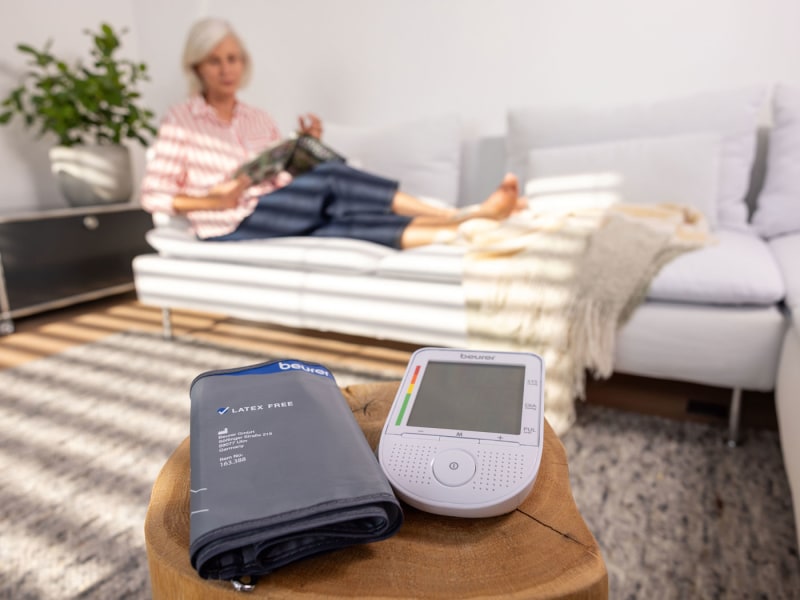
The monitor shows 138 over 86, and the question comes straight away: is that still normal for my age? Many tables online suggest that higher readings are fine at 60 or 80. Yet normal blood pressure values do not differ by age in adults. In this article, you will find out which limits apply, how to classify specific readings and how our talking Beurer BM 49 helps you measure at home.
Which blood pressure values count as normal at 40, 60 and 80
Normal blood pressure values do not depend on age: for adults, the same limit applies at 40 as over 80. A reading below 120/80 mmHg is optimal. Normal is 120 to 129 mmHg systolic and 80 to 84 mmHg diastolic. A reading of 130 to 139 over 85 to 89 mmHg counts as high normal, meaning too high but still acceptable.
The systolic value is the upper reading: it is produced when your heart pumps blood into the vessels. The diastolic value is the lower reading during the resting phase between two heartbeats. For classification, the higher of the two values is always decisive. Hypertension is the medical term for high blood pressure.
| Classification | at 40 years | at 60 years | at 80 years |
|---|---|---|---|
| Optimal | below 120 / below 80 | below 120 / below 80 | below 120 / below 80 |
| Normal | 120–129 / 80–84 | 120–129 / 80–84 | 120–129 / 80–84 |
| High normal | 130–139 / 85–89 | 130–139 / 85–89 | 130–139 / 85–89 |
| Hypertension grade 1 | 140–159 / 90–99 | 140–159 / 90–99 | 140–159 / 90–99 |
| Hypertension grade 2 | 160–179 / 100–109 | 160–179 / 100–109 | 160–179 / 100–109 |
All values in mmHg, systolic / diastolic. Values above grade 2 count as grade 3 hypertension.
Where the limit lies depends on where you measure. In the doctor's surgery, the upper limit of normal blood pressure is 140/90 mmHg on average over two days. At home, it is 135/85 mmHg, measured on 7 consecutive days.A We explain how to read individual values in more detail in our article Understanding blood pressure values: table, normal values and classification. We cover readings that are too low in our article When is blood pressure too low?
What changes in blood pressure over the years
Over the years, it is not the limits that change but the blood vessels. In later life, the blood vessels lose elasticity and the walls of the arteries become increasingly stiff.B
High readings become more common with age. In men, high blood pressure becomes noticeably more common from the age of 55, in women from around the age of 50.C Between the ages of 70 and 79, three in four people have blood pressure that is too high; among the over-80s, it is up to 80 per cent.A
So a higher reading in later life is common, but not normal. High readings in older age should never simply be accepted; discuss them individually with your doctor.D
If you do not measure your blood pressure, you often will not notice it: high blood pressure usually causes no symptoms at all. The only way to detect it reliably and early is to measure your blood pressure regularly. From the age of 40 in particular, it is a good idea to check your blood pressure regularly.E
Upper arm blood pressure monitors are suitable for measuring at home. Our Beurer BM 49 also announces your readings aloud after each measurement. This helps especially when small digits on the display are hard to read.
Isolated systolic hypertension: when only the upper value rises
Isolated systolic hypertension is when only the upper value is too high: it is consistently above 140 mmHg, while the lower value remains below 90 mmHg.F A reading such as 150 over 82 looks half normal at first glance. But because the higher value counts for classification, it falls into grade 1 hypertension.
Older people in particular should therefore not overlook the upper value. A good lower value does not make up for an upper value that is too high. It is best to note down both values and talk through the trend with your doctor.
How to classify specific readings correctly
A single reading is a snapshot. Going above the limits once or now and then does not mean you have high blood pressure, because blood pressure fluctuates over the day. A home blood pressure monitor provides readings for tracking your trend and for your appointment with your doctor. It does not make a diagnosis.
The following table classifies typical readings. The right-hand column shows the action listed in the Beurer BM 49 instructions for use for each range.
| Reading (mmHg) | Classification | Action on the BM 49 |
|---|---|---|
| 115 over 75 | Optimal | self-monitoring |
| 125 over 82 | Normal | self-monitoring |
| 130 over 85 | High normal | regular check-ups with your doctor |
| 138 over 92 | Grade 1 hypertension (the lower value decides) | regular check-ups with your doctor |
| 140 over 90 | Grade 1 hypertension | regular check-ups with your doctor |
| 150 over 82 | Grade 1 hypertension (isolated systolic) | regular check-ups with your doctor |
| 165 over 102 | Grade 2 hypertension | see a doctor |
| 182 over 112 | Grade 3 hypertension | see a doctor |
Is 130 over 85 normal? No, this reading counts as high normal: it is too high, but still acceptable. From 140/90 mmHg, grade 1 hypertension begins in the doctor's surgery; when you measure at home, the weekly average counts, with a limit of 135/85 mmHg.G For normal blood pressure at 60, the same figures apply as at 40, and even at 80 no limit shifts.
If the upper and lower values fall into different ranges, the BM 49 always shows the higher range. This way you can see at a glance where your reading stands.
Target values under treatment: when age plays a role
Only under treatment does age play a role, namely in the target value. The European Society of Hypertension (ESH) and the German National Disease Management Guideline on Hypertension recommend a target below 140 over 90 mmHg for patients aged 18 to 79, measured in the doctor's surgery. This recommendation also applies to people over 80 if it is tolerated.
The 2024 guidelines of the European Society of Cardiology (ESC) set a treatment target of below 130 mmHg systolic and below 80 mmHg diastolic. Older people may be treated less strictly. From the age of 85, or with moderate to severe frailty, milder targets may be considered.C
Your year of birth says little about how fit you are. Calendar age reveals little about how fit or frail a person is, which is why doctors assess biological age. Frailty is graded in categories from 1 to 9. For people in categories 1 to 5, a target of 120 to 129 mmHg systolic generally applies if the blood-pressure-lowering treatment is well tolerated. For categories 6 to 9, targets are set individually. In general, an upper value below 120 mmHg is not aimed for in older people, because lowering blood pressure too quickly and too far can lead to dizziness, feeling unwell and falls.B
Which value is right for you cannot be generalised. Previous illnesses such as a heart attack or stroke, other conditions such as diabetes and the medicines you take all play a role in setting your target.D With the Beurer BM 49, too, the standard values are only a general guide, because individual blood pressure varies from person to person and by age group. Your doctor will tell you your individual values. Incidentally, a normal reading while you are on medication does not mean that you do not have high blood pressure.
Tracking your own readings over the years
Your own trend says more than any table. We recommend noting down your self-measured readings regularly, ideally in the morning and evening. This helps your doctor to judge how your blood pressure is developing.B For reliable measurement at home, upper arm blood pressure monitors are a good choice: they let you monitor your blood pressure regularly and keep an eye on your readings.
To keep your readings comparable, you should follow a few rules with the Beurer BM 49:
- Always measure at the same times of day.
- For at least 30 minutes before the measurement, you should not eat, drink, smoke or exert yourself physically.
- Before each measurement, you rest for 5 minutes.
- Between two measurements, you wait at least 1 minute.
You will find step-by-step help with pictures in our guide How to measure your blood pressure correctly.
The BM 49 comes with a blood pressure record card for keeping track. If you prefer digital, you can transfer your readings to the “beurer HealthManager Pro” app with Scan & Save. The device stores 60 readings for each of 2 users, so a partner or relative can measure too. What was your average last week? The BM 49 answers this by calculating the average value of all stored readings as well as your morning and evening blood pressure for the last 7 days.
Do you also measure for your parents? Then have a look at our tips on blood pressure measurement for older people.
Hearing your values instead of reading them: the talking BM 49
The Beurer BM 49 is a talking upper arm blood pressure monitor: it announces the results aloud as well as showing them on the display. With the voice function on, it announces the upper and lower values and your pulse after each measurement. It then classifies your blood pressure on the WHO scale, from optimal to severe hypertension. The volume is adjustable and the voice function can be switched off. The announcements are available in German, French, Italian and Dutch.
As well as the spoken announcement, the risk indicator shows on a coloured scale which range your reading falls into. The illuminated display measures 7.0 x 7.7 cm, so it is easy to read. This makes the BM 49 a reliable companion for daily checks, especially if you find it hard to read the display.
The cuff supplied fits upper arm circumferences of 22 to 36 cm. For larger upper arms, an XL cuff for 35 to 44 cm is available as an accessory. The BM 49 is intended for home use and measures blood pressure and pulse in adults. We give a 5-year guarantee on the device.
If the device detects an irregular heartbeat during the measurement, it announces: "A possible irregular heartbeat has been detected." This is a sign of a possible heart rhythm irregularity, not a diagnosis: only a doctor can diagnose an arrhythmia. Self-diagnosis and self-treatment based on your readings can be dangerous, so follow your doctor's instructions. Read the instructions for use before your first measurement.
Our advice: measure your blood pressure regularly at home and keep a record of your trend. The Beurer BM 49 announces every reading to you.
Frequently asked questions
What blood pressure is normal at what age?
The same limits apply to adults of every age. Ideal is a reading below 120/80 mmHg; in the doctor's surgery, the upper limit is 140/90 mmHg.
What blood pressure is normal for a 70-year-old?
The same normal values apply to 70-year-olds as to all adults. Normal is 120 to 129 mmHg systolic and 80 to 84 mmHg diastolic.
What is a normal lower (diastolic) reading in mmHg?
A diastolic value of 80 to 84 mmHg is normal. Below 80 mmHg is optimal.
Is 130 over 85 normal?
130 over 85 counts as high normal: too high, but still acceptable. For this range, the Beurer BM 49 gives the action: regular check-ups with your doctor.