

What is Shiatsu?
Shiatsu translates to "finger pressure" and is a traditional Japanese massage technique. It originated in the 6th century when healing methods from China reached Japan and were further developed there. Over the centuries, Shiatsu evolved into the form we know today — a combination of massage, pressure point treatment, and gentle stretching.
The basis is the idea that the body is permeated by a life energy called Qi. This Qi moves along specific energy pathways – the meridians. By applying targeted, gentle pressure to specific points along these pathways, the energy flow is harmonised, and blockages are released. Shiatsu is used to relieve tension, reduce stress, and improve overall well-being.
To better understand the principle of Shiatsu, it is worth taking a look at two central concepts of Traditional Chinese Medicine: Qi and the meridians.

The Life Energy Qi
At the heart of Traditional Chinese Medicine is the concept of a universal life energy called Qi. This Qi flows through the body and the environment and is responsible for health, well-being, and vitality according to Traditional Chinese Medicine.
When Qi flows unhindered and evenly, a person is in balance. However, if the energy flow is disturbed – for example, due to stress, poor diet, or emotional burdens – ailments or illnesses can arise.
Shiatsu addresses this very point: By applying targeted pressure to specific points on the body, the flow of Qi is stimulated, blockages are resolved, and energetic balance is restored.

Meridians – the body's energy pathways
For Qi to flow unhindered through the body, it moves along the so-called meridians. These invisible energy pathways connect the internal organs and direct the life energy to every area of the body.
There are 12 main meridians, each associated with specific organs and body functions. They run in pairs on both sides of the body and are complemented by two central pathways at the front and back.
Each meridian has a fixed flow direction and is assigned to either Yin or Yang. Along the meridians are acupuncture points through which the energy flow can be influenced, for example, with needles, pressure, or Shiatsu. The goal of Shiatsu massage is to detect disturbances in the course of the meridians and promote energetic balance through targeted pressure.
Yin und Yang
In Traditional Chinese Medicine, Yin and Yang represent two opposing but complementary forces. Yin stands for calm, cold, and passivity, while Yang stands for activity, warmth, and movement. Their harmonious interplay is considered the foundation for health and well-being.
How a Shiatsu Massage Works
Shiatsu is more than a simple pressure massage – it is a holistic bodywork conducted with much mindfulness and body awareness. The focus is on touch, which has both muscular and energetic effects. Each session follows individual needs but is based on fixed basic principles.
The Process of a Shiatsu Massage
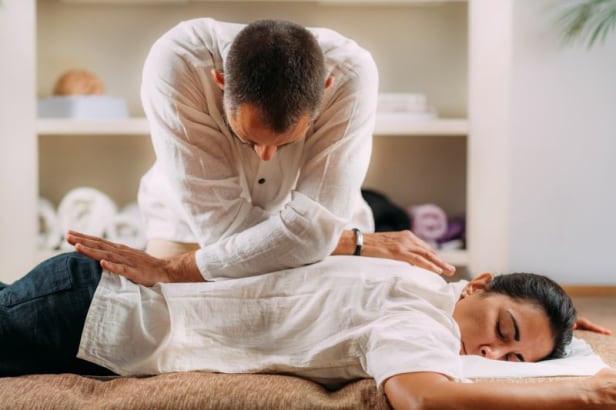
At the beginning of the treatment, the therapist usually conducts a short conversation to assess the client's complaints and general well-being. The client then lies down in comfortable clothing on a soft mat or futon. The therapist makes an energetic assessment by palpating certain body regions to identify tensions and energetic disharmonies.
The treatment is conducted with even, calm movements along the meridians. At the end, the client remains lying down for a short time to feel the effects. Clients often report a deep sense of calm and inner balance after a Shiatsu session.
Application Techniques of Shiatsu Massage
The work is done with fingers, palms, thumbs, elbows, or even knees. The pressure is applied not by force but by consciously shifting one's own body weight. Depending on the need, various techniques are combined: point pressure, flowing strokes, gentle stretches, or rotating movements of joints.
A key feature of Shiatsu is the calm, continuous working style. The movements are mindful and rhythmic – without haste or interruption.
Individual Adaptation to the Body's Condition
Each treatment is unique and adapted to the client's current condition. With practiced hands, the therapist detects tensions and energetic blockages. These observations provide insights into the state of the meridians and the distribution of Qi in the body. The treatment is then specifically adjusted – both in the choice of techniques and in their intensity and duration.
Typical Application Areas of a Shiatsu Massage
Shiatsu can generally be applied to the entire body. However, the neck, shoulder, and back areas are particularly often treated, as tensions occur more frequently here – whether due to stress, prolonged sitting, or unilateral strain. The legs, arms, abdomen, and feet also benefit from the treatment.
By working along the meridians, not only can local complaints be alleviated, but also distant body regions can be influenced.
The Health Benefits of Shiatsu
Shiatsu has a variety of positive effects on the body and mind:
- Relaxation of muscles and fascia: Tense muscles are loosened, and mobility is improved.
- Stress reduction and promotion of inner balance: The treatment has a calming effect, reduces stress hormones like cortisol, and helps relieve tension.
- Stimulation of circulation and metabolism: The gentle pressure promotes the circulation of blood and lymphatic fluid, supporting cell nourishment.
- Imvprovement of sleep quality: Many people report better sleep onset and more restful sleep after a Shiatsu application.
- Enhancement of general well-being: The massage supports the body in self-regulation and promotes a positive mood.
Many people use Shiatsu to reduce stress, counteract exhaustion, and alleviate inner restlessness. The massage can relieve tension and improve overall well-being. Additionally, it can be used to support complaints such as headaches, digestive problems, and emotional burdens.
Important: Shiatsu does not replace medical treatment but can complement it.

Shiatsu at Home: Relaxation at the Push of a Button
It is not always possible to regularly take advantage of a professional Shiatsu treatment. But you can benefit from a a Shiatsu massage device at home – flexible, convenient, and adaptable to your needs.
These devices work with rotating massage heads that mimic the typical finger pressure techniques of Shiatsu massage. The heads move along specific body parts, applying targeted, pleasant pressure. Many models also have an optional heat function that relaxes the muscles, promotes circulation, and intensifies the massage effect.
The range of Shiatsu massage devices is diverse and includes compact massage cushions that can be used flexibly for the neck, shoulders, legs, and other body parts, seat covers for the entire back, as well as massage belts and foot massagers. Each product is designed to specifically treat certain body areas and relieve tension.
This way, you can treat yourself to small breaks according to your daily form and needs, specifically treat tense areas, and create an effective way to relax and regenerate at home.
Shiatsu Massage Products from Beurer
If you want to treat yourself to a little break from everyday life, Beurer offers a wide selection of Shiatsu massage products for home use. Whether for the neck, back, or legs – the devices provide relaxation and well-being in your own home and are ideal for anyone looking for a little self-care.


